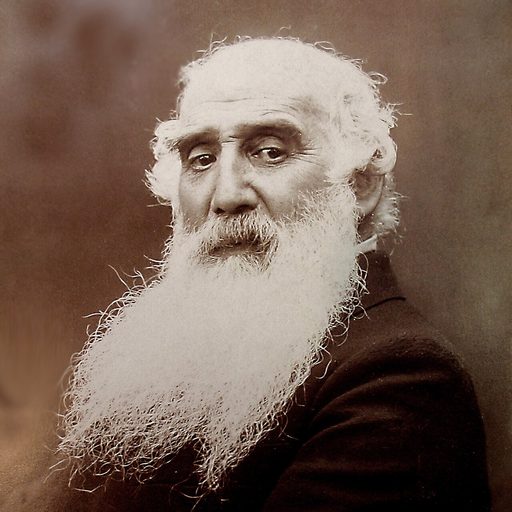
Pissarro was present at all eight exhibitions of the Impressionist group, from 1874 to 1886, and he is the only one who was: the eldest of the band, the one who kept the house together when the others fell out. Born in 1830 in the Danish West Indies, to a Sephardic father and a Creole mother, he reached Paris at twenty-five. Cézanne, Gauguin and Seurat worked alongside him, and he let himself be taught by them in return.
The story
Camille Pissarro was born on 10 July 1830 on Saint Thomas, in the Danish West Indies, to a Sephardic Portuguese Jewish father and a Creole mother. He reached Paris at twenty-five and left it afterwards only for the countryside of the Île-de-France and Normandy.
He is the only painter who took part in all eight Impressionist exhibitions, from 1874 to 1886: the oldest of the group, the one who held the house together when the others fell out, and the one who went hungriest.
Cézanne, Gauguin and Seurat worked at his side, and he let them teach him in return: he went over to pointillism at fifty-four, then came back to his own brushwork. Few painters put themselves in question that late.
A convinced anarchist, he corresponded with Kropotkin and drew the “Turpitudes sociales”, which official art ignored. The politics never once entered the canvases: they are lanes, roofs, mud, rain over the outskirts of towns.
He died on 13 November 1903 and lies in Division 7. His son Paulémile, a painter too, who died in 1972, joined him there: six of his seven children painted.
The grave
A slab of extreme sobriety, surrounded by a cast-iron railing adorned with downturned torches — the extinguished flame, a common motif of the century. The work is signed by the contractor Admant, the same as the family slab of Tony Aubin in Division 92. Nothing there points to the painter: no palette, no medallion, no title of a canvas, for one of the founders of Impressionism. His son Paulémile Pissarro (1884-1972), also a painter, rests with him.
On site, do not miss
The cast-iron railing and its downturned torches, around a slab that says nothing of the painter's trade.
Visitors' questions
Where is Camille Pissarro's grave?
In Division 7, Avenue Rachel, second row, in the lower part of the cemetery, a few minutes from the main entrance. The slab is of extreme simplicity, surrounded by a cast-iron railing with inverted torches.
Gustave CaillebotteWhy is he called the elder of Impressionism?
Because he was the oldest of the group and the only one to have taken part in all eight Impressionist exhibitions, from 1874 to 1886. He was also the one who held the house together when the others fell out.
Camille CorotWho were his pupils?
Cézanne, Gauguin and Seurat worked alongside him — and he let himself be taught in return, turning to pointillism at fifty-five before coming back to his own touch. Few painters question themselves so late.
Thomas CoutureWas he really an anarchist?
Yes, and by lasting conviction: he corresponded with Kropotkin and drew a series of “Turpitudes sociales” — social turpitudes. Politics, however, never enters his canvases, which show lanes, rooftops and rain over the outskirts of town.
Auguste BlanquiAudio guide to Père Lachaise: the best unusual guided tour!
Discover the secrets of the most astonishing tombs
the audio guidefrom€6.99