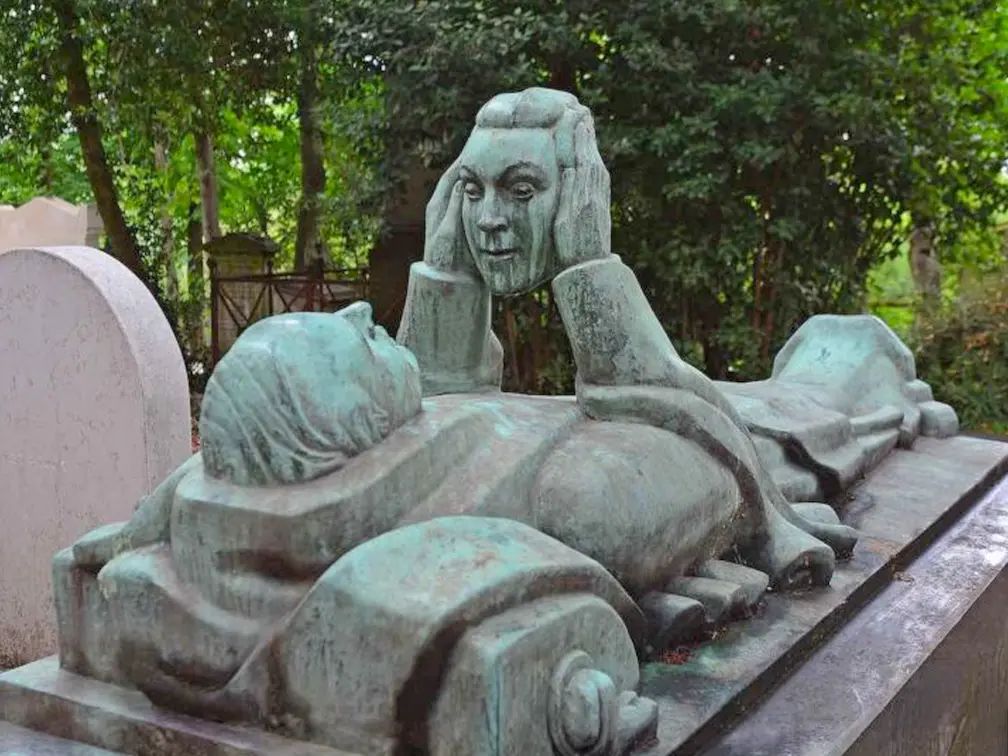
Rodenbach, a Belgian poet of the Symbolist movement, friend of Mallarmé and Verlaine, wrote in 1892 the book that fixed the image of Bruges for a century. A widower settles in a city chosen for its likeness to his grief, and thirty-five photographs of Bruges run through the story: no novel before it had carried any. His bronze lifts the stone lid with one hand and holds a rose in the other. Bruges long bore him a grudge for it.
The story
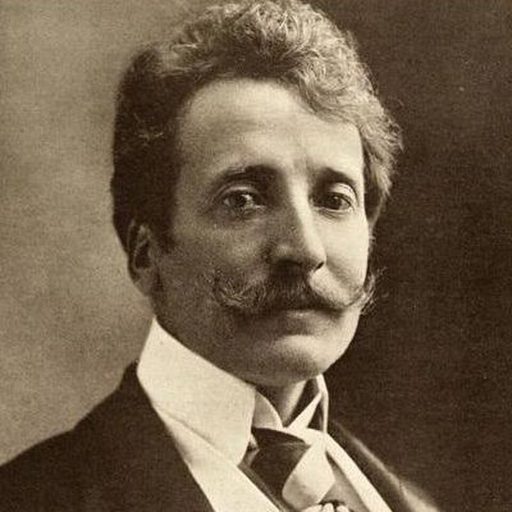
Georges Rodenbach was born at Tournai, in Belgium, in 1855, but it was in Paris that he became one of the poets of Symbolism, a friend of Mallarmé, of Verlaine and of Edmond de Goncourt.
“Bruges-la-Morte” came out in 1892 and made his name. A widower settles in a city chosen for its likeness to his grief. Thirty-five photographic views of Bruges run between the pages: it is the first novel illustrated with photographs.
The book fixed the image of Bruges for a century, and the town held it against him for years. In 1920 Korngold drew his opera from it, “Die tote Stadt”. Rodenbach knew none of that afterlife: he died in Paris on 25 December 1898, Christmas Day, at forty-three.
Four years later Charlotte Besnard carved, in Division 15, the monument people come to see: the poet in bronze, half risen, pushing back the lid of his tomb with one hand and holding a rose in the other, the carved stone broken under the effort. No other monument in the cemetery shows a dead man in the act of climbing out. It is also one of the most photographed.
The grave
The grave is one of the most photographed by visitors to Père-Lachaise, and the only one whose subject is a resurrection. Charlotte Besnard sculpted the poet in bronze in 1902, half risen, pushing back the lid of his tomb with one hand, a rose in the other — the stone is shown broken under his effort. The inscription beside it says nothing: “Georges Rodenbach, 1855-1898”. Everything is in the gesture.
On site, do not miss
The two hands of the bronze: one lifts the slab, the other holds a rose.
Visitors' questions
Where is Georges Rodenbach's grave?
In Division 15, chemin Bernard, first row, in the lower part of the cemetery — the same path on which the photographer Gilles Caron lies. The bronze sculpture, in which the poet climbs out of his tomb, makes it impossible to miss.
The writers of Père-LachaiseWhat does the sculpture on his grave represent?
The poet himself, in bronze, half risen, pushing back the lid of his tomb with one hand and holding a rose in the other. The work is by Charlotte Besnard and dated 1902, four years after his death.
Étienne-Gaspard RobertsonWhat is “Bruges-la-Morte”?
His novel of 1892. A widower settles in a city chosen for its likeness to his grief, and thirty-five photographic views of Bruges run between the pages: it is the first novel illustrated with photographs.
NadarDid his book inspire an opera?
Yes, “Die tote Stadt” by Erich Korngold, first performed in 1920. The novel had fixed the image of Bruges for a whole century — so much so that the city long held a grudge against its author.
Gérard de NervalAudio guide to Père Lachaise: the best unusual guided tour!
Discover the secrets of the most astonishing tombs
the audio guidefrom€6.99