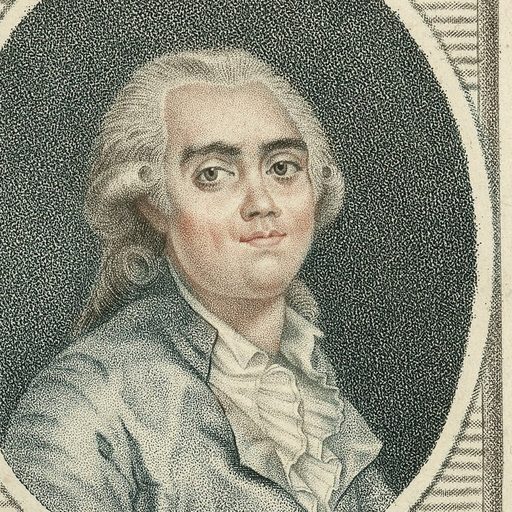
Leader of the royalist party in the Constituent Assembly, he nonetheless voted after Varennes for the suspension of the executive power. He opened a grocery business, emigrated as an agent of the British, and ended up Director of Police under the Restoration. The year of birth engraved on his stone is wrong by twenty years.
The story
Antoine Balthazar Joseph d'André was born at Aix-en-Provence on 2 July 1759. Elected to the Estates General by the nobility of the sénéchaussée of Aix, he crossed to the third estate following Philippe d'Orléans, and became one of the listened-to speakers of the Constituent Assembly, which he twice presided over.
Leader of the royalist party in the Assembly, he nevertheless voted, after the flight to Varennes in June 1791, to suspend the executive power — a royalist suspending the king to save the constitutional monarchy.
Politics closed to him, he opened a large grocery house in Paris; the left-wing press nicknamed him “the Grocer”. Accused of hoarding and of plotting, he emigrated to Britain and then to Austria, and became a royalist agent on British pay.
Elected to the Council of Five Hundred in 1797, he had to flee to Austria at 18 Fructidor to escape arrest. There he gave up politics for farming and set up a model farm near Vienna; in 1809, disappointed by Wagram, he allowed his son to serve Napoleon.
The Restoration made him director-general of Police, then intendant of the King's Household. He died at Aix-en-Provence on 16 July 1825 and lies in Division 31 with his son, the general and senator Antoine Joseph Maurice d'André.
The grave
A sober stone, without sculpture, whose inscription deserves a close reading: “Antoine Balthazard Joseph d'André, born on 2 July 1739, former deputy of the nobility of the seneschalsy of Aix to the Estates General, intendant of the king's domains, officer of the Legion of Honour, died on 16 July 1825”, and finally “De profundis”. The year of birth is wrong by twenty years: d'André was born in 1759, as the cemetery's inventories establish. His son, General Antoine Joseph Maurice d'André, senator of the Second Empire, who died in 1860, rests with him.
On site, do not miss
The engraved year of birth — 1739 instead of 1759 — and the “De profundis” that closes the inscription.
Visitors' questions
Where is Antoine d'André's grave?
In Division 31, Chemin de la Bédoyère, second row, in the older, upper part of the cemetery. The grave is plain and also holds his son, General Antoine Joseph Maurice d'André, who died in 1860.
Richard WallaceWhat role did he play in the Constituent Assembly?
Elected by the nobility of Aix, he joined the Third Estate and twice presided over the Constituent Assembly, where he led the royalist party. After the flight to Varennes, in June 1791, he voted for the suspension of the executive power.
Victor SchœlcherWhy was he called “the Grocer”?
Because he had opened a large grocery house in Paris after leaving the Assembly. The left-wing press turned it into a nickname, before accusing him of hoarding goods and plotting, which drove him to emigrate.
Juliette DoduIs there an error on his grave?
Yes, in the year of birth: the stone reads “born 2 July 1739” when he was actually born in 1759. The error, exactly twenty years out, has never been corrected; the cemetery's own records note it.
General FoyAudio guide to Père Lachaise: the best unusual guided tour!
Discover the secrets of the most astonishing tombs
the audio guidefrom€6.99