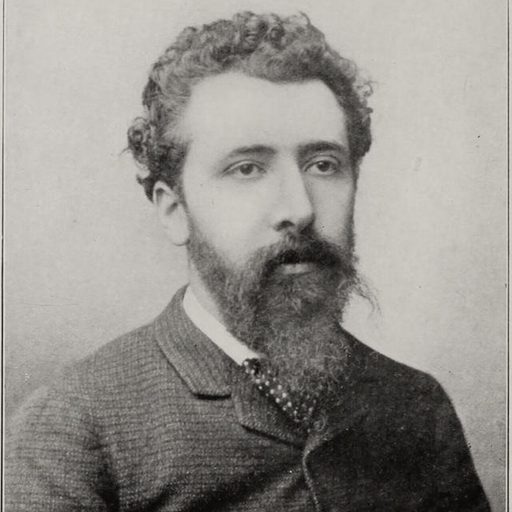
Seurat studied colour in treatises on optics rather than in studios, and drew from them a method: juxtapose touches of pure colour and let the eye do the mixing. A Sunday on La Grande Jatte cost him two years of work and dozens of studies. Monet and Renoir ran him down. All he left fits in seven large canvases, and he died at thirty-one.
The story
Georges Pierre Seurat was born in Paris in 1859. He studied colour not in the studios but in the treatises on optics — Chevreul, Rood — and drew a method out of them: lay down points of pure colour and let the eye do the mixing.
“Bathers at Asnières”, his first large picture, was refused by the Salon jury in 1884. That same year he helped found the Société des Artistes Indépendants, which exhibited with no jury and no prizes.
“A Sunday Afternoon on the Island of La Grande Jatte”, finished in 1886, is the painting that fixed Divisionism: two metres by three, two years of work, dozens of studies. Monet, Renoir and Sisley ran it down — Impressionism felt itself challenged by something younger.
His entire output comes to seven large paintings, some sixty canvases and about five hundred drawings and diagrams. Each of the big compositions took months of calculation.
He died on 29 March 1891, at thirty-one, of an infectious throat illness the doctors still argue over, leaving “The Circus” unfinished. He lies in Division 66 in the family vault.
The grave
A family vault, headed “Famille A. C. Seurat” — the parents' name before the painter's. The inscription that concerns him is brief and gives a detail that strikes: “Georges Pierre Seurat, artist painter, died on 29 March 1891, aged 31”. Nothing of pointillism, nothing of the Grande Jatte, nothing of the Société des artistes indépendants he had co-founded. The age stands in for commentary.
On site, do not miss
The age engraved beneath the name: “died on 29 March 1891, aged 31” — the inscription that counts most on this stone.
Visitors' questions
Where is Georges Seurat's grave?
In Division 66, avenue des Peupliers, first row, in the upper part of the cemetery — the Division of Marietta Alboni, Adolphe Alphand and Henri Cernuschi. It is a vault in the name of the Seurat family.
Henri CernuschiWhat is pointillism?
His method: placing dots of pure colour side by side and letting the eye do the mixing, instead of blending the pigments on the palette. He took it not from the studios but from the optical treatises of Chevreul and Rood.
Camille PissarroHow many paintings did he produce?
Seven large compositions, some sixty canvases and around five hundred drawings and studies — in a career of barely ten years. Each large canvas took months of studies and calculation.
Gustave CaillebotteWhy did the Impressionists criticise him?
Because “A Sunday Afternoon on the Island of La Grande Jatte”, in 1886, challenged their manner at the very moment it was finally winning acceptance. Monet, Renoir and Sisley disparaged it: the next generation had come too soon.
Camille CorotAudio guide to Père Lachaise: the best unusual guided tour!
Discover the secrets of the most astonishing tombs
the audio guidefrom€6.99