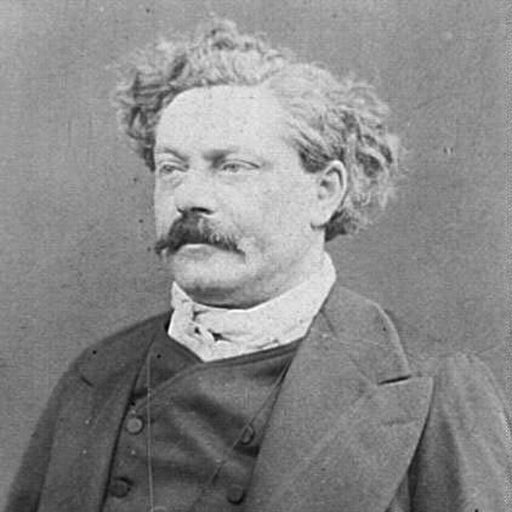
His father, an exile of 1851 who had taken refuge in London, was killed there in a duel by Emmanuel Barthélémy. He himself worked on the railways before joining the republican movement, commanding a battalion of the national guard, sitting on the Commune — where he opposed the execution of the hostages — and representing Paris. His bronze bust is signed Marguerite Syamour, a rare woman's signature in the cemetery.
The story
Frédéric Cournet was about fifteen when his father, a republican naval officer proscribed after the coup d'état of 1851, was killed in a duel in London by Emmanuel Barthélémy — one of the last French political duels.
Born at Lorient, the grandson of a deep-sea captain, he worked on the railways and joined the republican movement as early as 1863. When the Empire fell, he commanded a battalion of the national guard in Paris.
A member of the Paris Commune in 1871, where he opposed the execution of the hostages, and a former deputy for Paris, he died in 1885. His monument in Division 95 carries a bronze bust signed by Marguerite Syamour and cast by the Barbedienne foundry in 1886: a woman sculptor's signature is a rare thing at Père-Lachaise.
The inscription claims it without evasion: “ancien député de Paris, 1837-1885, et membre de la Commune de Paris 1871” — former deputy for Paris, and member of the Paris Commune. To carve that last word on a stone, fourteen years after the Bloody Week, was no small matter.
The grave
A monument topped by a bronze bust signed Marguerite Syamour (1886) and cast by the Barbedienne foundry — whose owner himself rests in Division 53. A woman sculptor's signature is rare at Père-Lachaise. The inscription, for its part, lays claim without evasion to the dead man's commitment: “Famille COURNET. Frédéric, COURNET, ancien député, de, Paris, 1837-1885, et, membre, de la commune, de Paris 1871.” — Cournet family. Frédéric Cournet, former deputy for Paris, 1837-1885, and member of the Paris Commune, 1871. To name the Commune on a stone, in 1885, was no small thing.
On site, do not miss
A bronze bust signed Marguerite Syamour, cast by Barbedienne — a rare woman's signature in the cemetery. The inscription names the Paris Commune without evasion.
Visitors' questions
Where is Frédéric Cournet's grave?
In Division 95, Avenue Transversale No. 2, first row, not far from the Communards' Wall. The monument carries a bronze bust signed Marguerite Syamour — one of the few women sculptors represented in the cemetery.
Eugène PottierWhat does the inscription on his grave say?
It lists his two political titles: “Frédéric COURNET, ancien député de Paris, 1837-1885, et membre de la Commune de Paris 1871” — former deputy for Paris, and member of the Paris Commune. Naming the Commune was no small thing under the Third Republic.
Charles DelescluzeWho was his father?
A republican naval officer, proscribed after the coup of 1851 and a refugee in London, where he was killed in a duel by Emmanuel Barthélémy — one of the last French political duels. Frédéric was about fifteen at the time.
Jean-Baptiste ClémentWhat did he do before politics?
He worked on the railways. He joined the republican movement only in 1863, once he had settled in Paris, and commanded a battalion of the national guard when the Empire fell.
André GillAudio guide to Père Lachaise: the best unusual guided tour!
Discover the secrets of the most astonishing tombs
the audio guidefrom€6.99