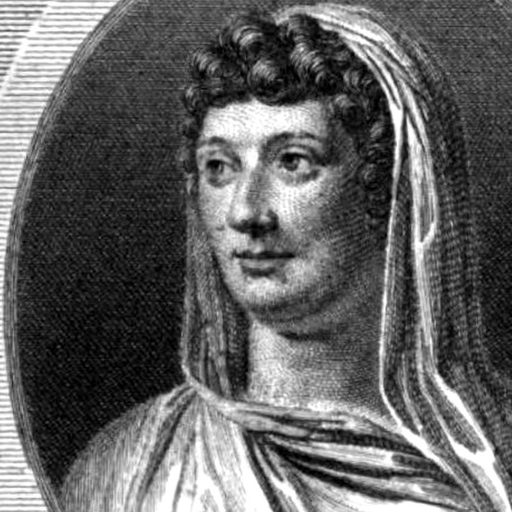
Sophie Cottin was married for three years, then found herself a widow without fortune at twenty-three: denounced as an aristocrat in 1793, her husband was found dead on the morning they came to arrest him. Withdrawn to the valley of the Orge, she hid a condemned royalist, then began to write in secret. Five novels appeared in eight years, one of which the whole of Europe translated and which was reprinted for a hundred years.
The story
Born Marie Risteau at Tonneins in 1770 and raised in Bordeaux by a mother in love with books, the future novelist Sophie Cottin married a rich Paris banker at twenty. The marriage lasted three years: denounced to the Jacobins as an aristocrat in 1793, her husband was found dead in his bed on the morning they came to arrest him. She was a widow and ruined at twenty-three.
Withdrawn to Champlan, in the Orge valley, she hid a royalist sentenced to death in his absence, then began to write — at first in secret, with no thought of publishing.
Five novels appeared in eight years: Claire d'Albe in 1799, Malvina, Amélie de Mansfield, Mathilde, and above all Élisabeth ou les Exilés de Sibérie in 1806, the story of a girl who crosses Russia on foot to win her father's pardon. The book was translated across Europe and reprinted for a century.
She died in Paris in 1807, aged thirty-seven. Posterity erased her in favour of her contemporary Madame de Staël; her grave, in Division 39, is nevertheless one of the few in the cemetery to hold a perpetual plot maintained free of charge by the City of Paris.
On site, do not miss
The marble of a listed tomb, in a Division where people usually come for Parmentier and David d'Angers.
Visitors' questions
Where is Sophie Cottin's grave?
In Division 39 of Père-Lachaise, in the old part of the cemetery. The grave is a listed monument and holds a perpetual plot maintained free of charge by the City of Paris — a rare arrangement.
Antoine Parmentier, Division 39What is Sophie Cottin's best-known novel?
Elizabeth, or the Exiles of Siberia, published in 1806: the story of a young girl who crosses Russia on foot to win her father's pardon. Translated across Europe, it was reprinted for close to a century.
Elisa MercœurWhy has Sophie Cottin been forgotten?
Because literary posterity kept Madame de Staël, her contemporary, and filed the sentimental novel under minor literature. Yet Cottin was one of the most widely read novelists in Europe between 1799 and 1830.
Marie d'AgoultWhat did Sophie Cottin die of?
A short illness, in Paris, on 25 August 1807: Sophie Cottin was thirty-seven and had not written for a year. Her whole literary career fits into eight years, from 1799 to 1806, and five novels.
David d'Angers, Division 39Audio guide to Père Lachaise: the best unusual guided tour!
Discover the secrets of the most astonishing tombs
the audio guidefrom€6.99