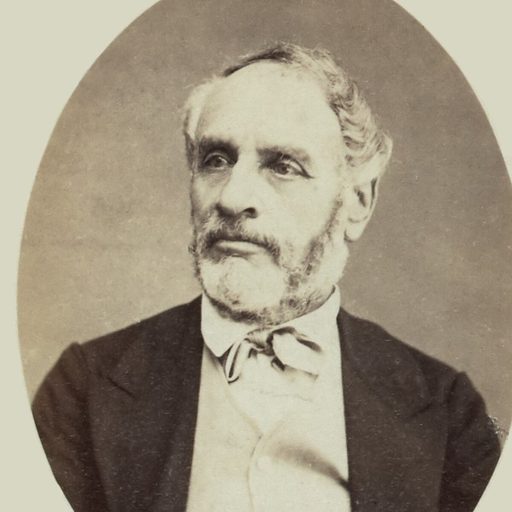
Delescluze, a republican journalist born in 1809, had known prison, Belle-Île and the penal colony of Guiana before being elected to the Commune; even his adversaries nicknamed him Iron Bar. On 24 May 1871, he cried from the rostrum: “Make way for the people!” The next day, with the Versailles troops in the city, he made his way to the barricade of the Château-d'Eau, where he got himself killed.
The story
“Make way for the people, for the fighters with bare arms!” Charles Delescluze threw out the phrase on 24 May 1871, as the Versailles troops took Paris back from the Commune. The next day this journalist of sixty-one, delegate for war and carrying no weapon, climbed onto the barricade at the Château-d'Eau and let himself be shot dead.
Born at Dreux on 2 October 1809, a lawyer turned journalist and a republican militant from 1830, Delescluze was prosecuted for conspiracy in 1836 and went into exile in Belgium. In 1848 he proclaimed the Republic at Valenciennes and became commissioner of the Republic for the North. Sentenced, he fled to England, and was arrested in 1853: Sainte-Pélagie, Belle-Île, Corte, then deportation to Guiana — Devil's Island, from 1854 to 1860. His own opponents called him “Iron Bar”.
He founded Le Réveil in 1868, a radical paper condemned three times, was elected mayor of the 19th arrondissement on 5 November 1870, then to the National Assembly, whose government he denounced, then to the Commune on 26 March 1871, by the 11th and the 19th arrondissements.
His inscriptions can barely be read today. They named the commissioner general of the Republic of 1848, the editor of the Réveil, the deputy for Paris, and his sister Azéma — but neither the Commune nor the barricade. The perpetual plot was granted to him free of charge by an order of 19 January 1883, twelve years after his death.
The grave
A grave whose inscriptions are today almost illegible. One could once read: “A la mémoire de Charles Delescluze, Commissaire général de la République, 1848, Rédacteur en chef du Réveil en 1868, Député de Paris à l'Assemblée nationale, 8 février 1871 et de sa sœur Azéma, décédée le 31 oct. 1876, leurs amis.” — to the memory of Charles Delescluze, Commissioner General of the Republic, 1848, editor-in-chief of Le Réveil in 1868, deputy for Paris at the National Assembly, 8 February 1871, and of his sister Azéma, died 31 October 1876; their friends. It mentions neither the Commune nor the barricade of the Château-d'Eau. The perpetual plot was granted to him free of charge by prefectoral order of 19 January 1883 — twelve years after his death.
On site, do not miss
The inscriptions are almost illegible. They named the “Commissaire général de la République, 1848” — Commissioner General of the Republic —, the editor-in-chief of Le Réveil, and his sister Azéma, who died in 1876 — neither the Commune, nor the barricade.
Visitors' questions
Where is Charles Delescluze's grave?
In Division 49, chemin Casimir-Delavigne, first row. Its inscriptions are now almost illegible: they named the “Commissaire général de la République, 1848” and his sister Azéma, who died in 1876.
Casimir DelavigneHow did Delescluze die?
On 25 May 1871, on the Château-d'Eau barricade, where he let himself be shot down. The day before, as the Versailles troops entered Paris, he had called out: “Make way for the people, for the fighters with bare arms!”
The Duke of MornyWhy was he called “Iron Bar”?
For his refusal to bend — the nickname came from his opponents themselves. He had known Sainte-Pélagie, Belle-Île and Corte, then transportation to Devil's Island from 1858 to 1860, and never gave an inch. On his return, in 1868, he founded Le Réveil.
Hubertine AuclertWhy does his plot date from 1883?
Because it was granted to him in perpetuity and free of charge by a prefectoral order of 19 January 1883, twelve years after his death — a late acknowledgement by the Republic of a man who died on a barricade against it.
Charles LonguetAudio guide to Père Lachaise: the best unusual guided tour!
Discover the secrets of the most astonishing tombs
the audio guidefrom€6.99