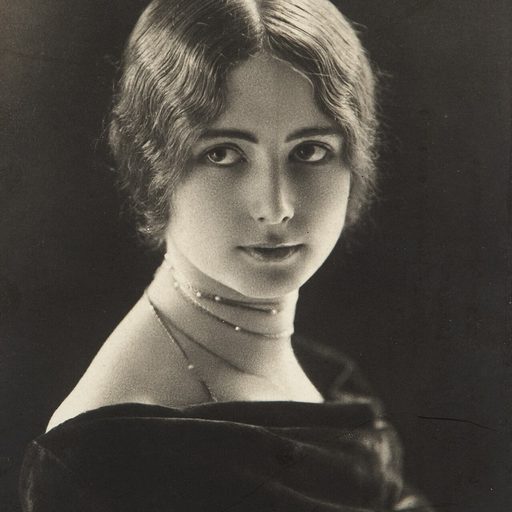
Cléo de Mérode entered the Opera's ballet school at eight, but it was her beauty that made her famous: Nadar photographed her, Boldini painted her, Degas and Toulouse-Lautrec drew her. A magazine proclaimed her queen of beauty in 1896. An affair attributed to her with Leopold II earned her a nickname she would spend her life denying. Simone de Beauvoir, in 1950, cited her believing her dead.
The story
Cléo de Mérode was born in Paris on 27 September 1875. She entered the Opéra ballet school at eight and was a coryphée at thirteen, but she became famous for something other than dancing: her beauty, photographed by Nadar, painted by Boldini, drawn by Degas and Toulouse-Lautrec.
In 1896 the magazine L'Illustration ran a readers' vote and crowned her queen of beauty. A rumoured affair with Leopold II of Belgium earned her the nickname “Cléopold” — she spent her life denying it, and never once succeeded.
Her real and lasting attachment was to Luis de Perinat, a grandee of Spain and a sculptor, from 1906 to 1919. It was he who carved the marble figure on her grave.
She published her memoirs in 1955, “The Ballet of My Life”, to set straight facts that fifty years of legend had buried.
In 1949 Simone de Beauvoir mentioned her in “The Second Sex”, believing her dead. Cléo de Mérode sued the following year, won one franc in damages — and public proof that she was alive. She died on 17 October 1966, at ninety-one.
The grave
A slab of pink granite, adorned with a marble statue of a seated woman bringing flowers. It is signed Luis de Périnat, grandee of Spain and sculptor, who was the dancer's lover from 1906 to 1919: the monument was thus commissioned from an intimate, for the mother's grave. The main inscription is indeed that of Vincentia, Baroness de Mérode, born in Mödling, Austria, and dead in Paris in 1899, then “Cléo de Mérode, 1875-1966”. Three words close the stone: “À ma maman, chagrin” — to my mother, sorrow.
On site, do not miss
The words engraved at the foot of the stone — “À ma maman, chagrin”, to my mother, sorrow — beneath the statue by her sculptor lover.
Visitors' questions
Where is Cléo de Mérode's grave?
In Division 90, Avenue Transversale No. 3, third row, in the upper part of the cemetery. The pink granite slab and its marble statue — a seated woman bringing flowers — mark it out.
Yvette ChauviréDid she sue Simone de Beauvoir?
Yes: “The Second Sex”, in 1950, referred to her as dead. She brought a suit, won one franc in damages and public proof that she was very much alive — she lived another sixteen years.
ColetteWhat was the “Cléopold” rumour?
The nickname born of a supposed affair with Leopold II of Belgium, in 1895. She spent her life denying it without ever managing to lay it to rest, and published her memoirs in 1955, “Le Ballet de ma vie”, to set the record straight.
Jane AvrilWho sculpted the statue on her grave?
Luis de Périnat, a grandee of Spain and a sculptor, who was her lover from 1906 to 1919. The marble statue shows a seated woman bringing flowers, set on a slab of pink granite.
Hélène AndrianoffAudio guide to Père Lachaise: the best unusual guided tour!
Discover the secrets of the most astonishing tombs
the audio guidefrom€6.99