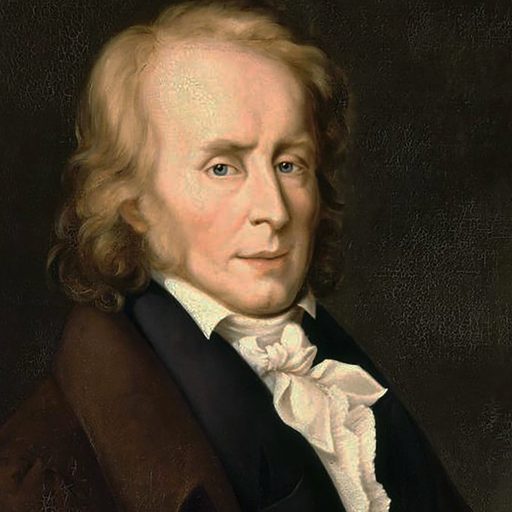
Benjamin Constant, born in Lausanne in 1767, learnt at about five, from a tutor, a “secret language” which he discovered much later to be Greek. Germaine de Staël, whose lover he became in 1794, brought him into the circle at Coppet, where a liberalism opposed to Bonaparte was taking shape. He wrote Adolphe in 1806 and waited ten years before publishing it: a hundred pages on a man who no longer loves and dare not admit it.
The story
Benjamin Constant de Rebecque was born at Lausanne on 25 October 1767, into a Protestant family of French descent. His mother died eight days later. His childhood was handed to a German tutor who beat him and then smothered him with affection so that he would not complain — the child said nothing. It was that same man who taught him, at about five, a ‘secret language’ he only understood later to be Greek.
His affair with Germaine de Staël, from 1794, set him at the centre of the Coppet circle, the hearth of the liberalism that opposed Bonaparte. A member of the Tribunate after 18 Brumaire, he was pushed out of it in 1802 and left for exile.
He wrote “Adolphe” in 1806 and did not publish it until 1816: a hundred pages on a man who has stopped loving and dares not say so, one of the founding books of the psychological novel.
A councillor of state to Napoleon during the Hundred Days after fighting him, then a refugee in England, he came back under the Restoration and had himself elected to the Chamber of Deputies in 1819, where he became one of the most listened-to liberal orators. “De la religion” appeared in five volumes from 1824.
He died in Paris in 1830, a few months after the July Revolution. His funeral, on 12 December, is shown in an anonymous oil painting kept at the Musée Carnavalet. He lies in Division 29.
The grave
A plain monument, without sculpture, whose whole interest lies in three words. The inscription opens with a Latin motto, “In arduis constans” — constant in adversity — which plays on the dead man's very name, then gives the civil status: “Constant de Rebecque, known as Benjamin Constant, 1767-1830”. The device is that of a heraldic motto, applied to a man who had no coat of arms, and it sums up exactly a career spent holding the same position under four successive regimes.
On site, do not miss
The three Latin words engraved at the head of the stone — “In arduis constans” — and the way they enclose his name.
Visitors' questions
Where is Benjamin Constant's grave?
In Division 29, Chemin du Dragon, first row, in the old, upper part of the cemetery — the same division as Claude Chappe's uninscribed monument. The stone is plain and bears a Latin motto.
Claude ChappeWhat does “In arduis constans” mean?
“Constant in adversity”. The epitaph plays on his surname, and sums up a life spent defending liberalism under regimes that all opposed it, from Bonaparte to the Restoration.
Paul BarrasWhat is “Adolphe”?
A hundred-page novel, written in 1806 and published in 1816, about a man who no longer loves and dares not say so. It is one of the founding works of the French psychological novel, and the only novel Constant completed.
Roger de BeauvoirWhat was his link with Germaine de Staël?
A liaison begun in 1794 that placed him at the heart of the Coppet circle, the home of European liberalism in opposition to Bonaparte. She shaped his political thinking as much as she fed his fiction.
Marie d'AgoultAudio guide to Père Lachaise: the best unusual guided tour!
Discover the secrets of the most astonishing tombs
the audio guidefrom€6.99