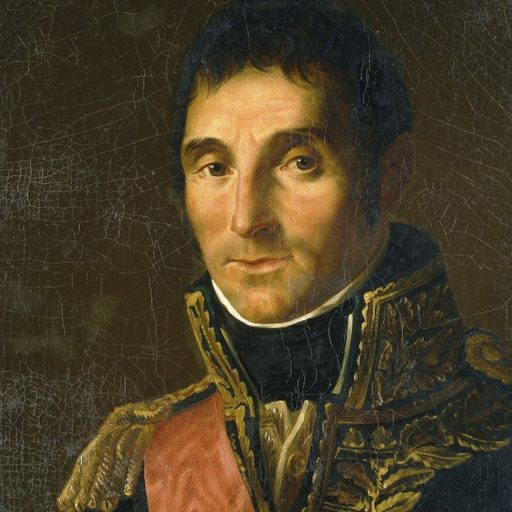
Masséna, Marshal of the Empire born in Nice in 1758, was orphaned at thirteen, a cabin boy then a grocer's clerk, and learnt to read in the army. Rivoli, Zurich, Genoa: Bonaparte called him the cherished child of Victory. At Wagram, thrown from his horse the day before, he commanded from an open carriage, exposed to fire. His greed made as much noise as his victories, to the point that his own soldiers mutinied.
The story
André Masséna was born in Nice on 6 May 1758. Orphaned at thirteen and unable to read, he went to sea as a ship's boy, then stood behind a grocer's counter in Antibes before enlisting. The Revolution did the rest: he was a brigadier general by August 1793, and it was in the army that he learned to read and write.
Rivoli in 1797, Zurich in 1799, the defence of Genoa in 1800: Bonaparte called him the darling child of Victory. Marshal in 1804, Duc de Rivoli in 1808, Prince d'Essling in 1809, after the battle where his corps held against the Archduke Charles.
At Wagram, thrown from his horse a few days earlier, he commanded from an open carriage under fire. The only wound of his whole career came from a shooting accident: the shot had left Napoleon's gun, but Masséna diplomatically laid the blame on Berthier.
His greed is still a byword. The systematic looting of Italy and Portugal, and the fact that he did not pay his men, brought on a mutiny among his own troops. Recalled from Portugal in disgrace in 1811, he never held a command again.
He died in Paris on 4 April 1817. His obelisk in Division 28 — where a path carries his name — also shelters his son-in-law the comte Reille and his grandson, General comte Reille.
The grave
A marble obelisk, adorned with a profile of the marshal by the sculptor François Joseph Bosio and with his coat of arms — an angel of victory, two medals hanging beneath a crown. The inscription begins with four names and no sentence: “Rivoli, Zurich, Gènes, Essling”, then “Masséna, died 4 April 1817”. His son, who died at twenty-six in 1821, his son-in-law Count Reille and his grandson General Count Reille, who died in 1887, also rest there. The path that runs along the grave bears his name.
On site, do not miss
The four battle names engraved on the obelisk, and the marshal's profile by Bosio above the coat of arms.
Visitors' questions
Where is Marshal Masséna's grave?
In Division 28, Chemin Masséna, first row — the alley bears his name, and the division is that of Beaumarchais, Paul Barras and Brillat-Savarin. The marble obelisk can be spotted from afar on the hillside.
BeaumarchaisWhich battles are engraved on his obelisk?
Four names, without a sentence: Rivoli in 1797, Zurich in 1799, Genoa in 1800 and Essling in 1809 — the ones that earned him his dukedom, his principality and Bonaparte's phrase about “l'enfant chéri de la Victoire” — the darling child of Victory.
Marshal AugereauWhere did Masséna come from?
From Nice, where he was born in 1758. Orphaned at thirteen and unable to read, he was a ship's boy and then a grocer's clerk in Antibes before enlisting; he learned to read and write in the army and was a brigadier general at thirty-five.
Augustin-Daniel BelliardWhy did he fall from favour?
For his greed: the systematic plundering of Italy and Portugal, and unpaid wages that triggered a mutiny in his own troops. Recalled from Portugal in 1811, he never held a command again.
François Marie d'AbovilleAudio guide to Père Lachaise: the best unusual guided tour!
Discover the secrets of the most astonishing tombs
the audio guidefrom€6.99