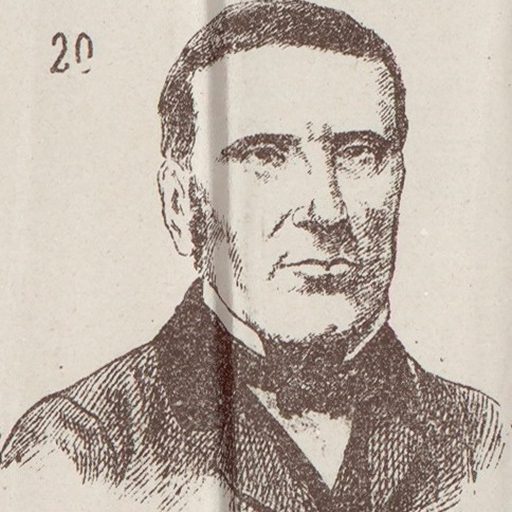
Marie-Alexandre MASSOL
See onthe map
Journalist and philosopher, founder of La Morale indépendante.
A Saint-Simonian who left for Egypt with Enfantin, he became tutor to Proudhon's children, then his executor. Convinced that morality owes nothing to religion, he launched La Morale indépendante in 1865. His stele bears a medallion by Aimé Millet and five words.
The story
The son of a former Oratorian, Marie-Alexandre Massol was born at Béziers in 1805 and came up to Paris in 1829 to read law. He gave up his studies within a few months: he had just heard of Saint-Simon, dead four years earlier, and joined the small group that claimed it would refound society on industry and science.
He followed Prosper Enfantin on his tour of France in search of work, then joined him in Egypt after a Saint-Simonian settlement in Algeria failed. When Enfantin lost his support with the viceroy, the group scattered. Massol came home without hurrying, by way of Constantinople and Vienna, and left again at once for London to found L'Observateur français, a paper meant to counterbalance the royalist Courrier d'Europe.
The revolution of 1848 brought him back to France. Lamennais asked him to write for La Réforme; he moved on to La Voix du peuple, Proudhon's paper. The friendship between the two men was such that Massol became tutor to the children of the theorist of anarchy, then his executor. In January 1865 he spoke at his graveside on behalf of freemasonry, wearing his sash — without a mandate from the Council of the Order, which was held against him.
A freemason before 1830, admitted in 1855 to the lodge “Renaissance d'Hiram”, he held that morality needs no religion to found it: it rests on human liberty and on the mutual respect of persons. The thesis divided the Grand Orient. Disappointed that the constitution of 1865 kept the reference to religion, he launched La Morale indépendante that same year with Henri Brisson. Deputy mayor of the 9th arrondissement in 1870 and a municipal councillor in 1874, he died in Paris on 21 April 1875 and lies in Division 75.
The grave
A stone stele bearing a bronze medallion by Aimé Millet, the sculptor of the Vercingétorix at Alésia and of the Fame of the Opéra-Comique. On either side, a funeral wreath carved in high relief. The inscription is limited to five words: “MASSOL, 1805-1875” — not a title, not a position, no religious formula. For a man who spent his life founding a morality independent of all religion, this silence of the stone makes one last argument.
On site, do not miss
The bronze medallion, at eye level, and the emptiness of the inscription around it: five words for an entire public life.
Visitors' questions
Where is Marie-Alexandre Massol buried?
In Division 75 of Père-Lachaise, chemin Bernard, second row. Division 75 is in the upper eastern part of the cemetery, not far from the Communards' Wall and the graves of the labour movement.
The Communards' WallWhat was La Morale indépendante?
The journal Massol founded with Henri Brisson. It argued that morality can stand without religion, on nothing but human freedom and the mutual respect of persons. The first issue appeared on 1 August 1865, and the argument divided French Freemasonry for a long time to come.
Political figures at Père-LachaiseWhat was Massol's connection with Proudhon?
As close as it could be. After writing for La Voix du peuple, he became tutor to Proudhon's children, then his executor. It was he who spoke at his graveside in January 1865, in the name of Freemasonry.
Writers & poets at Père-LachaiseWho were the Saint-Simonians?
The disciples of Claude-Henri de Saint-Simon, who died in 1825, and who wanted society rebuilt on industry, science and association. Massol followed their leader Prosper Enfantin as far as Egypt; Enfantin lies at Père-Lachaise too, in Division 39.
Prosper EnfantinAudio guide to Père Lachaise: the best unusual guided tour!
Discover the secrets of the most astonishing tombs
the audio guidefrom€6.99