Built in phases between 1893 and 1920 by the architect Formigé, the Père-Lachaise columbarium spans four wings and four levels around the crematorium: 26,606 numbered niches, including those of Maria Callas, Max Ophüls and Isadora Duncan.
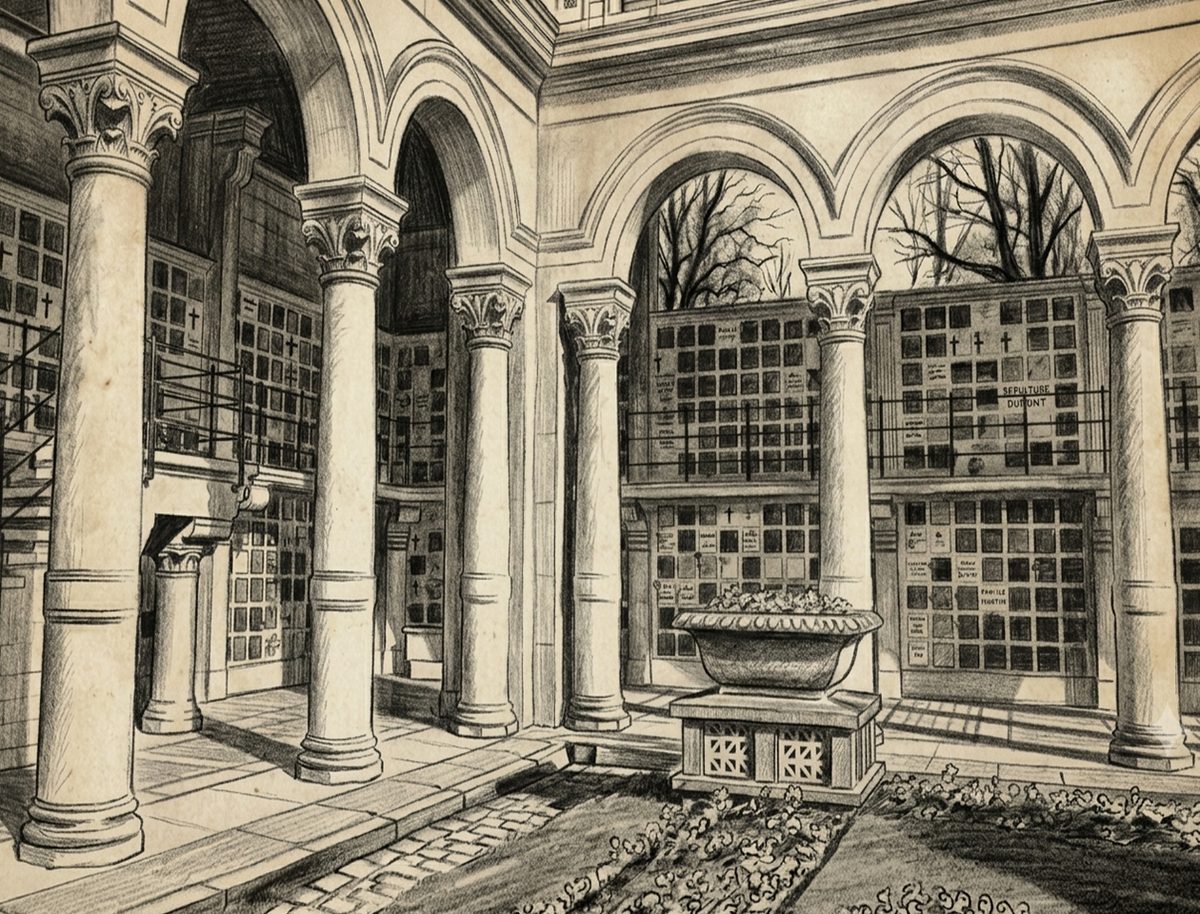
Beneath the wings of Formigé's neo-Byzantine crematorium, stone corridors sink underground across two levels. On the walls, rows of plaques bear a number, a name, two dates. There are twenty-six thousand six hundred and six of them, spread across four wings and four levels around a chapel most Père-Lachaise visitors never suspect exists. The columbarium, France's first and largest, is a building in its own right — listed as a historic monument since 17 January 1995, a labyrinth of memory where the soprano Maria Callas lies close to the film-maker Max Ophüls, the dancer Isadora Duncan and the comedian Pierre Dac.
When the crematorium began operating on 30 January 1889, the question of what to do with the ashes arose at once. A temporary columbarium was fitted out in the building's basement, but space ran short quickly: forty-nine cremations in the first year. On 27 June 1890, the municipal council approved the building of a first set of three hundred and four niches along the boundary wall on Rue des Rondeaux. But the architect Jean Camille Formigé, already responsible for the crematorium, thought bigger. He designed a “double portico divided by a longitudinal wall holding the funerary urns” — four wings arranged around the chapel, able to hold more than ten thousand niches. The first phase, six hundred niches, was completed in 1893. A further eight hundred and fifty followed in 1895. Work continued in stages into the 1920s to reach today's capacity.
The finished columbarium is spread across four levels. Above ground, four outer wings hold seven thousand and thirty niches. Beneath Wing C, a crypt adds a further one thousand four hundred and ten. Two underground floors — the first with eight thousand seven hundred and sixty niches, the second with nine thousand four hundred and six — account for most of the capacity. The whole complex occupies the entirety of Division 87, some four thousand nine hundred square metres. The niches are numbered from 1 to 25,765, then, after a jump of fourteen thousand numbers, from 40,000 to 40,837. The underground corridors, lit by artificial light, run past walls of engraved plaques, photographs and artificial flowers. Here and there, a personal object — a piece of sheet music, a model, a rosary — recalls what the numbers do not say.
Niche 16,258 bears the name of Maria Callas. But the “Bible of opera” no longer rests there: her ashes were scattered over the Aegean Sea in 1979.
Niche 16,258 bears the name of Maria Callas. But the “Bible of opera,” who died in Paris on 16 September 1977, no longer rests there: her ashes were scattered over the Aegean Sea in 1979. The niche is now no more than a cenotaph, a monument without a body, yet it still draws visitors and bouquets. Not far away, the film-maker Max Ophüls, the composer Paul Dukas — author of The Sorcerer's Apprentice — the soprano Régine Crespin and the comedian Pierre Dac, a Free French resistance figure and a voice of Radio Londres, share the same stone walls. Isadora Duncan, the American pioneer of modern dance who died in Nice in 1927, the jazz violinist Stéphane Grappelli and the Surrealist painter Max Ernst rest there too. Unlike the graves in the cemetery's paths, which are marked on the official map, the columbarium's niches are not signposted: you have to look for them.
The columbarium remains an active funerary space. Plots are granted for ten, thirty or fifty years and can be renewed — eternity, here, is negotiated in instalments. Families place the urn in a niche sealed with an administrative plaque, to which they often add a personalised plaque, a photograph, a few engraved lines. Some niches whose plot has not been renewed are reclaimed and reassigned, a quiet cycle that explains the missing numbers in the sequence. The 2022–2023 restoration of the crematorium also benefited the columbarium, whose façades and walkways were repaired. The whole complex, open the same hours as the cemetery via the Porte Gambetta, remains the largest columbarium in France — and the oldest.
How many niches does the Père-Lachaise columbarium hold?
26,606 niches, spread across four wings and four levels around the crematorium in Division 87. Four outer wings hold 7,030 niches, a crypt holds 1,410, and two underground floors add over 18,000 more.
Which famous figures rest in the Père-Lachaise columbarium?
Among them: the filmmaker Max Ophüls, the comedian Pierre Dac, the dancer Isadora Duncan, the violinist Stéphane Grappelli, the composer Paul Dukas and the painter Max Ernst. Maria Callas's niche has been a cenotaph since 1979.
Can visitors go inside the Père-Lachaise columbarium?
Yes, during the cemetery's normal opening hours. The underground corridors and outer wings are open to walk through freely. The columbarium stands in Division 87, in the eastern part of the cemetery, near the Gambetta gate.
How can you get a plot in the Père-Lachaise columbarium?
Niches at the Père-Lachaise columbarium are granted for 10, 30 or 50 years and can be renewed. Applications go through the cemetery's conservation office, which manages the columbarium separately from the crematorium.
 Heritage