In 1863, Baron Haussmann sought to close Père-Lachaise, Montmartre and Montparnasse and transfer all of Paris's dead to a thousand-hectare necropolis at Méry-sur-Oise, served by a funeral train. The council rejected the scheme twice.
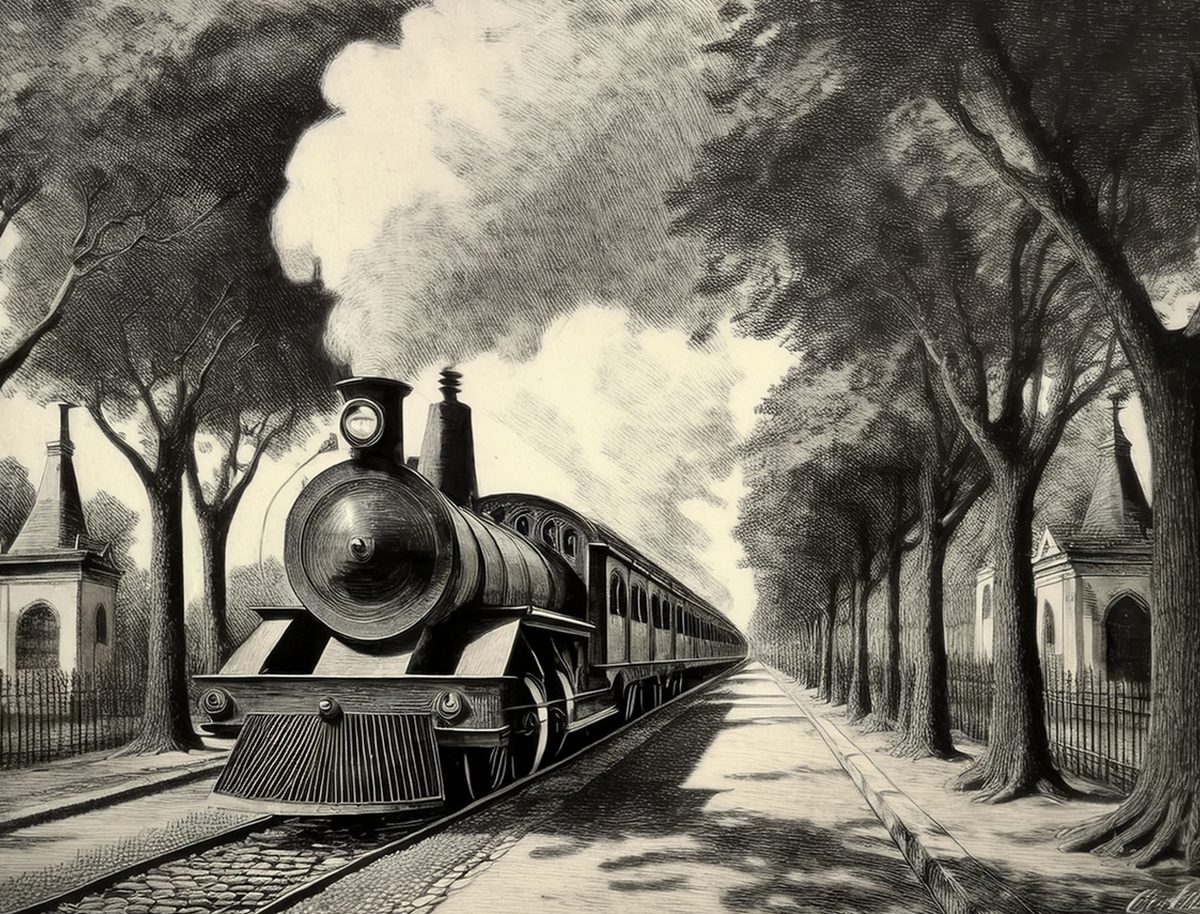
Baron Haussmann rests at Père-Lachaise. It is an irony history had no time to arrange: the man who wanted to raze the cemetery ended up buried in it. Georges Eugène Haussmann, prefect of the Seine from 1853 to 1870, cut the great boulevards through Paris, gutted its medieval blocks, and created its major parks and sewers. He also drew up a scheme he never managed to carry out: closing the three great Parisian cemeteries — Père-Lachaise, Montmartre and Montparnasse — moving the bodies already buried there, and transferring all of the capital's future dead to a giant thousand-hectare necropolis at Méry-sur-Oise, in the Val-d'Oise, twenty-two kilometres north of Paris. The planned means of transport: a funeral railway, with special carriages, dedicated stations and a departure every hour.
Haussmann's scheme grew out of a legal contradiction. In 1804, the imperial decree on burials had required cemeteries to be sited outside town boundaries. Père-Lachaise was created that same year in the village of Charonne, with Montmartre and Montparnasse on the edges of the capital. But in 1860, the expansion from twelve to twenty arrondissements brought these communes into Paris: cemeteries “outside the city” now found themselves inside it. Père-Lachaise, saturated since its last extension in 1850, already held seventy-five thousand graves. The undertaker Léon Vafflard warned as early as 1867: “The soil in these various cemeteries, saturated with organic matter, is no longer sufficient to break down the bodies.” Space was running out. The problem was at once a matter of public health, of law, and of property — since the land freed by closing the cemeteries would offer speculators an attractive prospect.
Four funeral stations, carriages graded by class of funeral, a departure every hour. The public called them the “death trains.”
In 1863, Haussmann devised a radical solution: creating a regional necropolis on the model of Brookwood Cemetery, opened in 1849 forty kilometres from London. The site chosen was Méry-sur-Oise, a town of fifteen hundred inhabitants. The administration had already acquired eight hundred and twenty-three hectares — an area comparable to the Bois de Boulogne. The scheme, put out for public consultation in 1867, envisaged a Pantheon for illustrious men, a Catholic church and separate areas for other faiths. The architect Alfred Feydeau, inspector general of the cemetery service, drew up plans for a monumental arrival station and a special funeral van. Four funeral stations were to be built independently of ordinary railway stations: one near each of the three Parisian cemeteries, all linked to the Montmartre station, the sole departure point for Méry. The carriages were graded to match the three classes of funeral. The journey was planned to take twenty minutes.
Opposition was immediate and came from every side. The mayors of the Oise valley refused to take Paris's bodies: why should Seine-et-Oise inherit the capital's dead? Only the representatives of Méry, Frépillon and Bessancourt, who stood to gain from the project, backed Haussmann. Princess Mathilde Bonaparte, a cousin of Napoleon III and owner of a château at Saint-Gratien on the planned railway route, had the minister of public works step in to change the line. Republicans denounced “the exile of the dead, after that of the workers pushed out to the edges of the city.” The public, more cruelly, dubbed the funeral carriages the “death trains.” The war of 1870, the siege of Paris and the Commune brought the project to a halt. The architect Feydeau submitted his detailed report in 1872, but the Empire had fallen and opinion had shifted.
The scheme dragged on for another ten years. Belgrand, Alphand, Hérold and Say tried to revive it by making the transfer optional — no longer moving bodies already buried. Nothing worked: the Paris municipal council rejected the plan once in 1879, and again in 1881. The solution finally adopted was more modest: Paris created outlying cemeteries on land beyond the commune's boundaries. Bagneux and Pantin opened in 1886, Thiais in 1929. Père-Lachaise, Montmartre and Montparnasse were spared. Of the Méry-sur-Oise necropolis, nothing survives but Feydeau's drawings — the arrival station, the Pantheon, the funeral van — kept in the archives. As for Haussmann, who died in 1891, he rests at Père-Lachaise, in the very cemetery he had wanted to close.
Yes. In 1863, Baron Haussmann planned to close Père-Lachaise, Montmartre and Montparnasse and move all the dead to a 1,000-hectare necropolis at Méry-sur-Oise, linked to Paris by a funeral railway. The city council rejected the plan in 1879 and 1881.
Why did Paris's cemeteries become a problem after 1860?
The 1860 annexation, which expanded Paris from 12 to 20 arrondissements, brought within the city cemeteries built outside its walls in 1804. Père-Lachaise, already saturated with 75,000 graves, now contradicted the imperial decree banning cemeteries inside towns.
An 823-hectare cemetery planned by Haussmann in 1863 to replace the three great Paris cemeteries. Modelled on Brookwood Cemetery near London, it envisaged a Panthéon, a Catholic church and a monumental funeral station designed by the architect Alfred Feydeau.
At Père-Lachaise, the very cemetery he had wanted to close. Georges Eugène Haussmann, prefect of the Seine from 1853 to 1870, died in 1891. With the Méry-sur-Oise transfer plan rejected, the three great Paris cemeteries remained in use.
 History