 Heritage
When Paris Learned to Burn Its Dead
France's first crematorium, opened in 1889 in a neo-Byzantine style by Jean Camille Formigé: the story of a fifteen-year fight for freedom of burial.
HeritageFrance's first crematorium, opened in 1889 in a neo-Byzantine style by Jean Camille Formigé: the story of a fifteen-year fight for freedom of burial.
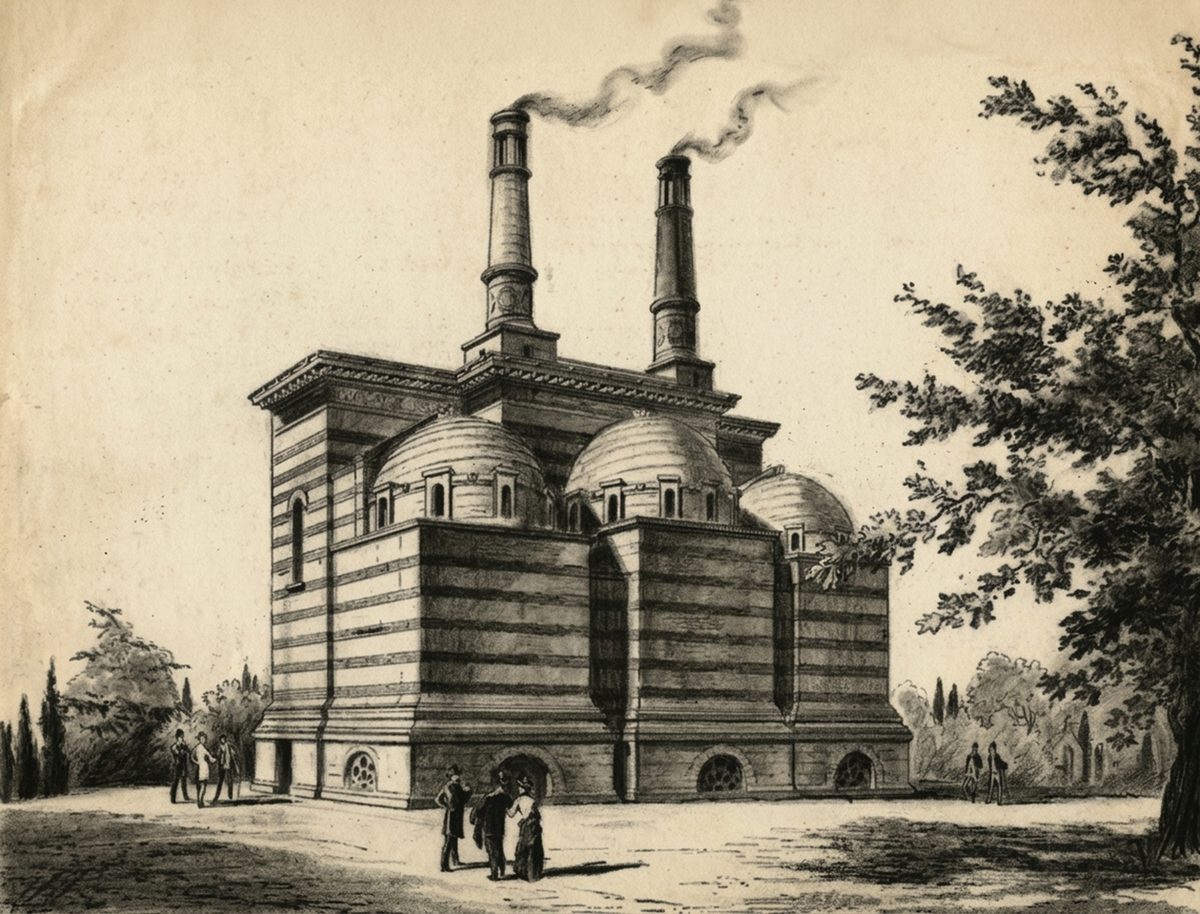
On 30 January 1889, a flame was lit at Père-Lachaise. For the first time in France, a body was officially cremated in a building designed for the purpose: a neo-Byzantine edifice of black and white stone, crowned with a brick-and-sandstone dome, designed by the architect Jean Camille Formigé in Division 87. The law of 15 November 1887 had legalised cremation two years earlier, ending a ban dating back to Charlemagne. But it took fifteen years of parliamentary battles, hygienist arguments and secularist campaigning before that flame was lit.
The idea resurfaced during the Revolution. In Year V, the deputy Daubermesnil put a bill before the Council of Five Hundred to allow citizens to have their dead burned. It was referred to committee and never went anywhere. After the 18 Brumaire coup and the religious backlash that followed, cremation again became unthinkable, except in medical emergencies: four thousand bodies were burned after the Battle of Paris in 1814, more at Sedan in 1870. On 14 August 1874, the Paris municipal council passed a motion inviting the prefect to hold a competition to find “the best practical method for cremating bodies.” In 1880, the Society for the Promotion of Cremation was founded, backed by Republican figures such as Gambetta. The law of 15 November 1887 finally settled the matter: every citizen was free to choose between burial and cremation.
It took fifteen years of parliamentary battles, hygienist arguments and secularist campaigning before that flame was lit at Père-Lachaise.
Work began in 1887 under Formigé and the engineer Ernest-Gustave Bartet. The concept was unprecedented: a “funerarium” combining a central crematorium surrounded by a columbarium to house the cinerary urns. The main chapel, built of black and white stone laid in polychrome horizontal bands, borrows its solemnity from the neo-Byzantine style. The roof is formed of a vast brick-and-sandstone dome, flanked by three half-domes and two chimneys rising above the graves. In the 1920s, the dome gained stained-glass windows by Carl Mauméjean. The columbarium spreads across four wings on four levels — two below ground, two above — offering more than twenty-six thousand niches. The whole complex has been a listed historic monument since 1995.
Long the only one of its kind in France, the Père-Lachaise crematorium remained unique for a decade: Rouen followed in 1899, Reims in 1903, Marseille in 1907, Lyon in 1913. The Catholic Church did not permit cremation until 1963, and it took until the 1980s for the practice to become widespread. The columbarium today holds the ashes of well-known figures — the film-maker Max Ophüls, the comedian Pierre Dac — and keeps a niche in the name of Maria Callas, now a cenotaph since her ashes were scattered over the Aegean Sea in 1979.
In 2022–2023, the City of Paris carried out a restoration that returned the sculptures and façades to their original clarity. In one of the ceremony rooms, a sculpture by Paul Landowski, Eternal Return, quietly accompanies grieving families — its plaster model is kept at the Musée-Jardin Landowski in Boulogne-Billancourt. Since 1 May 2026, the crematorium has been run by the Société Publique Locale Funéraire de Paris, ensuring fully public management. Formigé's building, designed to win over a society hostile to cremation, now hosts a rite chosen by close to one French person in two.
In 1887–1889. The architect Jean-Camille Formigé and the engineer Bartet built the first crematorium in France in Division 87 of Père-Lachaise. The first official cremation took place on 30 January 1889.
Read the full history of Père-LachaiseFormigé chose the neo-Byzantine style for its solemnity, with a dome of brick and sandstone, polychrome stonework in black-and-white bands, and three half-domes. Carl Mauméjean's stained-glass windows were added in the 1920s.
Discover the artists at Père-LachaiseYes. The columbarium is open during the cemetery's opening hours. It has four wings across four levels with 26,606 niches, including those of Max Ophüls and Pierre Dac. The whole complex has been a listed historic monument since 1995.
Check opening hours and accessOn 15 November 1887. This law ended a ban dating back to Charlemagne, after fifteen years of debate driven by the Society for the Propagation of Cremation. The Catholic Church did not permit cremation until 1963.
Find out more about Père-Lachaise