When Père-Lachaise opened in May 1804, only thirteen families agreed to bury their dead there. Parisians balked at this distant hill, with neither church nor parish tradition. It would take thirteen years and the transfer of famous remains to fill this deserted garden.
In Division 11, on the eastern flank of the hill, a few modest steles bear dates from 1804 and 1805. They are so unassuming that visitors walk past without seeing them, lost among the grander monuments that joined them twenty years later. These unadorned stones are the earliest traces of Père-Lachaise — and the witnesses of a spectacular failure. When the cemetery opened on 21 May 1804, it covered seventeen hectares of wooded hillside, with winding paths laid out by the architect Alexandre-Théodore Brongniart. It was the largest green space in eastern Paris, and it was a wasteland. Thirteen plots in the first year. Forty-four in 1805. Forty-nine in 1806. For seven years, the Cimetière de l'Est — its official name — remained an anomaly: a magnificent garden that Parisians stubbornly refused as a final resting place.
The refusal was no whim. It ran a thousand years deep in funerary tradition. Since the early Middle Ages, Parisians had buried their dead as close as possible to the living: in cemeteries attached to churches, sometimes beneath the very flagstones of the nave. The rich bought a place beneath the stones of their parish; the poor lay in the common grave of the adjoining cemetery. To be buried near a church meant resting near a saint's relics, benefiting from their intercession, remaining within the community of the faithful — the living as much as the dead. The Cimetière des Innocents, at the heart of Paris, had operated this way for six centuries, until its insalubrity became unbearable. In 1780, after a cellar wall in a neighbouring house collapsed under the pressure of decomposing bodies, the Conseil d'État ordered its closure. The bones were exhumed and transferred to the underground quarries — the future catacombs. But closing one charnel house did not erase a thousand-year-old habit: in 1804, Parisians still wanted to be buried near their church, in their own neighbourhood, among their own.
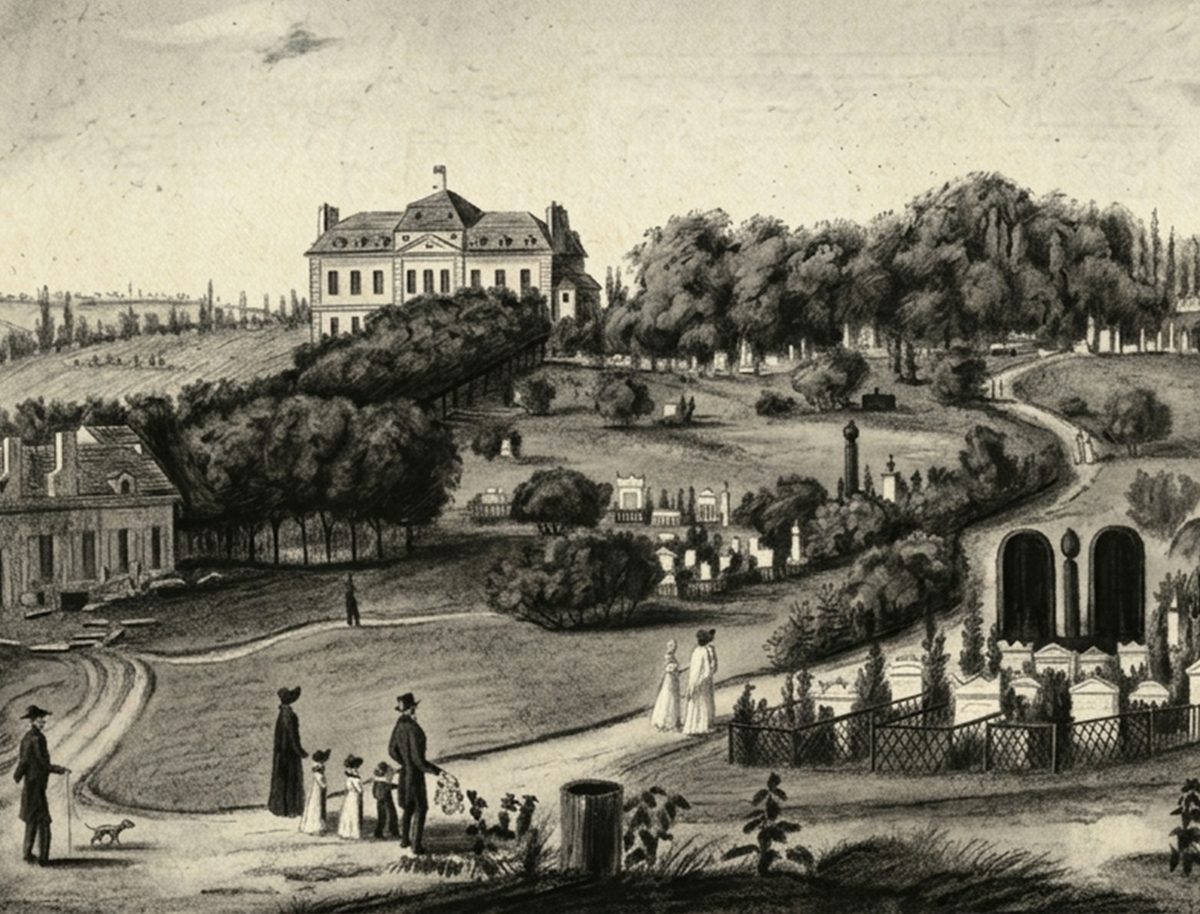
For seven years the cemetery was a green desert: seventeen hectares of lime trees and acacias, winding paths designed by Brongniart, and almost no one to rest there.
The site chosen by Prefect Frochot combined every handicap. Mont-Louis lay at Charonne, a rural commune east of Paris, beyond the toll barrier. For a Parisian from the Marais or the Cité, it was a journey: crossing the outer districts, climbing a hill, leaving the city behind. The cemetery had no church. The decree of 23 Prairial Year XII banned burials in places of worship, but what was meant to free families instead left them disoriented: a cemetery with no bell tower, no resident priest, no requiem mass, resembled nothing they knew. There was no parish tradition, no familiar neighbourhood, no ancestor's grave to lend the place legitimacy. The nearest church, Saint-Germain-de-Charonne, belonged to the village, not the city. Brongniart had laid out an English-style garden — undulating, planted with lime trees, cypresses and acacias, with vistas and groves — but Parisians recognised nothing of what a cemetery ought to be. What was on offer was to exile their dead to an unfamiliar countryside.
The first plot-holders were notables gambling on modernity. Pierre Jacquemart, a stockbroker, obtained the first perpetual plot on 4 June 1804. That same June, the gravestone of Reine Fevez was set in place — the oldest monument in the cemetery. But by the end of the first year, only fifteen burials had taken place in purchased plots: the rest went to the common grave, where the poor were laid without choice or ceremony. Prefect Frochot created the perpetual plot in 1805 — land bought once, for all eternity — to win over the bourgeoisie. In 1806, Napoleon ordered the transfer of the remains of Louise of Lorraine, wife of Henri III. It was hoped that imperial prestige would draw families in. Nothing worked: sixty-two plots in 1807. In 1808, Antoine Caillot published the cemetery's first guidebook, the Voyage pittoresque et sentimental. In 1809, the first cenotaph and the first sculpture appeared, raised for the dragoon lieutenant Antoine de Guillaume Lagrange. The site had its admirers, but not its dead. By 1815, after ten years' existence, the cemetery held only six hundred and thirty-five burials in purchased plots. Seventeen hectares of hillside for six hundred graves: the ratio was damning.
It was neither hygienist reasoning nor imperial decree that filled Père-Lachaise: it was the prestige of famous corpses. In 1817, the City organised the transfer of the presumed remains of Molière, La Fontaine, Héloïse and Abelard. The effect was immediate: perpetual plots, which had stagnated for thirteen years, surged. In 1821, the return of the Panthéon to Catholic worship finished redirecting celebrities towards the cemetery: marshals, academicians and artists flocked in. By 1830, there were thirty-three thousand plots. The deserted garden had become the most sought-after place in Paris. Today's visitor can read this history in the cemetery's very geography. The oldest divisions — 10, 11, 12 — show modest, scattered, often anonymous steles. Climbing towards the Grand Rond or descending towards Godde's chapel, the graves grow closer together, the mausoleums grander, the names more illustrious. Père-Lachaise carries in its topography the trace of its early failure: the first stones are unassuming because no one wanted to come.
The cemetery stands on the hill of Charonne, a rural parish east of Paris in 1804. Parisians were reluctant to bury their dead so far from their own neighbourhood and parish church. The 1817 transfer of the presumed remains of Molière and La Fontaine set the funerary fashion in motion.
What is the oldest visible grave at Père-Lachaise?
Reine Fevez's tombstone, laid in June 1804, is the oldest monument at Père-Lachaise. The first cenotaph and the first sculpture date from 1809, raised for the dragoon lieutenant Antoine de Guillaume Lagrange. The first funerary chapel, that of the Comte de Greffulhe, was built in 1810.
What role did Nicolas Frochot play in the creation of Père-Lachaise?
Nicolas Frochot, prefect of the Seine from 1800 to 1812, chose the Mont-Louis site and commissioned the architect Brongniart to draw up the cemetery's plan. Frochot created the perpetual plot in 1805 and organised the first transfers of prestigious remains to attract Parisian families.
In 1780, a cellar wall of a neighbouring house collapsed under the pressure of decomposing bodies from the Cimetière des Innocents, in central Paris. The Conseil d'État ordered the closure of Paris's oldest cemetery. The bones were transferred to underground quarries, which became the catacombs.
 History