Roughly 70,000 plots across 44 hectares, 90 per cent of them perpetual: Père-Lachaise has been full since the mid-twentieth century. To keep receiving its dead, the City reclaims abandoned graves and converts chapels into columbaria.
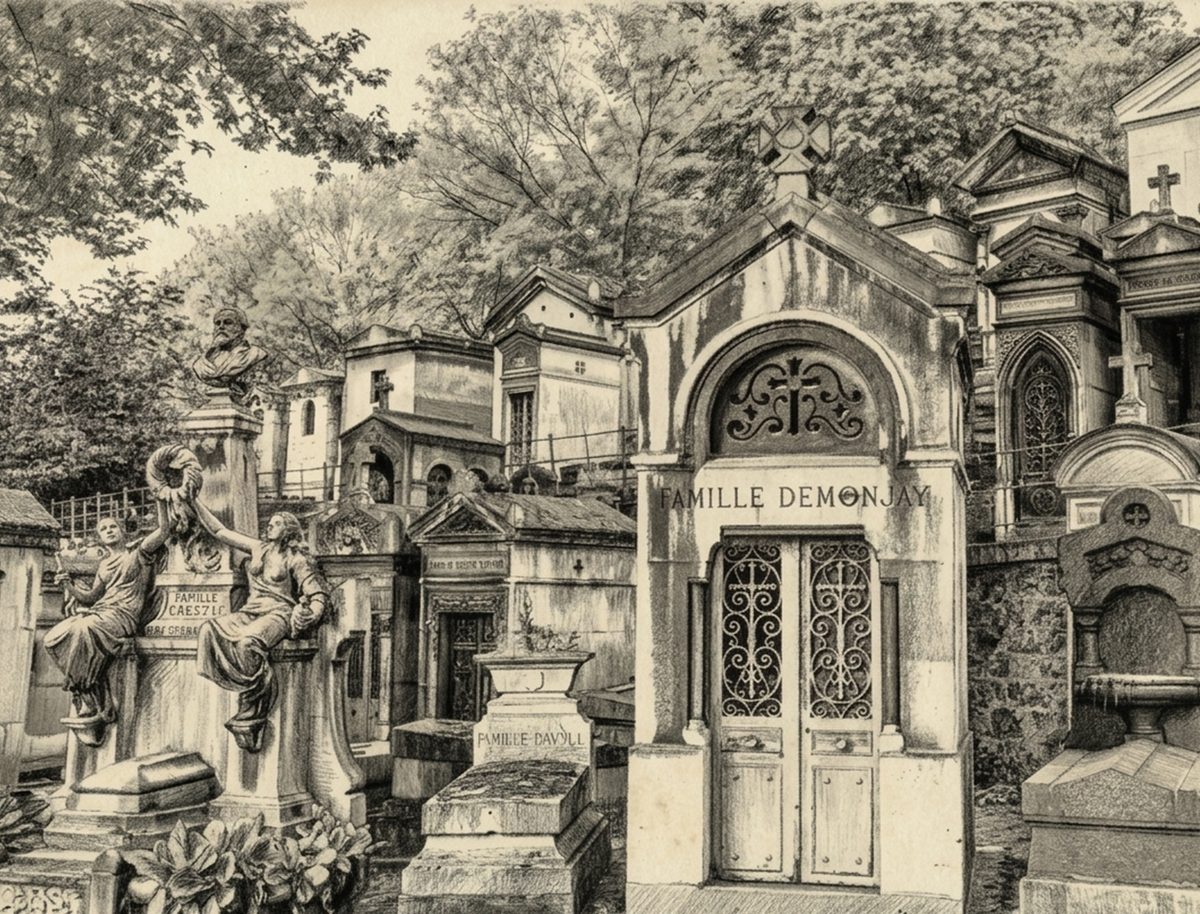
Whoever walks the paths of Division 19 passes between two worlds. On one side, funerary chapels with collapsed roofs, torn-out doors, vegetation invading the interior. On the other, graves kept up, decked in flowers, visited. The contrast is striking, and it sums up the paradox of Père-Lachaise: the cemetery is full to bursting — around seventy thousand plots across forty-four hectares, thirty thousand of them predating 1900 — yet hundreds of graves lie abandoned. Not one space is free for a new burial, and yet whole chapels crumble into ruin with no one to claim them. The largest cemetery in Paris is a living paradox: too full to take in new dead, too short of families to look after the old ones.
Père-Lachaise is a victim of its own success. When Prefect Frochot created the perpetual plot in 1805, he invented a formidable mechanism: for a single lump-sum payment, a family could occupy a piece of ground for eternity. Forty-nine perpetual plots were sold in the first year, eight hundred and thirty-three in 1812, thirty-three thousand in 1830. By 1850, after the fifth and final enlargement, there were seventy-five thousand graves. Since then, not a single hectare has been added. The five successive enlargements between 1824 and 1850 took the area from seventeen to forty-four hectares, and that is all there is. The columbarium, built in phases between 1893 and the 1920s, absorbed part of the demand with its twenty-six thousand six hundred and six niches — but these too are now almost all occupied. The garden of remembrance, the first in France, opened in 1985, receives the scattering of ashes: around thirteen hundred a year. But the pressure has not eased: Père-Lachaise remains the capital's most sought-after cemetery.
A full cemetery is not a dead one. It is an organism that regenerates itself: abandoned plots revert to the City, collapsed chapels are reborn, and spaces free up one by one.
The legal solution came after the First World War. Until 1924, the perpetuity of plots was absolute: once paid for, it could not be challenged. In exchange, the price was very high. But after 1918, the State found that thousands of graves were falling into ruin, for want of descendants or means. The law of 3 January 1924 replaced absolute perpetuity with relative perpetuity: the plot remained perpetual, but was now conditional on the grave being maintained. If a grave was neglected — no tomb left standing, invasive vegetation, collapsed fencing — the municipality could begin reclamation proceedings. Establishing abandonment required thirty years without upkeep, a three-year inquiry and a decision by the municipal council. The procedure is slow, tightly regulated, and never touches the thirty thousand pre-1900 graves listed as historic monuments. Each year, the City of Paris reclaims between one hundred and fifty and three hundred plots at Père-Lachaise — a drop in the ocean against the seventy thousand that exist.
Reclamation is not destruction: it is reassignment. The City imposes strict specifications on new plot-holders — respect for architectural harmony, choice of materials, integration into the landscape. Some abandoned chapels find an unexpected second life: about twenty have been converted into mini-columbaria, their outer structure kept and their interior refitted to hold cinerary urns. In January 2026, the City of Paris launched an unprecedented scheme: a lottery allowing thirty Parisians to acquire a plot in one of the three great cemeteries — ten at Père-Lachaise, ten at Montparnasse, ten at Montmartre — in exchange for undertaking to restore the monument exactly as it was. The winners, drawn by a bailiff on 19 January 2026, commit to rebuilding what they receive. Alongside this, associations — the ACMN, the Souvenir Français — and the City itself restore the most remarkable monuments: the Greffulhe chapel, the Ballesteros tomb, the Crawford pyramid.
Père-Lachaise is not a museum frozen in time. It is a working cemetery — close to ten thousand ceremonies a year — that must reconcile three conflicting missions: taking in new burials, preserving a listed heritage, and remaining a green space open to three and a half million visitors a year. Saturation is not a crisis: it is a permanent condition, managed through a quiet cycle of reclamations, reassignments and restorations. The oldest divisions — 11, 12, 13, the romantic flank of the hill — remain untouchable. The more recent Charonne plateau offers greater scope for turnover. The cemetery renews itself in layers, like the city above it. At Père-Lachaise, eternity is a promise each generation renegotiates.
Yes, but space is extremely scarce. The cemetery has been full since the mid-twentieth century, with around 70,000 plots across 44 hectares. New spaces open up only through the reclamation of abandoned plots — between 150 and 300 a year — or by converting chapels into columbaria.
What happens to an abandoned grave at Père-Lachaise?
After thirty years without upkeep, the City of Paris can begin a three-year reclamation process. The plot is then reassigned to a new holder, bound by specifications requiring respect for the cemetery's architectural harmony.
Around 70,000 ground plots, plus 26,606 columbarium niches. The cemetery covers 44 hectares divided into 97 Divisions. More than 30,000 graves predate 1900 and are listed in the historic monuments inventory.
In 2026, the City of Paris launched a lottery: ten plots at Père-Lachaise, ten at Montparnasse and ten at Montmartre, awarded to Parisians who commit to restoring the funerary monument exactly as it was. The winners were drawn by a bailiff on 19 January 2026.
 Society