Père-Lachaise is home to a hundred and forty wild animal species, including three pairs of foxes settled there since 2020 and colonies of stray cats protected since 1999. At night, unlit, the Charonne hill becomes an ecological corridor in the heart of Paris.
When the gates of Père-Lachaise close for the night, the cemetery becomes a different place. There is no night-time lighting at all. The visitors are gone. Across forty-four hectares of greenery and stone, another population takes over the paths: red foxes, beech martens, tawny owls, hedgehogs, bats, field mice. And cats. Père-Lachaise is home to nearly one hundred and forty wild animal species, recorded between 2010 and 2020 by the City of Paris. The cemetery is an island of biodiversity at the heart of the twentieth arrondissement — linked, on its eastern side, to the Petite Ceinture, the disused railway line that forms a continuous ecological corridor. Among this wildlife, two species hold a special place in the cemetery's popular image: the foxes, which arrived in 2020, and the stray cats, present for decades.
Red foxes have been living and breeding at Père-Lachaise since the spring of 2020 — the year of the first Covid lockdown, when the absence of visitors left the field open to wildlife. The cemetery's keeper, Benoît Gallot, identified three fox pairs. The animals are very discreet: like the beech martens and tawny owls, they move about mainly at night, hunting for field mice, shrews, voles and hedgehogs. By day, the foxes hide in the cemetery's undergrowth and thickets. The earliest or latest visitors sometimes catch sight of them rounding a corner — a pigeon in their jaws, as the keeper puts it. The presence of foxes at Père-Lachaise has gone viral on social media and in the press. Fox selfies have become a photographic genre all their own.
Three pairs of foxes have lived and bred at Père-Lachaise since the spring of 2020. Highly discreet, the foxes move between the graves at night, hunting field mice, voles and hedgehogs.
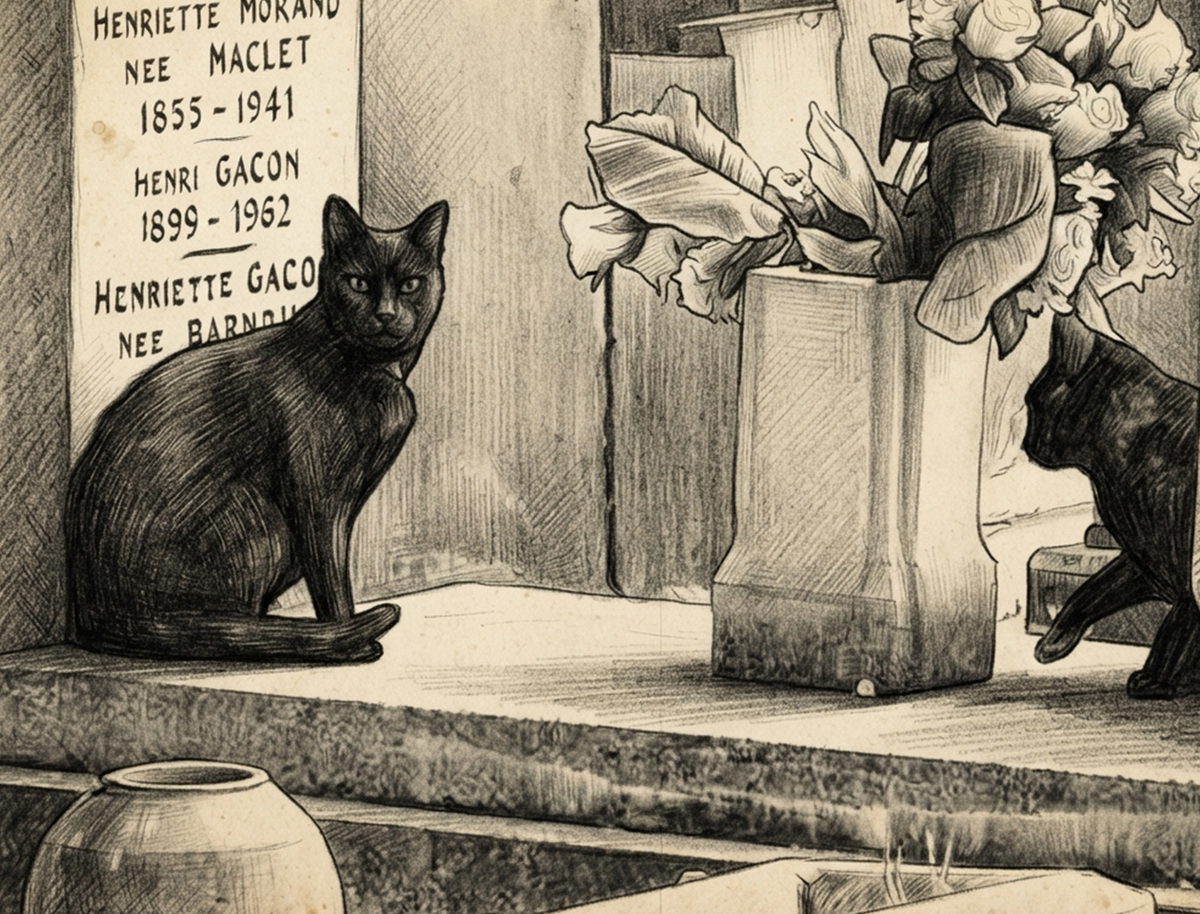
The stray cats of Père-Lachaise are an older institution still. Colonies of cats have lived in the cemetery for decades, split into small groups across the divisions. Since 1999, stray cats have enjoyed legal protection in France: the colonies are identified, and the animals are neutered and fed by volunteers who divide the cemetery's sectors among themselves. A shelter has been set up at the back of the cemetery for the cats, though many prefer to sleep inside the open mausoleums. The volunteer carers — the great majority of them women — maintain daily contact with the colonies, know every animal by name, and pay for the neutering out of their own pockets. The cats of Père-Lachaise also hunt rodents, contributing to the site's ecological balance alongside the birds of prey and the foxes.
The cohabitation of wildlife with the forty-four hectares of graves at Père-Lachaise is made possible by two factors: the absence of chemical treatments since 2015, which lets wild grasses and insects flourish, and the absence of night-time lighting, which leaves the night to the animals. The cemetery is also a refuge for seven species of bat, including the common pipistrelle. Père-Lachaise is the largest green space within central Paris: four thousand one hundred and thirty-four trees, more than two hundred and twenty wild plant species, one hundred and forty animal species. The cemetery's foxes, cats, owls and hedgehogs have no idea that they live among the graves of Chopin, Piaf and Jim Morrison. But the visitor who crosses their path at dusk discovers a Père-Lachaise that the tourist guides never show.
Yes. 3 pairs of red foxes have lived and bred at Père-Lachaise since spring 2020. Highly discreet, the foxes move about mostly at night in search of field mice, voles and hedgehogs. Curator Benoît Gallot has confirmed their presence.
Yes. The stray cats of Père-Lachaise have had legal protection since 1999. Volunteer feeders divide the cemetery into sectors, identify the animals and fund their sterilisation. A shelter has been set up at the back of the cemetery.
Père-Lachaise is home to close to 140 wild animal species, including 62 bird species, 7 bat species, foxes, beech martens, hedgehogs and stray cats. The cemetery is an island of biodiversity linked to the Petite Ceinture.
Père-Lachaise is a haven for wildlife thanks to the absence of night lighting, the end of pesticide treatments since 2015 and the nearby Petite Ceinture, an ecological corridor on the eastern side. The cemetery has 4,134 trees across 44 hectares.
 Society