A Thousand Stained-Glass Windows Behind Locked Doors
Père-Lachaise holds more than eleven hundred stained-glass windows in its funerary chapels — the largest collection of funerary stained glass in France. Almost all are invisible: the chapel doors are locked, and visitors pass by without knowing what the stone walls conceal.
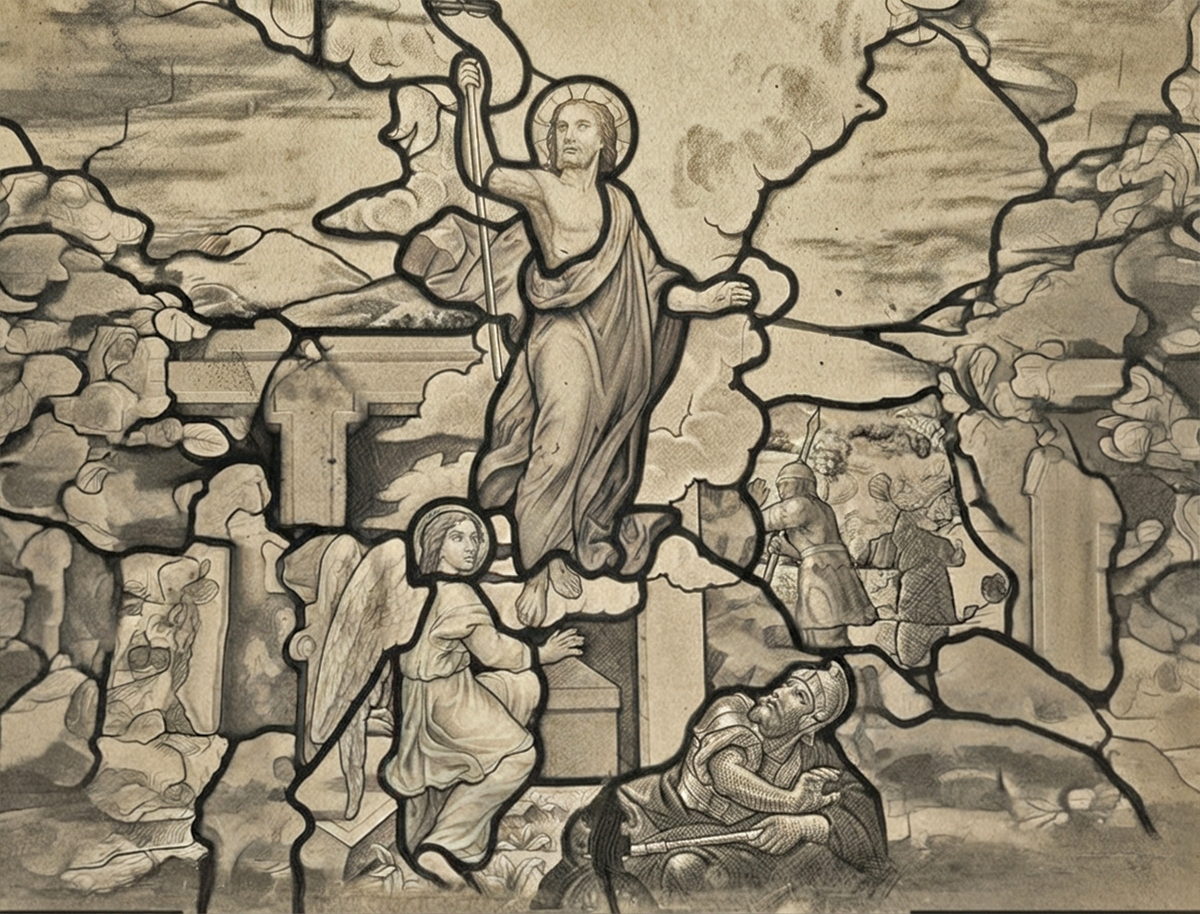
Behind the locked doors of Père-Lachaise's funerary chapels lies a heritage that almost no one sees. More than 1,100 stained-glass windows — 1,108 to be exact, catalogued by the Association of Friends and Enthusiasts of Père-Lachaise — adorn the round, pointed, trefoil or rectangular windows of the stone chapels. Crosses on gold backgrounds, Madonnas and Child, portraits of the dead painted on glass, Art Nouveau plant motifs, Art Deco geometric compositions. Most date from the second half of the nineteenth century, when bourgeois Catholic families had funerary chapels built on their plots. But the visitor walking the alleys sees none of it. The doors are shut, the grilles blocked, and light passes only through the gaps. Père-Lachaise holds the largest collection of funerary stained glass in France — and it is a museum kept under lock and key.
The first stained glass appeared along with the first chapel. In 1810, Count Greffülhe had the very first funerary chapel at Père-Lachaise built, in Division 43. The chapel's round windows hold the cemetery's earliest stained glass: a red star on a blue background, very simple, damaged today but still legible. Funerary stained glass then followed the evolution of religious stained glass. In the nineteenth century, the painted element took over: glaziers reproduced entire religious scenes on a single sheet of clear glass, with the lead confined to the border. Raphael's *Madonna of the Chair*, held at the Uffizi Gallery in Florence, is the most copied model — 33 versions survive at Père-Lachaise. The oldest dated and signed window, by the glazier F. Potet, dates from 1868. The most recent, installed in 2022 on the Nahra grave, shows that the tradition is not extinct.
The oldest stained-glass window at Père-Lachaise dates from 1810, the most recent from 2022. Between the two, more than a thousand compositions of painted, sandblasted, etched or moulded glass sleep behind doors that almost no one ever opens.
The APPL inventory sorts the windows into fifteen categories. Religious motifs dominate: 146 windows depict saints, 132 a cross, 103 the Madonna alone, 93 a Madonna and Child, 68 Christ, 42 a Crucifixion scene. But the secular windows form an unexpected group. Ninety-four windows are decorated with plant motifs — some in pure Art Nouveau style. 50 windows are portraits of the dead, sometimes so precise that they resemble photographic plates transposed onto glass. Eight windows are Jewish — the Jewish community adopted the funerary chapel in the late nineteenth century, though only briefly. And around 1930, modernist chapels began setting thick coloured glass fragments into concrete — when sunlight passes through them, the effect is striking.
About a quarter of the windows are signed, but little is known of the workshops that produced them. Around forty glaziers have been identified. The most prolific is Lucien Collinet, born in 1869, the author of some 50 windows at Père-Lachaise on his own. Jean-Louis Beuzon signed the last window of the great period in 1914. After the First World War, chapel construction slowed, and with it the commissioning of stained glass. A few exceptions remain: J. E. Guillemin in 1924, C. Ménès in 1990 — isolated commissions outside the great nineteenth-century wave. The history of these glaziers has largely yet to be written. Many left no trace beyond a signature etched in a corner of glass, visible only when a shaft of sunlight breaks through the grille of a forgotten chapel.
The problem with Père-Lachaise's stained glass is its fragility. The paint ages, wrinkles and flakes off — some windows are now mere ghosts of colour, where only the outline survives. Poor-quality industrial paints lose their sheen, then their colour. Weathering, thermal shock and vandalism finish the job. And above all, the chapels are private: they belong to the families holding the plots, who have often died out or stopped visiting. The doors stay shut, and the windows are neither maintained nor restored. Divisions 61 and 62, where chapels are most numerous, offer the densest concentration — but even there, one must press one's face to a grille to make out, in the gloom, a flash of blue or red. The largest museum of funerary stained glass in France is a museum you view through a keyhole.
How many stained-glass windows are there at Père-Lachaise?
1,108. The Friends of the cemetery have catalogued 1,108 stained-glass windows in the cemetery's funerary chapels. The oldest dates from 1810 (the Greffulhe chapel), the most recent from 2022 (the Nahra grave). About 25% bear their glazier's signature.
Can the stained-glass windows in the chapels at Père-Lachaise be seen?
Most of Père-Lachaise's funerary chapels are locked, since they belong to the families holding the plot. The stained glass can only be glimpsed through railings or gaps in the doors. Divisions 61 and 62 hold the highest concentration of chapels.
What motifs appear on the stained-glass windows at Père-Lachaise?
Religious motifs dominate: crosses, the Virgin, Christ, the Crucifixion, saints. But portraits of the deceased also appear, along with Art Nouveau foliage, Art Deco geometric patterns and 8 Jewish windows. The most copied design is Raphael's Madonna of the Chair.
What is the oldest funerary chapel at Père-Lachaise?
The chapel of the Comte de Greffulhe, in Division 43, built in 1810, is Père-Lachaise's first funerary chapel. Its round windows hold the cemetery's earliest stained glass: a red star on a blue ground, simple but still legible today.
 Heritage