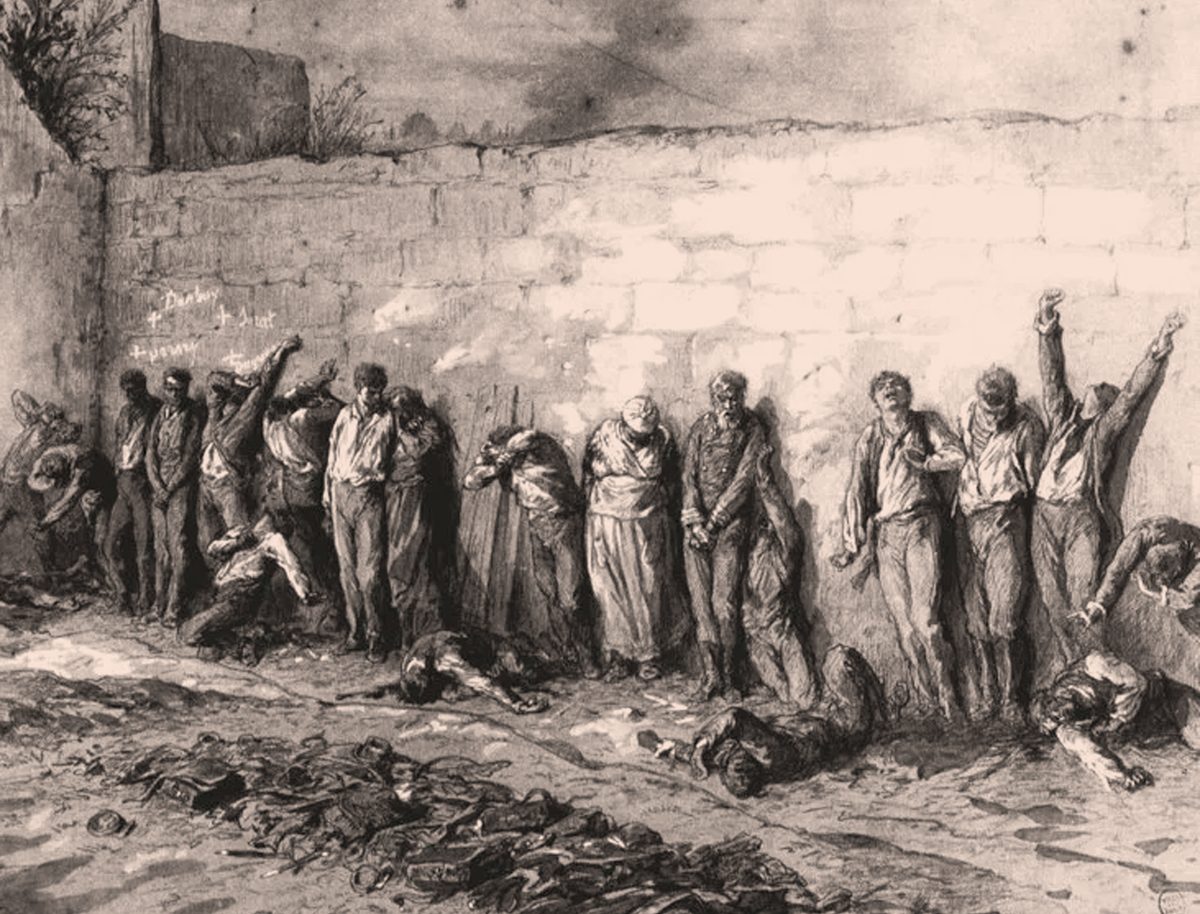
On 28 May 1871, Versailles troops seized Père-Lachaise after fighting among the graves. A hundred and forty-seven Communards were shot against the boundary wall in Division 76 — a wall that became the most emblematic site of memory for the French left.
In Division 76, along the cemetery's eastern boundary wall, a marble plaque bears six words in gold letters: “Aux morts de la Commune, 21–28 mai 1871” — to the dead of the Commune. It is one of fourteen listed monuments at Père-Lachaise — listed on 14 November 1983, more than a century after the events. Before this plaque, every year at the end of May, thousands march in silence, fists raised or a red rose in their buttonhole. The Communards' Wall is the cemetery's oldest and most political site of memory. It was here, on 28 May 1871, that one hundred and forty-seven prisoners of the Paris Commune were shot without trial by Versailles government troops and thrown into a common grave at the foot of the wall. The cemetery founded to receive the dead of the Parisian bourgeoisie became, in a single day of May, the symbol of every popular struggle.
The Paris Commune was born on 18 March 1871, two months after the armistice that ended the Franco-Prussian War. For seventy-two days, the insurrectionary government decreed the separation of Church and State, compulsory secular education and the cancellation of rents. On 21 May, the troops of Adolphe Thiers's government, which had withdrawn to Versailles, entered Paris through the Porte de Saint-Cloud. The Bloody Week began: seven days of street fighting, barricade by barricade, district by district. The total number of victims of the Versailles repression is estimated at between twenty and thirty thousand. The city burned — the Tuileries Palace, the Hôtel de Ville, the Palais de Justice were set alight. The Communards fell back eastward, towards Belleville, Ménilmontant and La Villette, the working-class districts that had been the heart of the insurrection.
On 27 May, the Commune's last defenders dug in at Père-Lachaise. Two hundred Communards armed with a dozen cannon held the high ground of the cemetery. They turned the chapel of the Duc de Morny into a munitions store. Versailles troops shelled the position from the hills of Montmartre before launching their assault late in the afternoon. Fighting continued hand to hand among the graves, in the paths, between the funerary chapels. The journalist Maxime Vuillaume, who survived the Bloody Week, would later recount the scene in his Cahiers rouges. On 28 May, Versailles troops took control of the cemetery. The last Communards captured with weapons in hand were taken to the Mazas prison, then brought back to Père-Lachaise to be executed. One hundred and forty-seven prisoners were shot against the eastern boundary wall, in Division 76, and thrown into a makeshift grave. In the days that followed, around a thousand bodies of Communards who had fallen in the street fighting of the surrounding districts joined them in a second grave.
They fought hand to hand among the graves with the energy of despair. Two hundred Communard fighters, armed with a dozen cannon, held the cemetery's high ground against the regular army.
The wall visitors see today is not the one from 1871: it was rebuilt between 1883 and 1884. But the place has kept its charge. On 23 May 1880, answering the call of Jules Guesde, twenty-five thousand people wearing a red rose in their buttonhole came to the Communards' Wall — the first pilgrimage, two months before Parliament voted the amnesty for the Communards. From then on, every year, on the last Saturday of May, left-wing parties and organisations “march to the Wall.” Jean Jaurès went there several times. On 24 May 1908, the marble plaque “Aux morts de la Commune, 21–28 mai 1871” was unveiled. That same day, a few metres from the wall, a monument was raised to the memory of Eugène Pottier, the author of L'Internationale. On 24 May 1936, the place saw its largest gathering ever: six hundred thousand people marched in the presence of Léon Blum and Maurice Thorez, the day after the Popular Front's victory.
The Communards' Wall was listed as a historic monument on 14 November 1983. Every year, at the end of May, wreaths of flowers pile up before the plaque — often red, bearing the names of parties, unions, memorial associations. On 1 May, the Grand Orient de France lays a wreath there. The Wall is the only monument at Père-Lachaise whose meaning is as much political as it is historic: it commemorates not a famous individual but a founding event. Along the Avenue Circulaire, in the east of the cemetery, fifteen deportation memorials — Auschwitz, Buchenwald, Ravensbrück, Mauthausen — extend this memory of persecution and resistance. Père-Lachaise, a romantic garden designed to receive the bourgeoisie's dead, is also a political cemetery. The Communards' Wall is its oldest and most living proof.
What happened at Père-Lachaise during the Paris Commune?
On 27 May 1871, two hundred Communard fighters entrenched themselves in the cemetery with a dozen cannon. Versailles government troops shelled the position, then stormed it. On 28 May, 147 prisoners were shot against the boundary wall in Division 76, at what became the Communards' Wall.
In Division 76, along the cemetery's eastern boundary wall. A marble plaque unveiled in 1908 bears the inscription “Aux morts de la Commune, 21–28 mai 1871” (To the dead of the Commune, 21–28 May 1871). Listed as a historic monument in 1983, the site draws an annual pilgrimage every last Saturday in May.
147 Communards were shot against the cemetery's eastern boundary wall on 28 May 1871, then thrown into a mass grave. About a thousand more, fighters killed in street battles in the surrounding districts, were buried nearby in the days that followed.
Is the Communards' Wall a listed historic monument?
Yes. The Communards' Wall, in Division 76 at Père-Lachaise, was listed as a historic monument on 14 November 1983. Since 1880, left-wing organisations have held a commemorative march there each year in late May. The largest gathering drew 600,000 people in 1936.
 History