In the nineteenth century, the funeral procession that carried the deceased to Père-Lachaise followed a strict price list: eight classes of funeral, from a one-horse hearse draped in black serge to an eight-horse carriage caparisoned in silver-embroidered velvet.
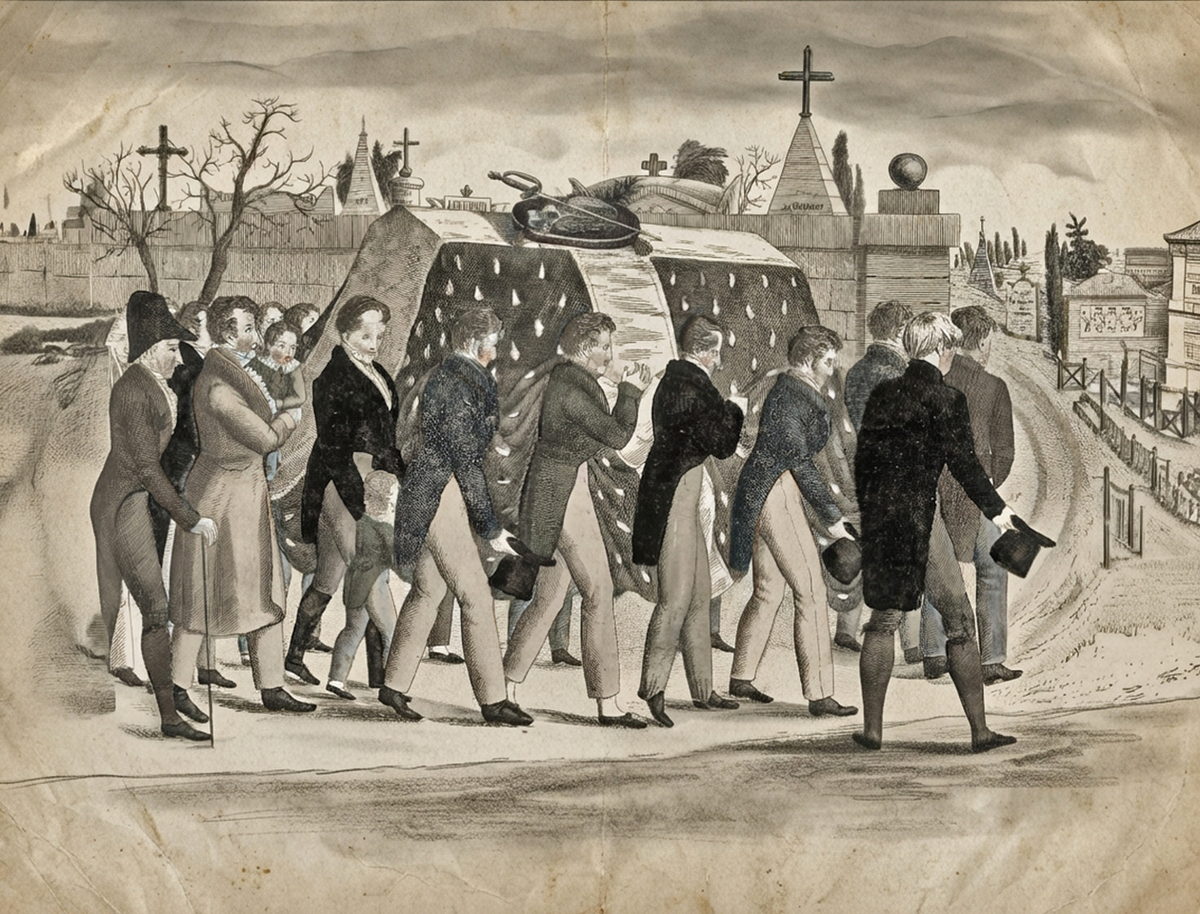
The hearse making its way up boulevard de Ménilmontant towards Père-Lachaise, one morning in November 1890, was not the same whether the dead man was a gentleman of independent means from the 8th arrondissement or a worker from Belleville. The gentleman was entitled to a first-class carriage, draped in black velvet trimmed with silver braid, drawn by four or six caparisoned horses, escorted by liveried bearers, and led by a master of ceremonies in a black coat and bicorn hat. The worker was entitled to an eighth-class hearse — a plain one-horse cart, a length of black serge with no ornament, no bearers, no liveried undertakers. Between the two, six intermediate classes graded every detail of the procession: the number of horses, the quality of the fabric, the length of the fringes, the number of candles, whether or not there was a canopy. Nineteenth-century funeral companies had turned death into a priced commodity, and the funeral procession that crossed Paris to the cemetery was a street spectacle that said everything about the dead person's fortune.
The system rested on a monopoly. Since the imperial decree of 23 Prairial Year XII — the same decree that created Père-Lachaise in 1804 — the funeral service had been entrusted to parish vestries, and then, from 1904, to the municipalities. In Paris, funerals were a municipal service whose prices were set by prefectoral order. Each class corresponded to a level of service defined down to the smallest detail. A first-class procession around 1890 cost roughly 3,000 francs — a clerk's annual salary. The price included a satin-lined hearse, horses draped in silver-fringed covers, bearers in full livery, a master of ceremonies, black hangings with silver teardrops for the building's doorway, and candelabra and candles. The eighth class, known as the “paupers' class”, cost only a few francs: a plain hearse, one horse, one driver. Between these extremes, each class added or removed one element — one more horse, one less ornament — making up a range of processions as codified as a restaurant menu.
The number of horses, the colour of the drape, the quality of the fringing, the number of liveried bearers and undertakers: everything came at a price. Nineteenth-century undertakers had priced death down to the last centime.
The nineteenth-century funeral procession was an urban spectacle. The hearse set off from the dead person's house, led by clergy in surplices and followed by the family in deep mourning — men in black frock coats, women veiled in crepe. The procession crossed the streets of Paris at walking pace, blocking traffic and drawing every eye. Passers-by removed their hats. Shopkeepers lowered their shutters as it went by. The number of following carriages could run into the dozens for an important figure. Victor Hugo's funeral procession, on 1 June 1885, brought out two million people between the Arc de Triomphe and the Panthéon. Adolphe Thiers's, in 1877, drew thousands to march to Père-Lachaise. The procession was the dead person's last public appearance, and the family who commissioned it knew that all Paris was watching.
The horse-drawn hearse disappeared in the early twentieth century. In 1904, the first motor hearses appeared in Paris — electric at first, then petrol-driven. The transition was slow: horse-drawn hearses survived into the 1940s in some provincial towns. But the funeral spectacle itself faded faster. After the First World War, processions crossed Paris ever more quietly. Black hangings vanished from house fronts. The system of eight classes was simplified and then abolished. The law of 28 December 1904, which put funerals under municipal control by stripping the parish vestries of their monopoly, marked the end of the concordat-era funeral regime. The funeral procession was no longer a social spectacle: it became a logistical journey.
At Père-Lachaise, the hearse has left no visible trace. The horses, the covers, the silver fringes, the liveried bearers, the bicorn-hatted masters of ceremony — all of it vanished with the century that had invented it. But the cemetery's architecture still bears the mark of the class system. The monumental chapels of the older divisions, with their bronze doors, stained glass and carved busts, are the graves of families who could afford a first- or second-class procession. The plain slabs of the more recent divisions are the graves of those entitled only to the eighth. Père-Lachaise, today as in 1890, is a mirror of the social hierarchy — except that the mirror no longer moves.
How much did a funeral at Père-Lachaise cost in the nineteenth century?
Around 1890, a first-class funeral procession to Père-Lachaise cost about 3,000 francs — a clerk's annual salary. Eighth class cost only a few francs. Eight fare classes existed, each setting the hearse, the horses and the ornamentation.
A horse-drawn hearse is a funeral carriage pulled by horses, used to carry the coffin from the house of the deceased to the cemetery. In nineteenth-century Paris, the number of horses (from one to eight) and the quality of the trappings depended on the funeral class chosen by the family.
The first motor hearses (electric) appeared in Paris in 1904. The transition was gradual: horse-drawn hearses survived in some provincial towns until the 1940s. In Paris, the traditional funeral procession declined after the First World War.
Why are there both chapels and slabs at Père-Lachaise?
The variety of monuments at Père-Lachaise reflects nineteenth-century social hierarchy. Families who ordered a first-class funeral had monumental chapels built in the older Divisions. The plain slabs in the more recent Divisions correspond to the humblest funeral classes.
 Society