 Society
The 1910 Strike
When the gravediggers downed tools, the cemetery tipped into chaos.
SocietyWhen the gravediggers downed tools, the cemetery tipped into chaos.
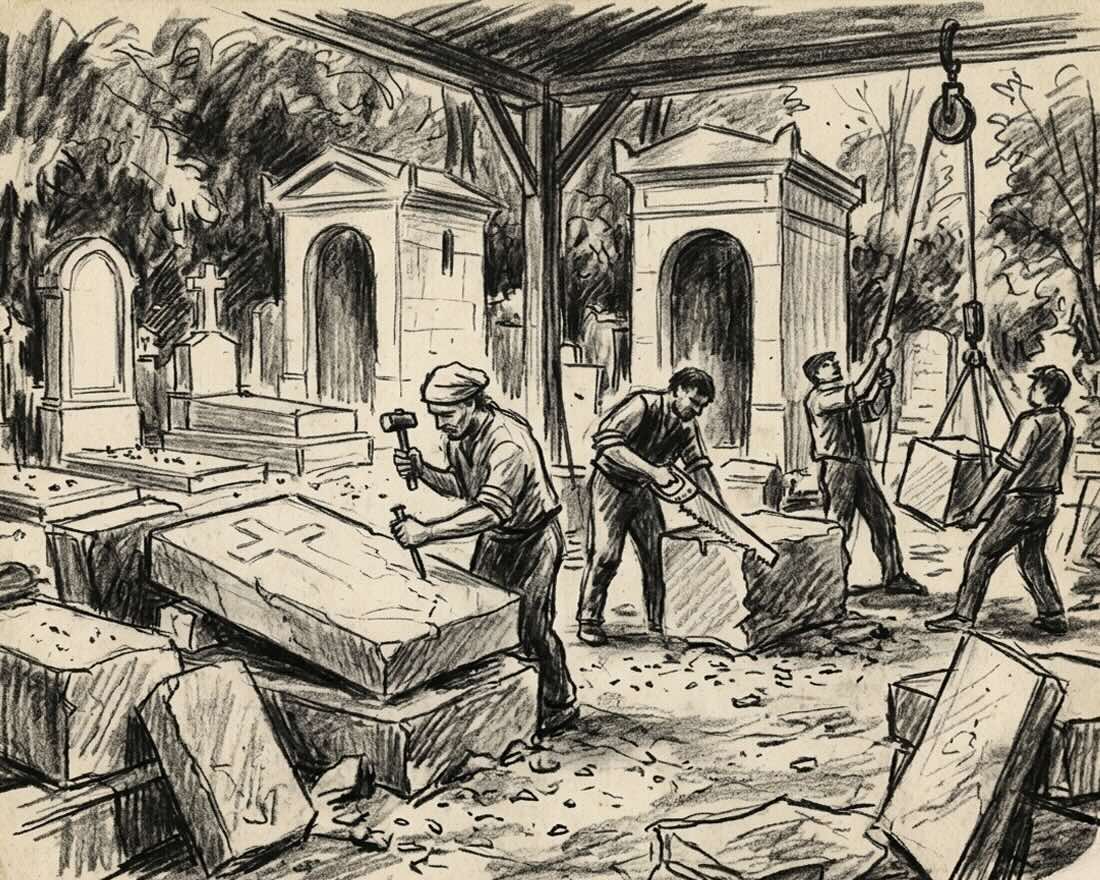
On 31 July 1910, an unusual silence, almost heavy with reproach, settled over the hills of Père-Lachaise. For the first time since this city of shadows had opened its gates, it was neither mourning, nor war, nor the onslaught of an epidemic that stilled the paths, but the dull rumble of social anger. As the summer sun bore down on the monuments, an army of unseen workers — stonemasons, builders, engravers and gardeners — decided, as one, to down tools. Paris watched, astonished, an unprecedented sight: the largest cemetery in the world lay paralysed, even as the dead, indifferent to the quarrels of the living, kept knocking at its door.
Yet this monumental crisis had its source in a detail some would call trivial. It all began when a stonemason's labourer refused to join the union, and was promptly branded a “scab.” The inter-union committee, unbending, demanded his immediate dismissal, but ran into the pride of a contractor, Monsieur Soupe, whose stinging reply set the whole affair alight: “I am the master.” In response to this affront, the site's thirty-three contractors declared a general lockout; from then on, not a single chisel touched stone, and the cemetery slid into tragic farce.
Even in the kingdom of shadows, work can stop.
The situation quickly turned surreal. Since the dead cannot wait, the City resolved to call in army combat engineers. Under the anxious gaze of grieving families, uniformed soldiers seized shovels to dig graves in haste, while lines of police patrolled among the tombs to smother any hint of unrest. This sanctuary of quiet reflection took on the look of an occupied zone, its abandoned worksites the very face of chaos: here a chapel stood corseted in scaffolding; there an epitaph broke off abruptly, leaving a dead man's name hanging unfinished, like a silent cry in the limestone.
This 1910 episode serves as a reminder of a truth the poetry of the place often tends to obscure. Behind the melancholy of the weeping willows lies a genuine industry, with its own hierarchies, class struggles and demands of production. By downing tools, these craftsmen of grief proved that Père-Lachaise was not only a sacred temple but a Belle Époque factory, where death too was a form of labour. They remind us that, amid prayer and marble, working life keeps its rights — for even in the kingdom of shadows, work can stop.
On 31 July 1910, the cemetery's marble-cutters, masons, engravers and gardeners stopped work. The site's 33 contractors responded with a general lockout: not a single stone was cut, and burials ground to a halt.
The history of Père-LachaiseFar more than gravediggers: marble-cutters, engravers, masons and gardeners maintain 44 hectares and tens of thousands of monuments. This is a working cemetery, not a frozen heritage site.
Plan your visitTwice, for opposite reasons. In May 1871, government troops crushed the last fighters of the Commune at the Communards' Wall. In 1910, the City had to call in army engineers to keep digging the graves.
The Communards' WallIt is one of the most politically charged places in Paris. The Communards' Wall, the monuments to deportees and the graves of working-class figures such as Eugène Pottier, author of The Internationale, keep it a living site of commemoration.
Free plots