The Dragon's Tomb (Antoine de GUILLAUME-LAGRANGE)
See onthe map
Non-commissioned officer, 16th Dragoon Regiment.
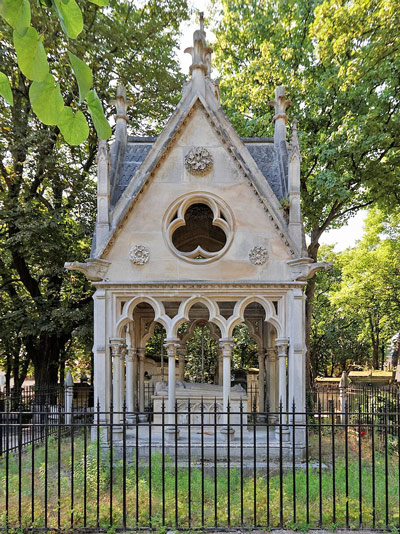
Antoine de Guillaume-Lagrange, a non-commissioned officer in the 16th Dragoon Regiment and an only son, was killed in Poland on 4 February 1807, aged twenty-five and a half. His body stayed there. His mother had the cemetery's first sculpture raised in Paris around 1809 — and had carved on it everything she knew of his death, down to his last words: “Ma mère ! ma pauvre mère !” — my mother, my poor mother.
The story
Antoine de Guillaume-Lagrange, born at Orléans, a non-commissioned officer in the 16th dragoons, fought at Austerlitz, at Jena, at Erfurt and at Spandau. He died in Poland on 4 February 1807, during the Empire's campaign against Russia and Prussia. His stone calls him “aged 25 years and 6 months.”
His body stayed where it fell. It was his mother who had the monument raised, about 1809, in a grove of the cemetery opened five years earlier: a grave with no body in it, and the first sculpture at Père-Lachaise. It is the work of Étienne-Hippolyte Godde, later the architect of the City of Paris.
The front face holds everything: his medallion under a laurel wreath, a sabre and a carbine carved on either side of the text, a draped woman collapsed at the foot of the stone, and the Latin epitaph STA VIATOR HEROEM VIDES — stop, traveller, you are looking at a hero.
On the back, his mother had the story of his death cut into the stone: at the entrance to a village, at a dangerous crossing, someone asked who would go first; he shouted “C'est moi”, it is I, rode forward, and a bullet went through his heart. His last words are cut there too: “Ma mère ! ma pauvre mère !” — my mother, my poor mother.
The grove, in Division 29, took the name of the bosquet du Dragon, the dragoon's grove, and the path beside it became the chemin du Dragon. Under the restored Bourbons the place served as a quiet meeting point for those who missed the Empire, so much so that the authorities rerouted the paths and put up railings to break up the visits. The monument was listed as a historic monument in 1983.
The grave
A stele raised by the dead man's mother, and the cemetery's first sculpture: it is by the architect Étienne-Hippolyte Godde, born the same year as he was. The front face carries the young man's medallion under a laurel wreath, a sabre and a carbine carved on either side, a draped woman collapsed at its foot, and the Latin epitaph STA VIATOR HEROEM VIDES — stop, traveller, you behold a hero. On the back, a long French text written by his mother tells how he died at the entrance to a Polish village: they asked who would go first, he answered “C'est moi”, and a bullet went through his heart. The body stayed in Poland; the monument, listed since 1983, gave its name to the Dragon grove and to the chemin du Dragon.
On site, do not miss
Everything is on the front face: the medallion under its laurel wreath, the sabre and the carbine carved on either side of the text, and at the foot a draped woman, kneeling, her face hidden. Walk round behind to read what his mother had carved there. Then look at the name of the path — chemin du Dragon: it was this monument that named it.
Visitors' questions
Where is the Dragon's Tomb?
In Division 29, chemin du Dragon, fifth row — the path takes its name from the monument, not the other way round. The Division is also that of Marshal Ney, the diplomat Caulaincourt and Claude Chappe. The monument, raised around 1809, has been a listed historical monument since 1983.
Marshal NeyWhat does the epitaph on the Dragon's Tomb say?
STA VIATOR HEROEM VIDES: “stay, traveller, you look upon a hero”. Those three words are carved on the front face, above a mother's tribute to her only son. The back carries a quite different text, long and in French, in which she tells how he died and quotes his last words.
Benjamin ConstantIs the body really in the Dragon's Tomb?
No. Antoine de Guillaume-Lagrange died in Poland on 4 February 1807 and stayed there: the Paris monument is a cenotaph, like those of Murat, Monge and Maria Callas. His mother, who would never see his body again, had his death carved into the stone for want of being able to bury him.
Joachim MuratWhy did the Bonapartists gather there?
Because after 1815 they needed somewhere to salute the Empire without saying so. The Dragon's grove served that purpose, until the authorities redrew the neighbouring paths and put up railings to break up the gatherings. The grove and the chemin du Dragon have kept the name.
Armand de CaulaincourtAudio guide to Père Lachaise: the best unusual guided tour!
Discover the secrets of the most astonishing tombs
the audio guidefrom€6.99