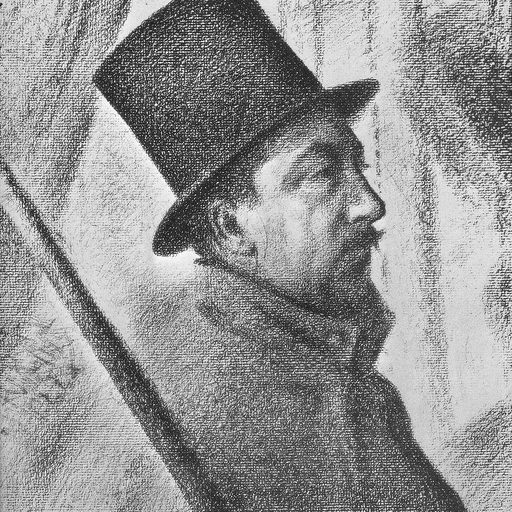
Signac met Seurat in 1884 and founded divisionism with him: touches of pure colour, laid down separately, which the eye takes charge of blending. After Seurat's death, he became its theorist: his book of 1899 served as a manifesto, and it was through him that Matisse and the Fauves discovered free colour. As much a sailor as a painter, he owned thirty-two boats and painted the coasts from the water.
The story
Paul Signac was born in Paris on 11 November 1863. He met Georges Seurat in 1884 and built Divisionism with him: pure colour laid down in separate touches that the eye puts back together. Seurat died in 1891; Signac became the theorist of it.
“From Eugène Delacroix to Neo-Impressionism”, published in 1899, is the manifesto of the movement — the book through which Matisse and the Fauves came to free colour.
He was a sailor as much as a painter. He owned thirty-two boats over the course of his life and painted the coasts from the water: Saint-Tropez, Collioure, Brittany, Venice. His watercolours were made at anchor.
President of the Société des Artistes Indépendants from 1908, he held the door open there until his death twenty-seven years later: no jury, no prizes — his was the show where young painters got their wall.
He died in Paris on 15 August 1935. His granddaughter Françoise Cachin, who died in 2011, lies with him: she was the first director of the Musée d'Orsay, where her grandfather's canvases hang, before she went on to run the museums of France — and she was also the granddaughter of Marcel Cachin, in Division 97.
The grave
A family grave, under the heading “Famille Signac”, whose interest lies in the sequence of its three inscriptions: “Paul Signac, 1863-1935”, “Ginette Cachin-Signac, 1913-1980”, his daughter, and “Françoise Cachin, 1936-2011” — his granddaughter, first director of the Musée d'Orsay, where her grandfather's canvases hang. The name Cachin also links this grave to that of Marcel Cachin, in Division 97: Françoise was the granddaughter of both men.
On site, do not miss
Three generations on the same stone: the painter, his daughter, and the founding director of the Musée d'Orsay.
Visitors' questions
Where is Paul Signac's grave?
In Division 67, chemin d'Ornano, third row, in the upper part of the cemetery — the Division of Louis Blanc, and the path of Alphand's bust. The grave brings together three generations of the family.
Louis BlancWhat was his connection with Seurat?
Together they built divisionism from 1884 onwards: pure colour laid in separate touches, which the eye recomposes. After Seurat's death in 1891, Signac became its theorist and its spokesman.
Georges SeuratWho is Françoise Cachin?
His granddaughter, who died in 2011 and is buried with him: she ran the museums of France and founded the Musée d'Orsay, where her grandfather's canvases hang. She was also the granddaughter of Marcel Cachin.
Marcel CachinWas he really a sailor?
He owned thirty-two boats over the course of his life and painted the coasts from the water — Saint-Tropez, Collioure, Brittany, Venice. His watercolours were done at anchor, which explains their low framing on the horizon.
Gustave CaillebotteAudio guide to Père Lachaise: the best unusual guided tour!
Discover the secrets of the most astonishing tombs
the audio guidefrom€6.99