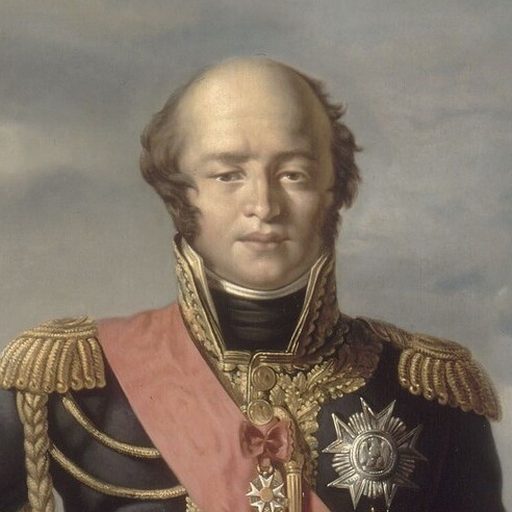
On 14 October 1806, at Auerstaedt, he faced a Prussian army of sixty-three thousand with twenty-six thousand men, and won — Napoleon at first refused to believe the report. The only Marshal of the Empire never to have been beaten, he passed for the only one the Empire had not made rich.
The story
Born on 10 May 1770 at Annoux, in Burgundy, into a minor military nobility without money, Davout left the École militaire in Paris in February 1788, a cavalry second lieutenant, a year before the Revolution. His fellow cadets found him dry and methodical; Bonaparte, who took him to Egypt, saw a guarantee in it.
On 14 October 1806, at Auerstedt, he faced the bulk of the Prussian army, sixty-three thousand men, with twenty-six thousand. He beat them. Napoleon, fighting the battle of Jena the same day, at first refused to believe the report. Duke of Auerstedt in 1808, Prince of Eckmühl in 1809, he governed the Grand Duchy of Warsaw in between.
The Russian campaign cost him his army: the First Corps went into Russia with seventy-two thousand men and came out of the retreat with fifteen thousand. In 1813 he shut himself up in Hamburg with forty thousand soldiers and held it for a year, refusing to give up the city before the Emperor's abdication.
Minister of War during the Hundred Days, he organised the defence of Paris after Waterloo, then paid for his loyalty with disgrace. The Restoration recalled him in the end: he was made a Peer of France in 1819. Nicknamed “the just”, he passed for the only marshal the Empire had not made rich.
He died on 1 June 1823 and lies in Division 28, chemin Masséna, second line. The Division is also that of the liberal tribunes Foy, Manuel and Béranger: the soldier of the Empire keeps company there with his political opponents.
The grave
The grave says little: “Sépulture du MARECHAL DAVOUT”, without a single battle. The only ornament is a plaque laid in 2006 for the bicentenary of Auerstaedt by the Saint-Cyr class that bears his name. The tomb is a family one: there rest also his brother-in-law, General Bonnin de la Bonninière, Comte de Beaumont (1763-1830), and his nephew General Léopold Davout, Duc d'Auerstaedt (1829-1904), whose inscription gives the dates 1820-1904.
On site, do not miss
The stone is austere, like the man: it names no victory. It is a plaque added in 2006 by a class of Saint-Cyr cadets that recalls Auerstaedt, two centuries after the battle.
Visitors' questions
Where is Marshal Davout's grave?
In Division 28, chemin Masséna, second row. The marshal (1770-1823) has rested there since June 1823, a few steps from General Foy's mausoleum and the graves of Manuel and Béranger — a Division of liberal tribunes as much as of soldiers.
General FoyWhy is Davout famous?
Because he is the only one of Napoleon's marshals never to have lost a battle. His victory at Auerstaedt on 14 October 1806, won against odds of more than two to one, remains one of the great feats of arms of the Empire.
Marshal NeyWhat is written on Marshal Davout's grave?
“Sépulture du MARECHAL DAVOUT” — grave of Marshal Davout — and not a word about his battles. A plaque was added in 2006, for the bicentenary of Auerstaedt, by the Saint-Cyr military academy class that bears his name. The marshal rests with his nephew, General Léopold Davout (1829-1904).
Marshal LefebvreWhich other marshals of the Empire rest at Père-Lachaise?
Ney, Murat, Masséna, Lefebvre, Kellermann, Grouchy and Suchet are buried here — a sizeable share of Napoleon's marshalate. Their graves are spread across Divisions 18, 28, 29 and 39, a few paths apart from one another.
André MassénaAudio guide to Père Lachaise: the best unusual guided tour!
Discover the secrets of the most astonishing tombs
the audio guidefrom€6.99