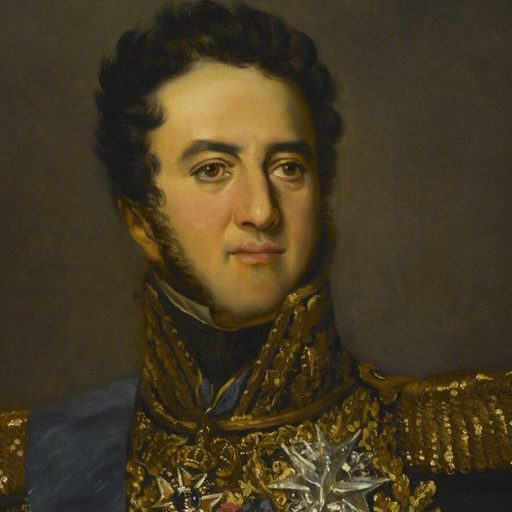
Suchet, the son of a Lyon silk merchant, first drew notice at the siege of Toulon by capturing an English general. Lodi, Rivoli, Arcole, then Marengo, Ulm, Austerlitz and Jena: Italy and the Empire did the rest. Yet it was Spain that earned him the baton, in 1811, after Saragossa, Lérida and Valencia. He is the only man Napoleon made a marshal for that theatre of war.
The story
Born in Lyons on 2 March 1770, the son of a silk merchant, Suchet enlisted in the national guard in 1791. At the siege of Toulon he captured the English general O'Hara: the Revolution noticed the second lieutenant.
The army France kept in Italy against Austria did the rest. Under Scherer, Augereau and Masséna he fought at Lodi, Rivoli, Castiglione and Arcole; general of brigade in March 1798, of division in July 1799, he fought at Marengo, then at Ulm, Austerlitz and Jena in the corps of Lannes.
Spain made him a marshal. From 1809 to 1814 he took Saragossa, Lérida, Tarragona and Valencia, won at La Albufera, and — rarer still — pacified Catalonia, which he then governed. He received the baton in July 1811: the only marshal Napoleon ever made for Spain.
Duke of Albufera in 1812, he protected Ferdinand VII in 1814, rallied to Napoleon during the Hundred Days, fell from favour until 1819, and was made a peer of France. His name is cut on the Arc de Triomphe, thirty-third column on the western side — and a recipe for poularde still carries his title.
He died near Marseilles on 3 January 1826 and rests in Division 39, on Chemin Masséna, first row, beneath one of the finest military monuments in the cemetery.
The grave
One of the finest military monuments in the cemetery, raised by the architect Louis Visconti (1791-1853). It bears a marble bust and a bas-relief by David d'Angers dated 1828 — a winged female genius holding a cannon — trophies of arms and a coat of arms by Jean-Baptiste Plantar on the reverse, and a cast-iron railing moulded with grenades, Greek helmets and inverted torches. The inscription, for its part, lists the victories in wreaths: “Maréchal SUCHET, duc d'Albufera. Saalfeld, Iéna, Pulstuk. Marcalet, Ordal. Tarragone, Sagonte, Valence.”
On site, do not miss
The bas-relief by David d'Angers: a winged female genius holding a cannon. Then the cast-iron railing, where grenades, Greek helmets and inverted torches can be read — the whole funerary vocabulary of the Empire in a single object.
Visitors' questions
Where is Marshal Suchet's grave?
In Division 39, chemin Masséna, first row, beneath a monument by Louis Visconti. The Division holds Murat's cenotaph, Cambacérès and Admiral Decrès: the military quarter of the old cemetery.
Joachim MuratWhy was Suchet made a marshal?
For Spain — and he is the only one who was. Between 1809 and 1814 he took Saragossa, Lérida, Tarragona and Valencia, won at Albufera and pacified Catalonia, which he then governed. The baton came in July 1811.
Marshal LefebvreWhat can be seen on Suchet's monument?
A marble bust and a bas-relief by David d'Angers dated 1828 — a winged female genius holding a cannon — trophies of arms by Jean-Baptiste Plantar on the reverse, and a cast-iron railing of grenades, Greek helmets and inverted torches.
David d’AngersIs Suchet's name on the Arc de Triomphe?
Yes, on the west side, thirty-third column. His title also left an unexpected trace in the kitchen: “poularde Albuféra”, a dish of chicken with rice and truffles, is named after his Spanish victory.
André MassénaAudio guide to Père Lachaise: the best unusual guided tour!
Discover the secrets of the most astonishing tombs
the audio guidefrom€6.99