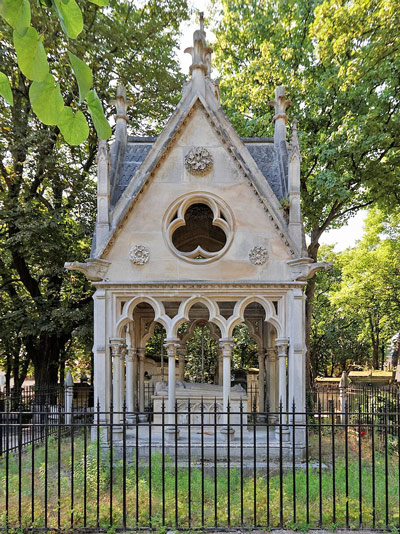
Lesurques was convicted and executed in 1796 for the attack on the Lyon mail coach, a crime he had not committed. Nothing weighed against him but a physical resemblance to the real murderer, and witnesses called upon to recognise faces they had barely glimpsed. His monument is a cenotaph, and his widow had it carved there that a human error, the most deplorable there is, had killed him.
The story
On 27 April 1796 horsemen attacked the Lyon mail coach near Lieusaint, in Seine-et-Marne. It carried the post, bills of exchange and money bound for the Army of Italy, the one Bonaparte was then leading against Austria. The postal clerk and the postilion had their throats cut and the load was carried off. The attack had been prepared: several mounted men who knew the hour of passage and the contents of the strongbox struck at a chosen point of a road the mail coaches travelled without escort. It was the money of the Republic that had just been stolen a few leagues from Paris: culprits would be needed, and quickly. Joseph Lesurques, who lived in Paris on his private income, was not on that road.
The investigation singled him out for one reason only: his physical resemblance to Dubosq, one of the true authors of the crime. The witnesses, called to identify faces glimpsed in darkness and violence, identified him. Joseph Lesurques, born in 1763, with no record and no motive, produced witnesses who swore they had seen him in Paris that day: the court set them aside. Justice in the Year IV was swift, in a Republic that dreaded brigandage and wanted examples, and its procedure offered almost no remedy against an identification by sight.
He was sentenced to death and guillotined on 30 October 1796. Dubosq was arrested in 1800 and executed the following year — which changed nothing for Lesurques. His family demanded a retrial throughout the century, and his daughter Virginie carried the petition to the Court of Cassation, which ruled it inadmissible: since Dubosq had been condemned as an accomplice and not as the principal, the conviction of Lesurques still stood in law. He was never rehabilitated. Yet in French courtrooms his name became the word for a miscarriage of justice.
The monument in Division 8 is a cenotaph: it honours a man who does not lie beneath it. Its inscription is a plea: “A la mémoire de Joseph LESURQUES, victime de la plus déplorable des erreurs humaines” — to the memory of Joseph Lesurques, victim of the most deplorable of human errors — signed “his widow and his children”. A later addition answers it: “Martyrs tous deux sur la terre, tous deux sont réunis au ciel”, martyrs both on earth, both reunited in heaven. The family never obtained from the law what it asked for; it had the verdict cut into the stone instead. There, and nowhere else, Joseph Lesurques is acquitted.
The grave
A cenotaph, a monument raised to the memory of a man who does not rest there: Père-Lachaise holds a few of them — Kucharski, the Duke of Massa, the Duchess of Mazarin and Marshal Sérurier. The inscription is a carved plea: “A la mémoire de, Joseph LESURQUES, victime de la plus déplorable des erreurs humaines, 31 oct. 1796, sa veuve et ses enfants.” — To the memory of Joseph Lesurques, victim of the most deplorable of human errors, 31 Oct. 1796, his widow and his children. A later addition answers it: “Martyrs tous deux sur la terre, tous deux sont réunis au ciel.” — Both martyrs on earth, both are reunited in heaven. The date carved — 31 October — differs by one day from that of the execution.
On site, do not miss
It is a cenotaph: a monument with no body under it. Read the inscription: “victime de la plus déplorable des erreurs humaines” — victim of the most deplorable of human errors — signed by his widow and his children.
Visitors' questions
Where is Joseph Lesurques's monument?
In Division 8 of Père-Lachaise — but it is a cenotaph: the monument honours a man who does not lie beneath it. Our entries record others: Kucharski, the Duke of Massa, the Duchess of Mazarin, Marshal Sérurier. The monument was raised by his widow and his children.
Alexandre KucharskiWhat was the Courrier de Lyon affair?
The attack, in April 1796, on the Lyon mail coach near Lieusaint: the post office clerk and the postilions butchered, the mail and the cash consigned to the Army of Italy carried off. One of the loudest criminal cases of the Directory.
Pierre Louis DulongWhy was he convicted?
On nothing but his physical likeness to Dubosq, the real murderer. The witnesses, asked to pick out faces glimpsed in the middle of violence, pointed to him. His protests and the evidence in his favour were brushed aside.
Christine PascalWas his name ever cleared?
The mistake was admitted after Dubosq was arrested, years afterwards — too late for Lesurques, guillotined on 30 October 1796. The case is still one of the most cited in French law on mistaken identification.
Pierre HaïkAudio guide to Père Lachaise: the best unusual guided tour!
Discover the secrets of the most astonishing tombs
the audio guidefrom€6.99