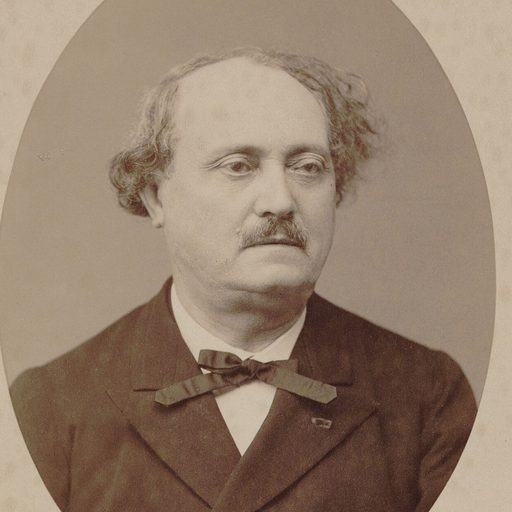
Beethoven's last quartets passed in France for unplayable. The quartet he founded around 1855 was the first to perform them regularly, and he taught at the Paris Conservatoire. His stone bears no title: “A Pierre MAURIN. Ses amis, ses admirateurs.” — to Pierre Maurin, his friends, his admirers.
The story
Beethoven's quartets, and above all the last ones, passed in France for unplayable and incomprehensible. The violinist Pierre Maurin set out to have them heard regularly: a work of teaching as much as of music — Habeneck's with the orchestra, Maurin's in chamber music.
Born in 1822, he founded in 1852 with the cellist Pierre Chevillard the Société des derniers quatuors de Beethoven — the Maurin-Chevillard quartet — and led it until his death. In 1875 he succeeded Delphin Alard as professor of violin at the Paris Conservatoire, where he taught Lucien Capet.
He died in 1894. The City granted him a free plot the following year, and his stone in Division 33 carries no title at all: “A Pierre MAURIN, 1822-1894. Ses amis, ses admirateurs.” He lies there beside General Lejeune, whose epitaph runs to a single word.
On site, do not miss
Division 33 is worth the visit for the neighbouring grave of General Lejeune, whose epitaph is a single word.
Visitors' questions
Where is Pierre Maurin's grave?
In Division 33, avenue Circulaire, first row, not far from General Lejeune, whose epitaph is a single word. He died in 1894, at seventy-two.
Louis François LejeuneWhat did he found?
The Société des derniers quatuors de Beethoven, in 1852, with the cellist Pierre Chevillard — the Maurin-Chevillard quartet, the first in France to make a case for Beethoven, at a time when those works passed for unplayable. He led it until his death.
Ginette NeveuWhy was Beethoven a battleground?
Because his quartets, the late ones above all, passed in France for unintelligible. Playing them regularly was as much teaching as music-making — Habeneck's work in the orchestra, Maurin's in the chamber repertoire.
François-Antoine HabeneckWhy two different forenames?
His forename appears in two forms, “Jean-Pierre” and “Pierre (Jean)”: it is the same man, the order of the names having varied from one record to the next.
Ivry GitlisAudio guide to Père Lachaise: the best unusual guided tour!
Discover the secrets of the most astonishing tombs
the audio guidefrom€6.99