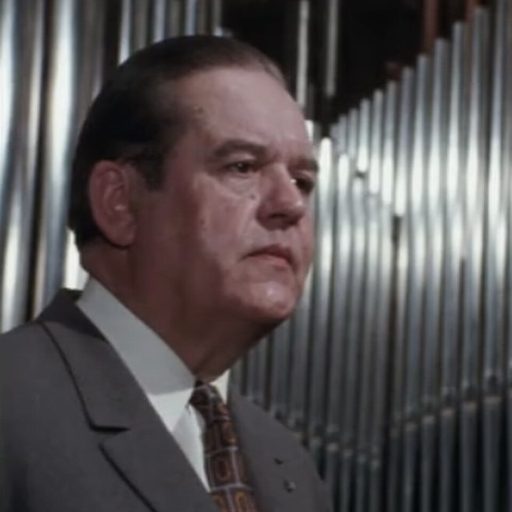
Organist, composer — and an architect with a diploma from the Beaux-Arts in 1941: two complete trainings pursued in parallel. Titular organist of the great organ of Saint-Sulpice after Marcel Dupré, Jean-Jacques Grunenwald was the first in the world to record the complete organ works of Bach.
The story
Jean-Jacques Grunenwald carried two trainings at once. First prize for organ at the Conservatoire in 1935 in Marcel Dupré's class, first prize for composition in 1937, second Grand Prix de Rome — and, in 1941, a diploma in architecture from the École nationale des beaux-arts. Few musicians of the century did as much.
Born at Cran-Gevrier, in Haute-Savoie, on 2 February 1911, he made between 1957 and 1962, at Soissons cathedral, the first complete recording in the world of Bach's organ works: some two hundred pieces, five years of work. Nobody had done it before him.
A professor at the Schola Cantorum and then at the Geneva Conservatoire, he gave more than fifteen hundred recitals and signed the score of Monsieur Vincent in 1947. In January 1973 he succeeded his own teacher, Marcel Dupré, as organist of the great organ of Saint-Sulpice.
He died on 19 December 1982. The plaque in Division 71 lists the titles in the order in which he claimed them — composer, organist of the great organ, two decorations. The architect is not on it, nor is the Soissons recording.
The grave
A family tomb bearing a plaque in his name: “Jean-Jacques GRUNENWALD, compositeur de Musique, Titulaire du G.O de St Sulpice à Paris, chevalier de la Légion d'Honneur, chevalier du Mérite, 1911-1982.” — composer, titular organist of the great organ of Saint-Sulpice in Paris, Knight of the Legion of Honour, Knight of the Order of Merit. The architect with a Beaux-Arts diploma is not mentioned, nor is the complete Bach recorded at Soissons. Two other men rest there: the printer François Antoine Appel (1821-1882) and the surgeon Maurice Virenque (1888-1949).
On site, do not miss
The plaque lists the titles in the order he claimed them: “compositeur de Musique, Titulaire du G.O de St Sulpice, chevalier de la Légion d'Honneur, chevalier du Mérite” — composer, titular organist of the great organ of Saint-Sulpice, Knight of the Legion of Honour, Knight of the Order of Merit. The architect is not there.
Visitors' questions
Where is Jean-Jacques Grunenwald's grave?
In Division 71, allée Circulaire, first row, in a family grave that also holds the printer François Antoine Appel (1821-1882) and the surgeon Maurice Virenque. A plaque carries his titles.
Albert GrisarWas Grunenwald an architect too?
He was, qualifying from the École des Beaux-Arts in 1941 — a second full training carried on alongside music. Few musicians of the century practised two professions at that level; his funerary plaque, even so, mentions only the music.
Jacques-Martin TétazWhat did he record at Soissons?
The complete organ works of Johann Sebastian Bach, from 1957 to 1962, in Soissons cathedral: the first complete recording by a French organist. Some two hundred pieces, twenty-four discs and five years of work.
The crematorium and the columbariumWho preceded Grunenwald at Saint-Sulpice?
Marcel Dupré, his own professor at the Conservatoire, whom he succeeded in January 1973. The Saint-Sulpice loft had been held before them by Widor and, in the nineteenth century, by Lefébure-Wély, who rests in Division 4 of the same cemetery.
Lefébure-WélyAudio guide to Père Lachaise: the best unusual guided tour!
Discover the secrets of the most astonishing tombs
the audio guidefrom€6.99