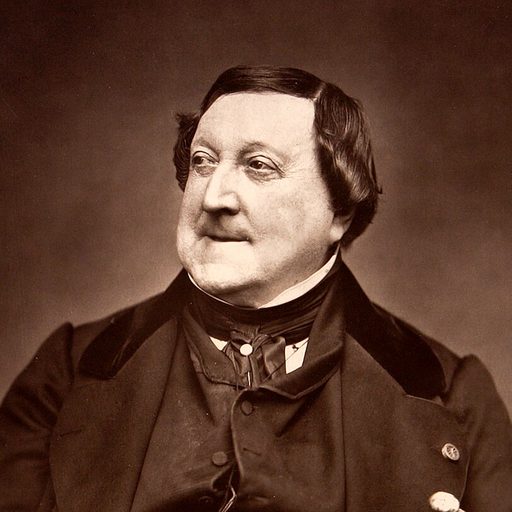
Thirty-nine operas, then silence: after “William Tell”, he stopped writing for the stage for thirty-nine years that no explanation ever cleared up. His Parisian chapel stands empty since 1 May 1887: Italy claimed its composer, transferred to Santa Croce in Florence.
The story
Gioachino Rossini was born in Pesaro on 29 February 1792. Between 1806 and 1829 he wrote thirty-nine operas — “The Barber of Seville” in 1816, “William Tell” in 1829 — and dominated the European stage as nobody had before him.
Director of the Théâtre-Italien in Paris and first composer to King Charles X in 1825, he stopped dead after “William Tell”: thirty-nine years of retirement, begun at thirty-seven, for which no explanation has ever quite convinced. He still wrote a few sacred pieces and his “Sins of Old Age”.
He died at Passy on 13 November 1868. His fortune, a very large one, went first to his widow and then, in the main, to his native Pesaro, which founded a music school with it; a share paid for a home in Paris for old musicians.
His chapel was built in Division 4 by the architect Charles Doussault. But Italy wanted its composer back: on 1 May 1887 his body was moved to the church of Santa Croce in Florence, the Italian national pantheon, where Michelangelo and Galileo lie.
What remains in Division 4 is a chapel without its dead man. Olympe Pélissier, his second wife, who died in 1878, lies there alone — and the inscription now carries no more than two names.
The grave
The chapel is the work of the architect Charles Doussault, with two oil lamps set on pedestals before the entrance. It is empty of its dead since 1 May 1887: Italy claimed Rossini, and his remains rest since then in the church of Santa Croce in Florence, beside Michelangelo and Galileo. The inscription still bears the composer's name, “ROSSINI”, followed by that of his second wife, “Mme Olympe Rossini, born 20 Floréal Year VII, died 22 March 1878” — Olympe Pélissier is today the only one resting there. It is the fourth cenotaph in the cemetery described in this guide, after Andranik, Bellini and Maria Callas.
On site, do not miss
The two oil lamps on their pedestals before the chapel — and, inside, a single name that still counts: his wife's.
Visitors' questions
Where is Rossini's grave?
In Division 4, avenue Principale, first row — the same path as Colette, Musset and Félix Faure. But it is a cenotaph: the composer's body left for Florence on 1 May 1887, and the chapel stayed behind.
Alfred de MussetIs Rossini's body still there?
No. It was moved on 1 May 1887 to the church of Santa Croce in Florence, Italy's national pantheon, where Michelangelo and Galileo lie. His Paris chapel now holds only his wife, Olympe Pélissier.
Vincenzo BelliniWhy did he stop composing?
Nobody has ever explained it convincingly. After “William Tell” in 1829, at the age of thirty-seven, he fell silent for thirty-nine years, writing nothing more than a few sacred pieces and his “Péchés de vieillesse” — the “Sins of Old Age”.
Luigi CherubiniWho inherited his fortune?
Mostly the City of Paris, to fund a home for elderly musicians. The bequest sits alongside that of Marietta Alboni, who endowed hospice beds and savings books for Parisian schoolchildren.
Marietta AlboniAudio guide to Père Lachaise: the best unusual guided tour!
Discover the secrets of the most astonishing tombs
the audio guidefrom€6.99