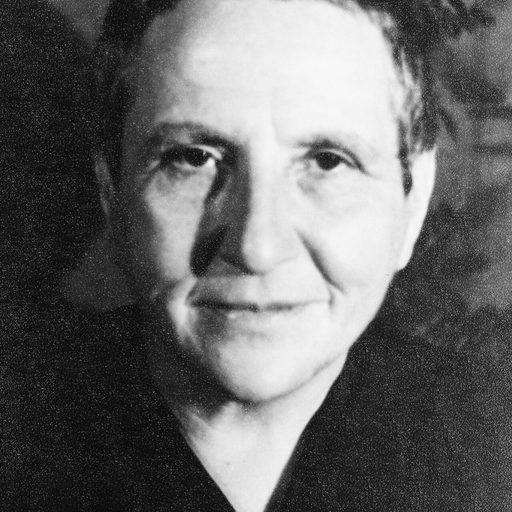
Gertrude Stein settled in Paris in 1903, on the rue de Fleurus, and bought what nobody wanted: Cézanne, Matisse, Picasso, who painted her portrait in 1906. Her salon became the first place where modern art could be seen. It was to Hemingway that she threw the phrase “a lost generation”. On the front of her stone, carved in English, her name stands alone: that of Alice Toklas, her companion for thirty-nine years, is on the back.
The story
Gertrude Stein was born at Allegheny, near Pittsburgh, on 3 February 1874. She settled in Paris in 1903 with her brother Leo, at 27 rue de Fleurus, and from 1904 they bought what nobody else would: Cézanne, Matisse, Picasso.
Their salon became the place where modern art could be seen before it reached the museums. Picasso painted Gertrude Stein's portrait there in 1906; she defended the Cubists while the critics still took them for practical jokers.
After the First World War the young Americans of Paris all came through her rooms — Hemingway, Fitzgerald. It was to Hemingway that she threw the phrase posterity kept: a lost generation — which he, in his memoirs, says she had from her garage owner.
Her own writing is more radical than her reputation as a discoverer suggests: repetition, syntax taken apart, narrative refused. “The Autobiography of Alice B. Toklas”, in 1933 — her own life told under her companion's name — was her one public success.
She died on 27 July 1946 at Neuilly-sur-Seine, of stomach cancer. Alice Toklas, her companion since 1907, outlived her by twenty-one years and joined her in 1967: her name is carved on the back of the stone, in Division 94, the Stein family having refused to have it on the front.
The grave
A stele carved in English, which is rare at Père-Lachaise, and which bears only one name on its front: “Gertrude Stein, Alipghany 3 February 1874 – Paris 29 July 1946”. The birthplace is written “Alipghany” for Allegheny, the district of Pittsburgh where she was born, and the date of death is given as 29 July when she died on the 27th, at Neuilly-sur-Seine. Alice B. Toklas's name is on the back: she had asked for it to be there, the Stein family having refused the front. Her inscription shifts from English to French: “San Francisco April 30 1877, Paris 7 mars 1967”.
On site, do not miss
Walk round the stone: Alice B. Toklas's name is carved on the back, with her cities and her dates — “San Francisco April 30 1877, Paris 7 mars 1967”, English and then French. On the front, Gertrude Stein's date of death is two days out.
Visitors' questions
Where is Gertrude Stein's grave?
In Division 94, avenue Circulaire, first row, in the upper part of the cemetery — the Division of Zénobe Gramme's statue and Andranik's equestrian cenotaph. The stele is carved in English, and Alice B. Toklas's name is read on the back of the stone.
Zénobe GrammeWho was Alice B. Toklas?
Her companion for thirty-nine years, from 1907 to Gertrude Stein's death in 1946. Alice Toklas outlived her by twenty-one years and joined her in the grave in 1967: her name is carved on the back of the stone, the Stein family having refused to have it on the front.
Rosa BonheurWhat was the salon in the rue de Fleurus?
The place where modern art was seen before it entered the museums: at 27 rue de Fleurus, Gertrude Stein and her brother Leo hung Cézanne, Matisse and Picasso from 1904, when nobody was buying them. Picasso painted her portrait there in 1906.
Marie LaurencinDid she coin the “lost generation”?
She threw it at Hemingway to describe the young Americans of post-war Paris, and he used it as the epigraph of “The Sun Also Rises”. Hemingway relates, however, in “A Moveable Feast”, that she had it from her garage owner: the phrase went round the world under Stein's name.
AlainAudio guide to Père Lachaise: the best unusual guided tour!
Discover the secrets of the most astonishing tombs
the audio guidefrom€6.99