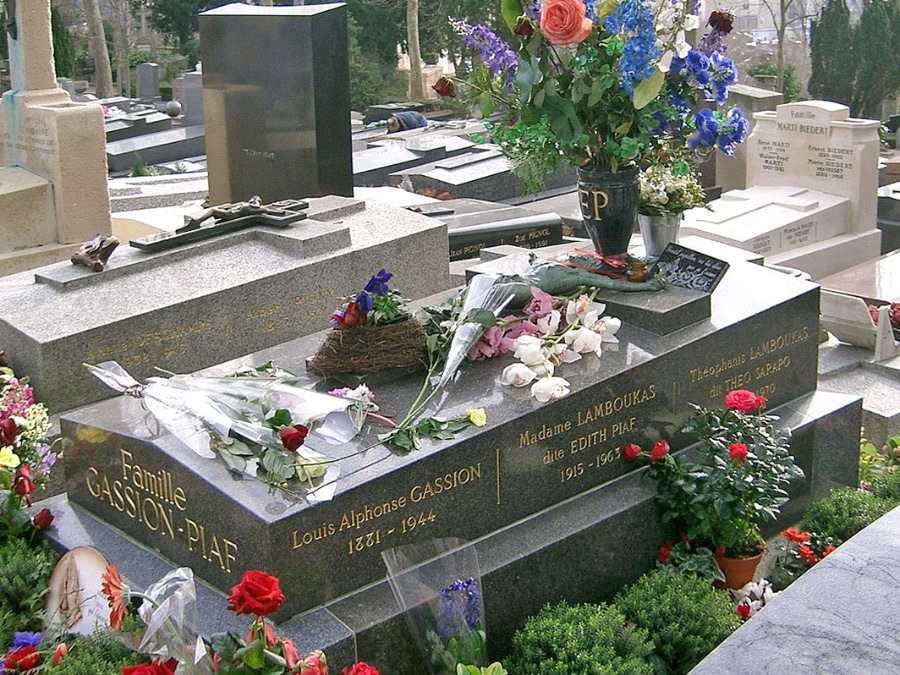
The Church refused her a Mass; her funeral procession set off a crush of mourners. Dead at Plascassier on 10 October 1963, she was brought back discreetly to Paris so that her death could be registered there: it became official only the next day, the day Cocteau died. The stone bears only “Famille Gassion-Piaf”.
The story
Legend has her born on the pavement of 72 rue de Belleville, under a street lamp. She was born in the Tenon hospital, in the twentieth arrondissement, on 19 December 1915 — an ordinary birth for a childhood that was anything but. She sang first in the street, beside her contortionist father.
Late in 1935 Louis Leplée, who ran the cabaret Le Gerny's, asked her to sing and found her a stage name: “la Môme Piaf”, the sparrow kid. Maurice Chevalier applauded her from the room. A few months later Leplée was murdered; Édith was questioned by the police and the tabloids feasted on it. She was twenty, and her career already read like a crime column.
On 28 October 1949 Marcel Cerdan died when his plane came down over the Azores. She had premiered the Hymne à l'amour in New York a few weeks earlier, written for him: the song became his tomb. Thirteen years later, in October 1962, she married Théo Sarapo, twenty years her junior, to the sniggering of the press.
She died on 10 October 1963 at Plascassier, near Grasse, at forty-seven. Her body was brought back discreetly to Paris so that the death could be registered in her own city: it became official only on the 11th, the day Jean Cocteau died. The Church refused her a funeral mass on account of her private life.
It changed nothing. The cortège set off a crush in which every social origin was mixed together. She lies with her father Louis Gassion, her daughter Marcelle — dead at two — and Théo Sarapo, killed in a car crash in 1970. The Friends of the cemetery are categorical: the star of Père-Lachaise is not Jim Morrison. It is her.
The grave
A dark stone, adorned with a bas-relief of Christ on the cross, on the axis of the third transverse avenue. No sculptor is attached to it: what this grave offers to be read are its four names — “Famille GASSION-PIAF”; Marcelle Dupont (1933-1935), the daughter who died at two; Louis Alphonse Gassion (1881-1944), the contortionist father; “Madame Lamboukas, known as Édith Piaf”; and Théophanis Lamboukas, known as Théo Sarapo, the last husband, who died seven years after her. The plaques and notes from admirers are endlessly renewed.
On site, do not miss
The black slab forever covered in flowers and messages, and the small crucifix left by visitors.
Visitors' questions
Where is Édith Piaf's grave?
In Division 97, in the upper, eastern part of the cemetery. From the main entrance, allow a good twenty minutes of uphill walking.
Frank AlamoWho is buried with Édith Piaf?
Her father Louis Gassion, her daughter Marcelle who died at two, and her second husband Théo Sarapo. The stone bears the inscription “Famille Gassion-Piaf”.
Alain BashungUnder what name should visitors look for the grave?
Under the family name Gassion: Édith Piaf was a stage name. That is why many visitors walk right past it without noticing.
Gilbert BécaudWhy did Piaf not have a religious funeral?
The Catholic Church refused her a funeral mass because of her private life. That stopped nothing: her funeral procession drew such a crowd at Père-Lachaise that every social background mingled together.
Jean-Baptiste ClémentAudio guide to Père Lachaise: the best unusual guided tour!
Discover the secrets of the most astonishing tombs
the audio guidefrom€6.99