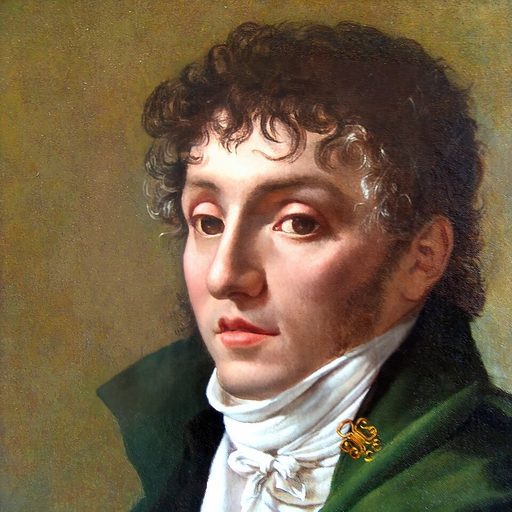
Méhul was playing the organ at ten. Once in Paris, he was noticed by Gluck, who pushed him towards the theatre, and the Revolution gave him a task: it was he who wrote the Chant du départ, the Republic's second anthem, sung as much as the Marseillaise under the Directory. In 1795 an academy of the Institut opened its doors to him, the first time for a musician. His four symphonies were rediscovered much later.
The story
Étienne-Nicolas Méhul was born at Givet, in the Ardennes, on 22 June 1763. An early musician, deputy organist at ten, he came up to Paris, where Gluck noticed him and pressed him to write for the stage.
The Revolution gave him an official role. He wrote anthems for the national festivals, among them the “Chant du départ”, on lines by Marie-Joseph Chénier — the second anthem of the Republic, sung as widely as the Marseillaise under the Directory and the Empire. Chénier lies in Division 8.
In 1795 he was the first musician elected to the Institut: music entered with him the class that would become the Academy of Fine Arts.
He wrote more than thirty operas — “Ariodant”, “Le Jeune Henri”, and “Joseph”, which took the 1807 prize for the best lyric work — along with four symphonies in which one hears Mozart and already Beethoven, long forgotten before they were found again.
He died of tuberculosis in the rue de Montholon on 10 October 1817, at fifty-four. His pupils raised him a column in Division 13, dated 29 November — the day after the first performance of “Valentine de Milan”, the opera he had left unfinished and which his nephew Daussoigne completed and staged on 28 November 1822.
The grave
A column topped by an engraved lyre, by an unknown hand, on a perpetual plot maintained free of charge by the City of Paris. The inscription gives the civil status and the office — “Etienne Méhul, 1763-1817, membre de l'Institut” — but the essential is in a laurel wreath, where his pupils had the date of their tribute engraved: “Ses élèves, le 29 novembre 1822, lendemain de la 1ʳᵉ représentation de Valentine de Milan” — his pupils, 29 November 1822, the day after the first performance of Valentine de Milan. Five years after his death, they waited for the premiere of his unfinished opera to give him a monument.
On site, do not miss
The lyre engraved at the top of the column, and the dedication from his pupils in its laurel wreath, dated 29 November 1822.
Visitors' questions
Where is Méhul's grave?
In Division 13, Chemin Méhul, second row — the alley bears his name, and it is the division of Casimir Périer's mausoleum and Alain Bashung's grave. A column topped by an engraved lyre marks it.
Casimir PérierWhat is the “Chant du départ”?
The second anthem of the Revolution, composed by Méhul to verses by Marie-Joseph Chénier, and sung as often as the Marseillaise under the Directory and the Empire. Chénier rests in Division 8 of the same cemetery.
François-Joseph GossecWho raised his monument?
His pupils, on 29 November 1822, five years after his death — and precisely the day after the first performance of “Valentine de Milan”, the opera he had left unfinished. The inscription says so, inside a laurel wreath.
André GrétryWhat else did he compose?
More than thirty operas, including “Ariodant”, “Le Jeune Henri” and “Joseph”, awarded a prize in 1807 as the best lyric work, and four long-forgotten symphonies in which one hears Mozart and, already, Beethoven.
Luigi CherubiniAudio guide to Père Lachaise: the best unusual guided tour!
Discover the secrets of the most astonishing tombs
the audio guidefrom€6.99