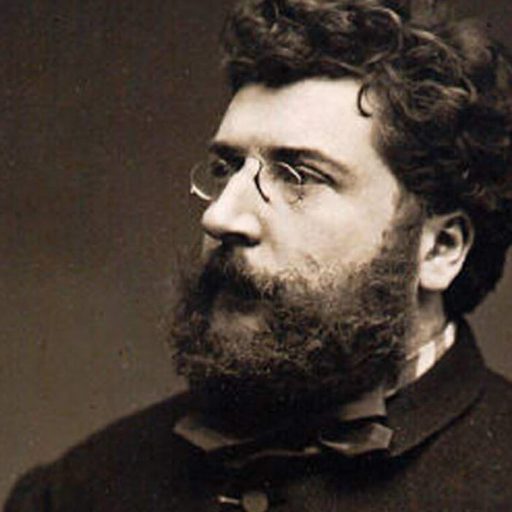
Georges Bizet entered the Conservatoire at nine and won the Grand Prix de Rome in 1857, the very year he tied with Charles Lecocq in an operetta competition. Berlioz hailed his Pearl Fishers in 1863. He married his teacher's daughter, and their son would count among the intimates of Marcel Proust. Six opera titles are engraved on the sides of his monument, Carmen last.
The story
Alexandre César Léopold Bizet was born on 25 October 1838 in the rue de la Tour d'Auvergne in Paris, and was not christened “Georges” until March 1840. He entered the Conservatoire at nine. In 1857 his operetta “Le Docteur Miracle” tied with Charles Lecocq's for Offenbach's prize, and that same year he took the Grand Prix de Rome for composition.
“Les Pêcheurs de perles” earned him, on 8 October 1863, a warm notice from Berlioz in the Journal des débats. In 1869 he married Geneviève Halévy, his teacher's daughter; their son Jacques, born in 1872, would be among Marcel Proust's closest friends.
“L'Arlésienne”, given at the théâtre du Vaudeville on 1 October 1872, was withdrawn after twenty performances. The orchestral suite he drew from it triumphed the following month at the Concerts Pasdeloup: the public applauded the music once it was cut loose from the play, a pattern that would repeat itself with Carmen.
Carmen opened at the Opéra-Comique on 3 March 1875 — the very day Bizet was made a chevalier of the Legion of Honour. The audience was outraged by a heroine who was a working woman, free, and murdered on stage; the press spoke of obscenity, and the house emptied for the last performances.
On 29 May he swam in the icy Seine near Bougival. Acute rheumatism declared itself the next day, and cardiac complications carried the composer off in the night of 2 to 3 June 1875. He was thirty-six and believed his opera a failure; Carmen is today one of the most performed in the world.
The grave
The monument was designed by Charles Garnier, the architect of the Opéra, and bears a bronze bust signed Paul Dubois. The main face is engraved “To Georges Bizet, his family and his friends, 1838-1875”; the sides line up the titles of his works, Les Pêcheurs de perles, La Jolie Fille de Perth and Djamileh on one side, L'Arlésienne, Patrie and Carmen on the other. His son Jacques Bizet, a friend of Marcel Proust, who died on 3 November 1922, rests with him. The bust was stolen in November 2006; the culprits were arrested, and the original returned to its place at the beginning of 2025.
On site, do not miss
The bronze bust, back in its place, and the list of six operas engraved on the sides of the monument — Carmen last, on the right.
Visitors' questions
Where is Georges Bizet's grave?
In Division 68, Avenue de la Chapelle, first row, in the eastern part of the cemetery. The monument, designed by Charles Garnier, is recognisable by its bronze bust and the opera titles engraved on its sides.
Francis PoulencWhy did Carmen cause a scandal?
Because the opera, first performed on 3 March 1875, put on stage a working-class heroine, free and sensual, murdered before the audience's eyes — something the Opéra-Comique's public considered immoral. The press called it obscene.
Reynaldo HahnWhat did Bizet die of?
Cardiac complications following an attack of rheumatic fever, on the night of 2 to 3 June 1875 at Bougival. He had gone swimming in the icy Seine a few days earlier. He was thirty-six.
Édouard LaloWhat is engraved on his monument?
The titles of his works, on both sides: The Pearl Fishers, The Fair Maid of Perth and Djamileh on the left, L'Arlésienne, Patrie and Carmen on the right. The main face reads “To Georges Bizet, from his family and friends”.
Georges EnescoAudio guide to Père Lachaise: the best unusual guided tour!
Discover the secrets of the most astonishing tombs
the audio guidefrom€6.99