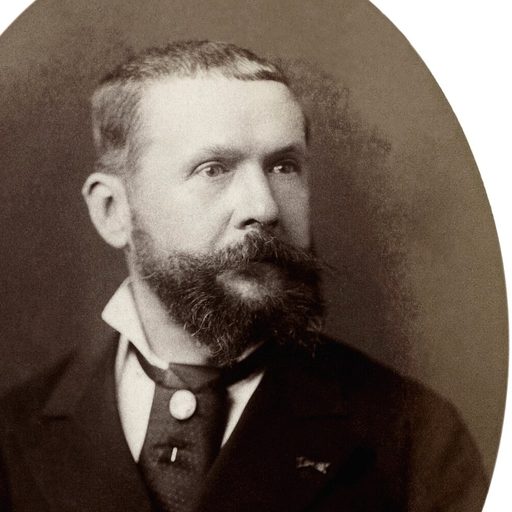
Gaston Tissandier, a chemist turned aeronaut, founded in 1873 the review La Nature, which explained the sciences to the general public. On 15 April 1875 he went up with two companions in the balloon Le Zénith to study high altitude: at eight thousand six hundred metres all three lost consciousness, and he alone woke up. He came back down almost deaf, and published the account that advanced the understanding of altitude sickness.
The story
Born in Paris on 20 November 1843, a chemist by training, Tissandier fell for ballooning and became one of the most widely read popularisers of science of his day. In 1873 he founded the review La Nature, which explained science and engineering to the general reader.
During the siege of Paris he was one of the aeronauts who left the encircled city by air: on 30 September 1870 he rose in the Céleste and came down near Dreux. It is that title — aeronaut of the siege of Paris — that he had cut first on his grave.
On 15 April 1875 he went up in the balloon Le Zénith with Joseph Crocé-Spinelli and Théodore Sivel to study the effects of high altitude. Three weeks earlier the same balloon had flown from Paris to the basin of Arcachon and set the record for duration. Past eight thousand metres the three men decided to climb further; they lost consciousness, and the barometer would record eight thousand six hundred metres.
The balloon came down at Ciron, in the Indre, about four in the afternoon: the envelope tore against a tree, the basket stayed whole. Tissandier alone came round — his two companions were dead for want of oxygen. He lost almost all his hearing, and published an account that advanced the understanding of altitude sickness.
He went on to build, with his brother Albert, an airship driven by an electric motor, which flew with men aboard for the first time on 8 October 1883 at Auteuil. He died on 30 August 1899, at fifty-five, and lies in Division 27, chemin Saint-Louis, first row, in the family grave — the same row as General Hugo, Victor's father. His companions of the Zénith lie in Division 71, under a double bronze effigy in which they hold each other's hand.
The grave
A family tomb spanning several generations of Tissandiers, in Division 27, Chemin Saint-Louis, first row, whose slab bears an engraved balloon. The epitaph chooses its titles: “Mr Gaston TISSANDIER, chevalier de la légion d'honneur, aéronaute du siège de Paris, survivant de la catastrophe du Zénith, décédé à Paris le 30 août 1899, dans sa 56ᵉ année.” — Knight of the Legion of Honour, aeronaut of the siege of Paris, survivor of the Zénith disaster, died in Paris on 30 August 1899, in his 56th year. Neither chemistry, nor the review La Nature: two balloons were enough to define a life.
On site, do not miss
The balloon engraved in the slab, and the epitaph that sums up his life in two titles: “aeronaut of the siege of Paris, survivor of the Zénith disaster”. His two companions have their monument in Division 71: a double bronze recumbent effigy in which they hold each other's hand.
Visitors' questions
Where is Gaston Tissandier's grave?
In Division 27, Chemin Saint-Louis, first row, in the Tissandier family grave: a slab engraved with a balloon. General Hugo, Victor's father, lies on the same row. The monument to his two companions of the Zénith stands in Division 71, on the Avenue Circulaire: a double bronze recumbent effigy in which they hold each other's hand.
Admiral BruatWhat happened on the flight of the Zénith in 1875?
On 15 April 1875 the three aeronauts rose beyond eight thousand metres to study high altitude, with too little oxygen aboard. They lost consciousness; the barometer, later checked at the Sorbonne, recorded eight thousand six hundred metres. The balloon came down at Ciron, in the Indre: Crocé-Spinelli and Sivel were dead, Tissandier alone survived, and remained almost deaf.
Crocé-Spinelli and SivelWhat was the journal La Nature?
A popular science journal founded by Tissandier in 1873, which made the discoveries and techniques of his day accessible to all. He was long its principal editor, alongside his ascents.
Édouard BranlyWhat is written on Tissandier's grave?
“Aéronaute du siège de Paris, survivant de la catastrophe du Zénith, décédé à Paris le 30 août 1899, dans sa 56ᵉ année” — balloonist of the siege of Paris, survivor of the Zénith disaster, died in Paris on 30 August 1899, in his 56th year. The two titles he chose both hang on balloons — not on chemistry, nor on the journal he founded.
Sophie BlanchardAudio guide to Père Lachaise: the best unusual guided tour!
Discover the secrets of the most astonishing tombs
the audio guidefrom€6.99