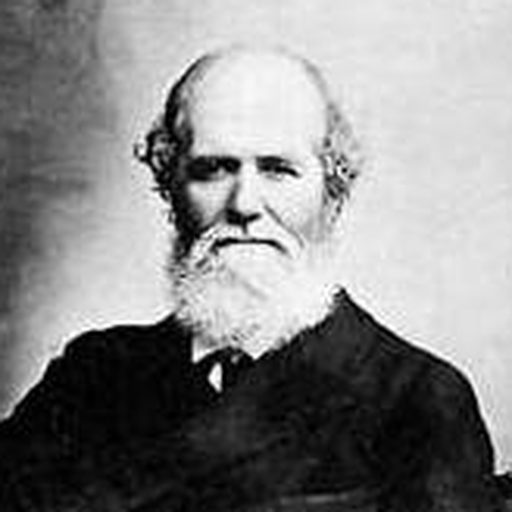
An exile of 1851 who came home with the amnesty, he became the disciple of Allan Kardec, then his successor: editor of La Revue Spirite and publisher of his works. A sensational trial sentenced him in 1875 to a year in prison for “spiritist fraud”. His epitaph answers: “Ce fut un homme de bien” — he was a good man.
The story
Born at Tulle on 2 May 1817, Pierre Gaëtan Leymarie came early to Paris. The coup d'état of 1851, by which Louis-Napoléon Bonaparte seized power, threw him onto the roads of exile with thousands of other republicans, and he returned only with the amnesty of 1859. Those eight years out of France made him a man of conviction rather than of career, trained to defend minority causes.
A great reader, he discovered the writings of Allan Kardec, the founder of spiritism, and became one of his most ardent disciples. The doctrine promised communication with the dead and presented itself not as a religion but as a science — which was enough to win over a century that believed in progress as much as in the beyond. Table-turning filled the drawing rooms of Paris at the time, and followers in France were counted in hundreds of thousands.
On Kardec's death, in 1869, Leymarie was appointed administrator of the Société spirite, then became editor-in-chief and director of La Revue Spirite, the organ of the movement. He was also the publisher of the Works of Allan Kardec: to run the review and publish the founder's books was to hold the whole doctrine — an enviable position, and therefore an exposed one.
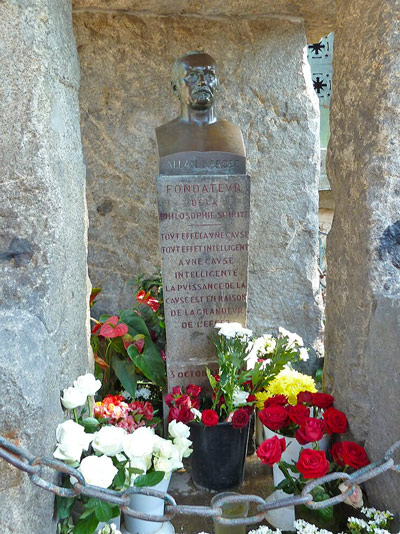
In 1875 the photographer Édouard Buguet confessed that he had manufactured false photographs of ghosts by double exposure; Leymarie, who had published them in his review, was tried alongside him for “fraud” and sentenced to a year in prison and a fine of five hundred francs. On appeal his good faith was recognised. He died in 1901 and lies in Division 70; his epitaph calls him “continuateur de son Œuvre, de 1870 à 1901”, the continuator of Kardec's work, before ending on six words: “Ce fut un homme de bien” — he was a good man. The stone gives his birth as 1827 — ten years too many.
The grave
An inscription that answers a trial: “A Pierre Gaëtan LEYMARIE, Disciple d'Allan Kardec, et continuateur de son Œuvre, de 1870 à 1901. 1827-1901. Ce fut un homme de bien.” — To Pierre Gaëtan Leymarie, disciple of Allan Kardec and continuer of his work from 1870 to 1901. 1827-1901. He was a good man. The last six words are a carved rehabilitation — twenty-six years after the conviction for “spiritist fraud”. The year of birth, 1827, is exact: Leymarie was born at Tulle on 2 May of that year.
On site, do not miss
The epitaph ends with a rare formula: “Ce fut un homme de bien” — he was a good man — a posthumous reply to the conviction of 1875. Note the year carved: 1827, when he was born in 1817.
Visitors' questions
Where is Gaëtan Leymarie's grave?
In Division 70 of Père-Lachaise. His epitaph calls him “Disciple d'Allan Kardec, et continuateur de son Œuvre, de 1870 à 1901” — a disciple of Allan Kardec who carried on his work from 1870 to 1901 — and closes on six words: “Ce fut un homme de bien”, he was a good man. Division 70 is also that of the ironmaster Pierre Frédéric Dorian.
Pierre Frédéric DorianWhat was La Revue Spirite?
The journal of the French spiritist movement, founded by Allan Kardec. Leymarie became its editor and manager after the founder's death in 1869, and administrator of the Spiritist Society at the same time.
Prosper EnfantinWhy was he convicted?
For “spiritist fraud”, at the end of a much-reported trial in 1875: a year in prison and a five-hundred-franc fine. His followers read it as persecution rather than a verdict, and the case became a founding episode of the movement.
Marie-Anne LenormandIs there any doubt about his dates?
About his birth: he was born on 2 May 1817, where the stone is carved “1827-1901”. Ten years apart — the exile of 1851 and the Paris career leave no doubt.
Jeanne Lagarde-GuéretAudio guide to Père Lachaise: the best unusual guided tour!
Discover the secrets of the most astonishing tombs
the audio guidefrom€6.99