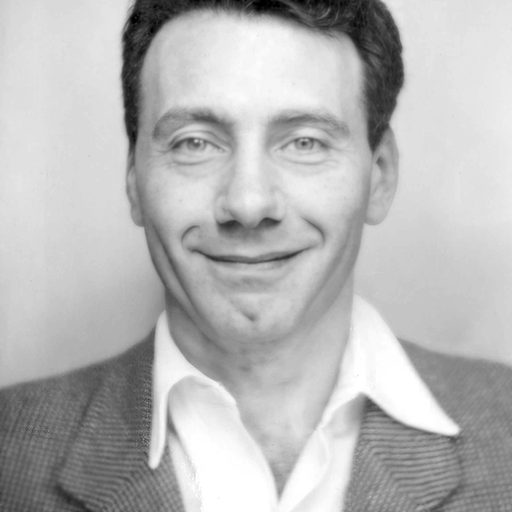
Nathan Korb, the son of Lithuanian Jewish immigrants, was singing in the streets at thirteen. He brought to Édith Piaf's attention an unknown he believed better than himself, Yves Montand, and left more than a thousand songs — “À Paris”, “Marjolaine”. The war had taken his mother, who was deported.
The story
Born in Paris in 1917, Nathan Korb was the son of Lithuanian Jewish immigrants settled near the Bastille. At thirteen he sang in the streets with his brother, and he joined the Théâtres Ouvriers de France, the workers' theatre movement.
He met Jacques Prévert, entered the circle of poets who wrote songs, and brought Édith Piaf an unknown young man he thought better than himself: Yves Montand, whose voice he revealed and for whom he would write.
The war took his mother, deported to Auschwitz in 1943. A member of the Resistance, he came back from it with a repertoire of more than a thousand songs: “A Paris”, “Marjolaine”, “Bal petit bal”, “Le Temps du muguet”, and “Quand un soldat”, which the censors banned from the airwaves in 1953.
He wrote for the cinema as well — the score of Jacques Tati's Playtime, of Le Cave se rebiffe, of Maigret voit rouge — and founded in 1960 his own music publishing house, where he discovered Alain Barrière, Daniel Guichard and Serge Lama.
He died in April 2002 and rests in Division 44, on the Avenue Aguado, first row — a few paces from Yves Montand, as he had asked. The stone names him “fils de Rose et Joseph Korb” — son of Rose and Joseph Korb.
The grave
A simple grave whose inscription is a line of descent: “Francis LEMARQUE fils de Rose et Joseph KORB 1917-2002” — son of Rose and Joseph Korb — then “Ginette KORB fille de Gabrielle et Albert RICHES 1924-2019” — daughter of Gabrielle and Albert Riches. Both stage names and both birth names are there, each tied to its parents — for a man whose mother died in deportation, the wording is not neutral. The grave is a few metres from Yves Montand's, as he had asked.
On site, do not miss
The stone names him through his parents: “Francis LEMARQUE fils de Rose et Joseph KORB” — son of Rose and Joseph Korb. It is the only mention of his real name — and it comes through them.
Visitors' questions
Where is Francis Lemarque's grave?
In Division 44, avenue Aguado, first row, not far from Yves Montand's: that was his wish. The stone names him “Francis LEMARQUE fils de Rose et Joseph KORB” — son of Rose and Joseph Korb: his real name appears only through his parents.
Yves Montand and Simone SignoretDid Francis Lemarque discover Yves Montand?
He did: he had him heard in Piaf's circle, convinced that this young unknown would sing his songs better than he could himself. He wrote songs for him, and asked to be buried near him at Père-Lachaise.
Édith PiafWhich songs did Francis Lemarque write?
More than a thousand, including “À Paris”, “Marjolaine”, “Bal petit bal”, “Le Temps du muguet” and “Quand un soldat”, which the censors banned from the airwaves in 1953. He also wrote the music for Playtime, Jacques Tati's film, and in 1960 founded his own music publishing house, where he discovered Alain Barrière, Daniel Guichard and Serge Lama.
Michel DelpechWhere did Francis Lemarque come from?
From a family of Lithuanian Jewish immigrants settled near the Bastille: his name was Nathan Korb, and at thirteen he was singing in the streets with his brother. His mother died in deportation during the war.
Joseph JoffoAudio guide to Père Lachaise: the best unusual guided tour!
Discover the secrets of the most astonishing tombs
the audio guidefrom€6.99