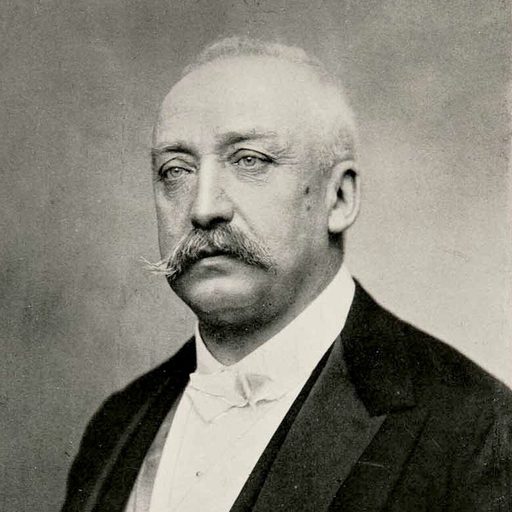
Félix Faure, a Le Havre merchant turned parliamentarian, was elected President of the Republic in January 1895. He loved pomp, ceremonies and uniforms, which earned him the nickname of the Sun President, and he received Tsar Nicholas II in 1896. It was to him that Zola addressed J'accuse, and he remained hostile to a retrial of Dreyfus. He died at the Élysée in February 1899.
The story
Félix Faure was born in Paris on 30 January 1841. A Le Havre merchant turned member of parliament, he published “Les Budgets contemporains” in 1887 and took a statistics prize from the Academy for it. On 17 January 1895, after Casimir-Perier resigned, he was elected President of the Republic with 430 votes out of 801.
He loved pomp, uniforms and ceremony: Paris called him the Sun President. In 1896 he received Tsar Nicholas II and sealed the Franco-Russian alliance — the high point of his seven years.
The Dreyfus affair filled the rest. It was to him that Zola addressed “J'accuse”, on 13 January 1898; Faure stayed hostile to any retrial, out of what his biographers call a convenient legalism.
On 16 February 1899 he died at the Élysée in the arms of Marguerite Steinheil, the wife of a well-known painter. A president dying mid-embrace kept Paris in puns for half a century, and gave Clemenceau a line nobody has bettered: “He wanted to be Caesar, and he was only Pompey” — a pun no translation can carry, and Paris caught it at once.
Buried at first in a temporary vault, he was given a permanent plot in Division 4 and Saint-Marceaux's bronze recumbent effigy. Clemenceau again: “Félix Faure has returned to nothingness. He must have felt at home there.”
The grave
A bronze bas-relief signed René de Saint-Marceaux (1845-1915) shows the president as a recumbent effigy wrapped in the French flag — a patriotic staging that contrasts with the circumstances of his death. The inscription keeps to the essentials: “Félix Faure, 1841-1899, President of the Republic”. The monument is not the original: Faure was first buried in a temporary vault, and only later received his permanent plot and his effigy. The “Sun President”, who loved pomp, got it even in his grave.
On site, do not miss
The bronze recumbent effigy and its flag, then the inscription in three words: “President of the Republic”.
Visitors' questions
Where is Félix Faure's grave?
In Division 4, Avenue Principale, first row, a few minutes from the Boulevard de Ménilmontant entrance — the same alley as Colette, Thomas Couture, Alexandre Falguière and Paul Baudry's monument.
ColetteHow did Félix Faure die?
At the Élysée, on 16 February 1899, in the arms of Marguerite Steinheil, the wife of a well-known painter. The death of a president in mid-embrace fed half a century of Parisian jokes.
Édouard DaladierWhat does the recumbent figure on his grave represent?
The president lying wrapped in the French flag: a bronze bas-relief by the sculptor René de Saint-Marceaux. He had first been buried in a temporary vault, before a permanent plot was granted.
Auguste BlanquiWhat was his role in the Dreyfus affair?
It was to him that Zola addressed “J'accuse”, on 13 January 1898: the open letter was written to the President of the Republic. Faure remained opposed to a retrial, on legalistic grounds, and died thirteen months later.
Alphonse BertillonAudio guide to Père Lachaise: the best unusual guided tour!
Discover the secrets of the most astonishing tombs
the audio guidefrom€6.99