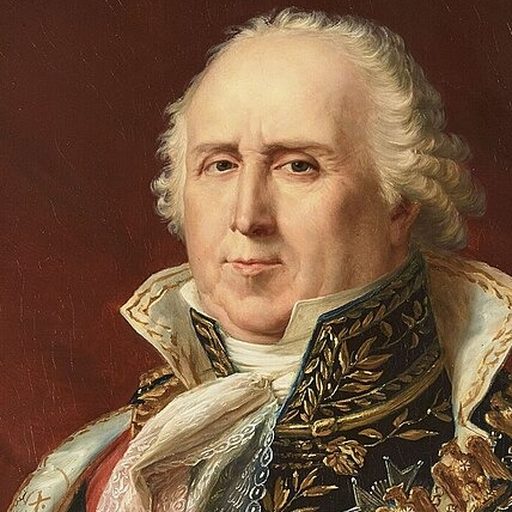
Lebrun, born in 1739 into a Norman family without fortune, spoke English, Spanish, Italian, Latin and Greek. After the 18 Brumaire, he became the Third Consul, with Bonaparte and Cambacérès, then Prince Arch-Treasurer of the Empire and Duke of Piacenza. He died in 1824. A path in the cemetery bears his name, something few of the dead obtain here.
The story
Charles-François Lebrun was Bonaparte's third consul, the one who took the finances. The path that runs alongside his grave carries his name: Père-Lachaise grants that distinction to only a handful of its dead.
Born on 19 March 1739 at La Bouchelière, in the Manche, the fourth son of a family of small landowners, he studied at the collège de Coutances and then at the collège de Grassin in Paris. He spoke Greek, Latin, Italian, Spanish and English fluently, and in 1762 travelled through Belgium, Holland and England, whose parliamentary system he wanted to understand.
The Empire made him prince arch-treasurer in 1804, then duc de Plaisance; it was he who created, in 1807, the Cour des comptes, which still audits French public money today. The Restoration made him a peer of France. He died in 1824 at Sainte-Mesme, at eighty-five.
The stone is dated 1831, seven years after his death, and unrolls the full list of titles. But it is the sign on the path beside it that made him a permanent landmark of the cemetery.
The grave
A grave whose inscription bears a year: “Sépulture de la famille de PLAISANCE, MDCCCXXXI” — grave of the family of Piacenza, 1831, seven years after the consul's death. Then comes his full list of titles: “Charles François LEBRUN, 3ᵉ consul, Prince Architrésorier de l'Empire, Duc de PLAISANCE, Pair de France, 1739-1824.” — Third Consul, Prince Arch-Treasurer of the Empire, Duke of Piacenza, peer of France. The most remarkable detail, however, is not on the stone but beside it: the path that runs along the grave bears his name, chemin Lebrun.
On site, do not miss
The name of the path is the landmark: chemin Lebrun. The inscription is dated “MDCCCXXXI” — 1831, seven years after his death — and unrolls his full list of titles.
Visitors' questions
Where is Lebrun's grave?
In Division 5, along the chemin Lebrun — the path carries his name. It is a distinction the cemetery grants to only a handful of its dead, and it is the surest landmark for finding the grave, which dates from 1831.
Francis PoulencWho were the three consuls?
Bonaparte, Cambacérès and Lebrun, from 1799 to 1804. The last two were then heaped with titles — Cambacérès Arch-Chancellor, Lebrun Prince Arch-Treasurer of the Empire, then Duke of Plaisance and peer of France under the Restoration.
CambacérèsWhat does his inscription say?
It carries a date: “Sépulture de la famille de PLAISANCE, MDCCCXXXI” — 1831, seven years after his death. Then comes his full style: third consul, Prince Arch-Treasurer of the Empire, Duke of Plaisance, peer of France.
Marshal MassénaWhat schooling did he have?
The college of Coutances, then the collège de Grassin in Paris. He spoke five languages fluently — Greek, Latin, Italian, Spanish, English — and travelled in 1762 through Belgium, Holland and England.
SieyèsAudio guide to Père Lachaise: the best unusual guided tour!
Discover the secrets of the most astonishing tombs
the audio guidefrom€6.99