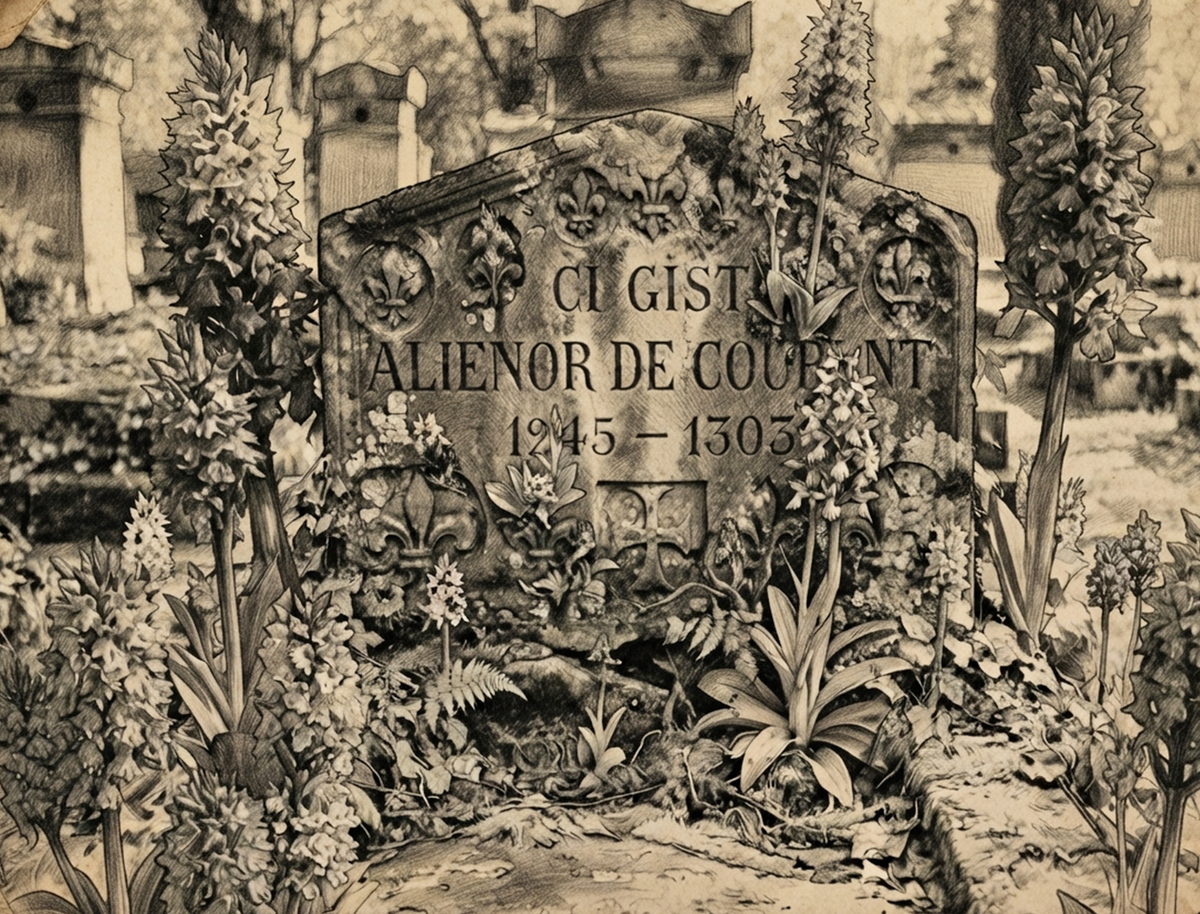
Père-Lachaise holds more than two hundred and twenty wild plant species, recorded between 2010 and 2020. Wild orchids bloom there in summer. The small-flowered buttercup, a species rare and protected in Île-de-France, grows there between the burial slabs.
On a grave in Division 12 of Père-Lachaise, a small white flower grows in a crack in the stone. It is a stonecrop — a plant named for its ability to split rock. On the side of the same grave, a profusion of pale violet blooms: ivy-leaved toadflax, which botanists call the “ruin of Rome”. A little further on, between two shifted slabs, a wall lettuce offers its edible leaves to anyone who can recognise them. Père-Lachaise is home to more than two hundred and twenty wild plant species, catalogued between 2010 and 2020 by naturalists from the City of Paris. And since chemical treatments stopped in 2015, the cemetery's wild flora has grown richer year on year — to the point of welcoming wild orchids and protected species.
The most remarkable find is the small-flowered buttercup, a rare species protected in Île-de-France. The head keeper, Benoît Gallot, has confirmed that this fragile plant grows at Père-Lachaise — a sign of the site's ecological quality. The small-flowered buttercup grows only in undisturbed habitats, sheltered from pesticides and intensive mowing. Wild orchids also appear in the cemetery in summer, colonising the lawns and banks of the least-visited divisions. Orchids growing in the heart of Paris is remarkable: these plants need untreated soil, mycorrhizal fungi in the substrate and freedom from disturbance — three conditions that Père-Lachaise, with its forty-four hectares closed at night and free of pesticides for ten years, now provides.
The small-flowered buttercup, a species rare and protected in Île-de-France, grows at Père-Lachaise between the burial slabs. The curator Benoît Gallot confirmed the presence of this fragile plant, a sign of a healthy ecosystem.
The graves of Père-Lachaise form a biotope unlike any other in France. Mosses, lichens and houseleeks colonise the horizontal surfaces of the slabs. Pellitory-of-the-wall — the “wall plant” — settles into the mortar joints of the chapels. Golden stonecrops form yellow carpets on the stones most exposed to the sun. In spring, violets cover the ground in mauve patches, followed by bittersweet nightshade with its dark violet flowers, herb-Robert with its pink blooms, wood avens with its yellow petals, and white bittercress on its slender stems. In autumn, ivy overruns abandoned graves, forming green mantles that hide the funerary inscriptions. The ethnobotanist Valentine Diguet, who surveyed the cemetery in 2024, recorded stonecrop, ivy-leaved toadflax, wall lettuce and Armenian grape hyacinths — flowers in electric-blue clusters — growing there.
The floral richness of Père-Lachaise is the direct result of two decisions: the end of pesticides in 2015 and the grassing of the avenues. The cemetery's gardeners let wild flora settle in between the graves. The paths are turfed. Wild grasses grow between the slabs. The keeper, Benoît Gallot, in La Vie secrète d'un cimetière, describes how nature is reclaiming ground that belonged to it before 1804. A visitor who leans in over the graves of Père-Lachaise discovers an accidental botanical garden: two hundred and twenty species growing where no one planted them, orchids flowering among the graves, and a protected buttercup that has chosen to settle among the dead. Père-Lachaise is a cemetery — but it is also a living herbarium spanning forty-four hectares.
Yes. Wild orchids bloom at Père-Lachaise in summer, colonising the lawns and banks of the least frequented Divisions. Orchids growing in the heart of Paris are exceptional, a result of the cemetery ending pesticide use in 2015.
Père-Lachaise is home to small-flowered buttercup, a species rare and protected in the Île-de-France, and wild orchids. The cemetery has more than 220 wild plant species: rock samphire, ivy-leaved toadflax, violets, grape hyacinths and herb-Robert.
More than 220 wild plant species were recorded at Père-Lachaise between 2010 and 2020 by the City of Paris. The cemetery is also home to 4,134 trees of 80 different species, 9 of them listed as remarkable, across 44 hectares.
No. Père-Lachaise has used no pesticide treatment since 2015. Ending pesticide use allowed wild plants and pollinating insects to return. Curator Benoît Gallot has chosen to let nature reclaim its place among the graves.
 Society