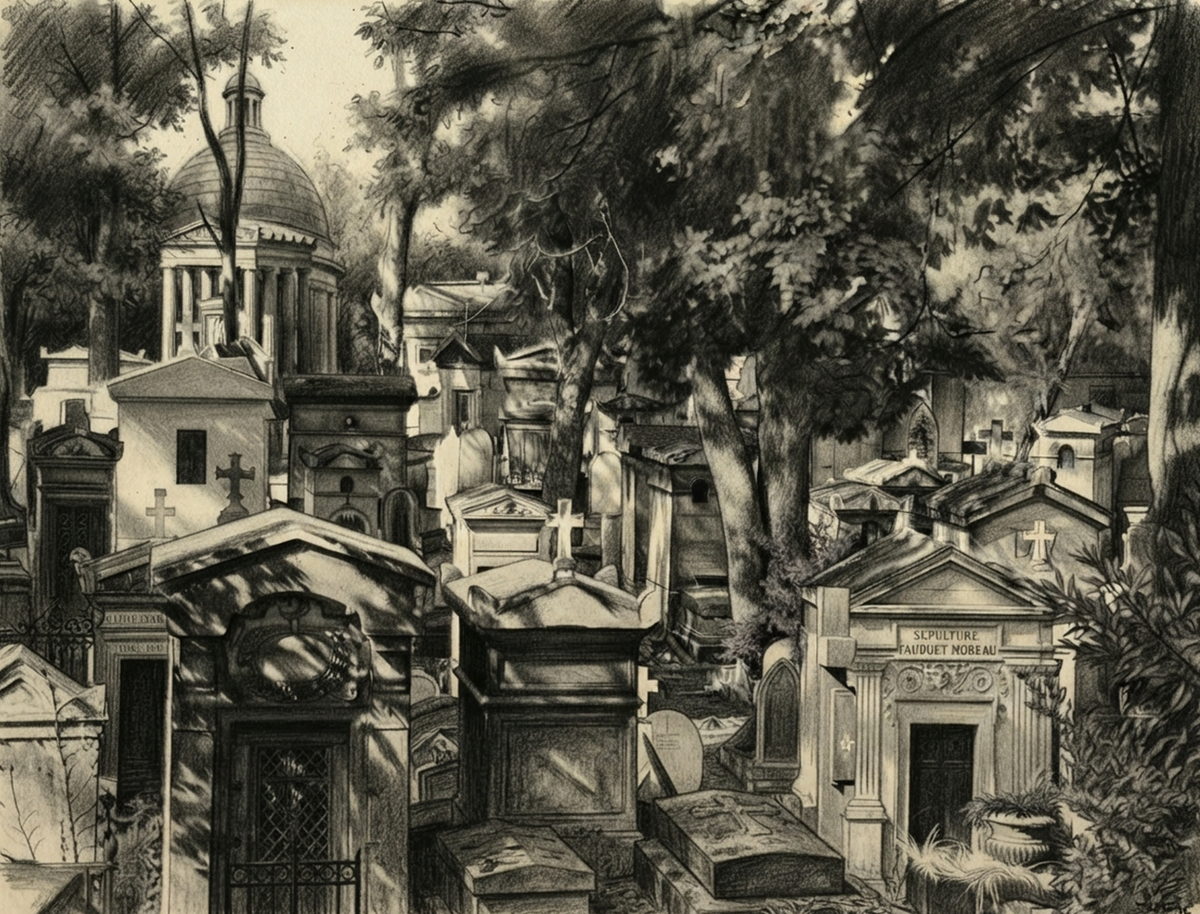
At Père-Lachaise, trees have engulfed entire graves: roots gripping the stones, trunks swallowing the steles, branches lifting the slabs. This phenomenon, dubbed “plant necrophagy,” affects dozens of graves across the cemetery's forty-four hectares.
In Division 45 of Père-Lachaise, a common plane tree twenty-six metres tall — the largest tree in the cemetery — has spread roots so powerful that they wind between the neighbouring vaults, gripping the stones in a network of living wood. Funerary slabs are lifted, cracked, absorbed. The stone seems to dissolve into the bark. The phenomenon has a name: the cemetery's keepers call it “vegetal necrophagy”. At Père-Lachaise, dozens of trees have engulfed, lifted, split, covered or swallowed graves. Roots prise gravestones apart as though they were clods of earth. Trunks absorb wrought-iron railings. Branches lift chapels. And once a tree has become interlocked with a funerary element — a sculpture, a stone, a railing — the grave is, as a rule, protected: neither can be touched without destroying the other.
In Division 12, the grave of Louise-Joséphine Labalmondière has been entirely swallowed by a tree. The headstone is embedded in the trunk, and the funerary inscriptions are barely legible through the folds of bark. In Division 36, a tree has grown up through the very centre of the monument to Frédéric Louis Le Harivel du Rocher, splitting the stone in two and turning the grave into an organic assemblage of wood and limestone. In other divisions, family chapels are pushed apart by trunks growing from within, slabs are covered by roots that wrap around them like fingers, and collapsed headstones serve as a base for young trees growing straight through the broken stone. The APPL — the Friends and Enthusiasts of Père-Lachaise association — has photographed and documented these cases, describing them as a “dance of death” between the plant and the mineral.
In Division 12, a tree has entirely engulfed the grave of Louise-Joséphine Labalmondière. The stele is embedded in the trunk, and the roots have lifted the slab. The monument has become part of the tree.
The phenomenon comes down to Père-Lachaise's exceptional density: four thousand one hundred and thirty-four trees and ninety-six thousand six hundred plots across forty-four hectares — one tree for every thirteen graves, on average. The roots of plane trees, maples and limes search the soil for water and nutrients, and the joints between stones, the cracks in slabs and the gaps in railings offer paths of least resistance. The tree grows, the stone resists, then gives way. The process takes decades. The end of chemical treatments in 2015 sped up the vegetal reclamation. The keeper, Benoît Gallot, in La Vie secrète d'un cimetière (“The Secret Life of a Cemetery”), owns the choice: letting nature reclaim its rights, even at the stone's expense. The dilemma is real — the funerary heritage decays, but biodiversity flourishes. Stonecrops, ivy-leaved toadflax and wall lettuce colonise the abandoned graves.
The visitor who wanders the south-eastern divisions of Père-Lachaise — the most wooded, the oldest, the most forgotten — finds a landscape that calls to mind a temple lost in the jungle more than a Parisian cemetery. Inscriptions vanish beneath the ivy. Monuments sink into the ground. Trees and graves are no longer separate: living matter and dead matter have merged. The process is irreversible. Once a tree has engulfed a grave, the stone cannot be freed without felling the tree, nor the tree felled without destroying the grave. Père-Lachaise has been a listed remarkable site since the law of 2 May 1930 — its oldest section is protected both as built heritage and as natural heritage. The cemetery's necrophagous trees are not a problem to be solved: they are a sign that nature, sooner or later, always reclaims what belongs to it.
A grave-eating tree is one whose roots or trunk have engulfed a grave at Père-Lachaise: stones enclosed, slabs lifted, steles absorbed. The phenomenon affects dozens of graves in the cemetery, where 4,134 trees coexist with 96,600 plots.
Yes. The roots of Père-Lachaise's plane trees, maples and lime trees crack slabs, lift stones and engulf monuments. But once a tree has merged with a grave, the grave is protected: neither can be touched without destroying the other.
Yes. The oldest part of Père-Lachaise has been a listed remarkable site since the law of 2 May 1930. The cemetery enjoys double protection: for its built heritage, with 14 listed monuments, and its natural heritage, with 9 remarkable trees across 44 hectares of green space.
Is vegetation kept under control at Père-Lachaise?
Père-Lachaise has used no pesticide treatment since 2015. Curator Benoît Gallot has embraced letting nature reclaim its place. Spontaneous vegetation — rock samphire, ivy-leaved toadflax, wall lettuce — colonises abandoned graves.
 Heritage