Isadora Duncan, a pioneer of modern dance, died in Nice on 14 September 1927, strangled by a scarf caught in a car wheel. The dancer's ashes rest in the Père-Lachaise columbarium, niche 6,796, alongside the ashes of her two children, who drowned in the Seine in 1913.
On 14 September 1927, on the Promenade des Anglais in Nice, Isadora Duncan climbed into an open-top Amilcar driven by Benoît Falchetto, a young Italian mechanic. The dancer was wearing a long painted silk scarf, wound around her neck and streaming in the wind. The car pulled away. The scarf caught in the spokes of the left rear wheel and the axle hub. Isadora Duncan was pulled out of the car and dragged for several metres. Death was instantaneous — a fracture of the cervical vertebrae. The dancer was forty-nine. Her last words, according to legend, were: “Adieu, mes amis, je vais à la gloire” (“Farewell, my friends, I am off to glory”). The line is probably apocryphal, but Isadora Duncan's death became one of the most famous accidents of the twentieth century.
The death at Nice was not the first tragedy in Isadora Duncan's life. On 19 April 1913, in Paris, a car carrying the dancer's two children — Deirdre, aged seven, daughter of the director Gordon Craig, and Patrick, aged three, son of Paris Singer, heir to the sewing-machine fortune — slid off a quay and into the Seine at Neuilly-sur-Seine. The children drowned along with their governess. The car had stalled at the river's edge; the driver had got out to restart the engine; the vehicle rolled backwards into the water. Duncan was shattered by the tragedy. She tried to return to the stage, travelled to South America and Russia — married the poet Sergei Yesenin in 1922, and divorced him in 1923. But Isadora Duncan's dancing was never again what it had been before the Seine.
On 19 April 1913, the car carrying Isadora Duncan's two children slid into the Seine at Neuilly. Deirdre, seven, and Patrick, three, drowned along with their governess. Duncan never recovered.
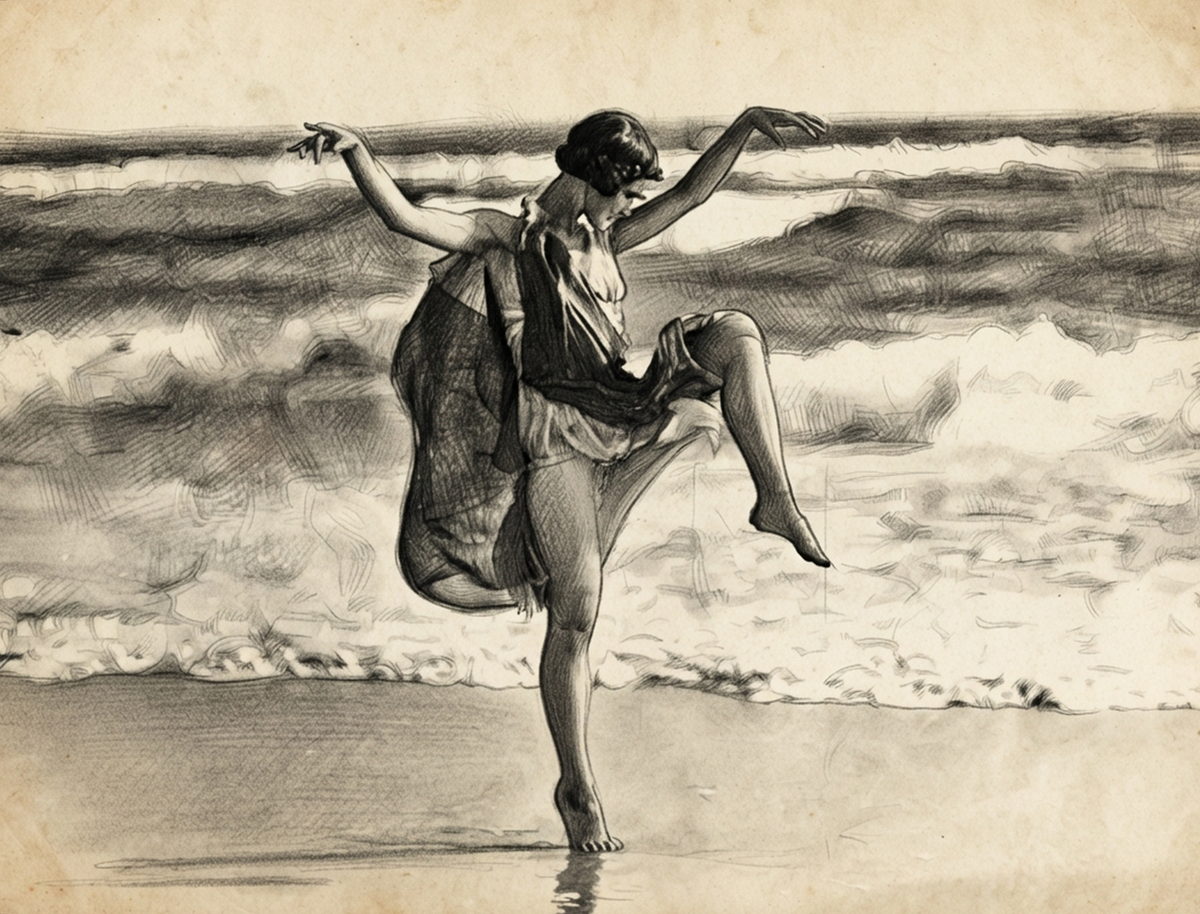
Isadora Duncan, born Dora Angela Duncan in San Francisco in 1877 or 1878 — the exact date is disputed — is regarded as the founder of modern dance. Duncan rejected classical ballet, pointe shoes, the tutu and codified steps. She danced barefoot, in a Greek tunic, to the music of Beethoven, Chopin and Wagner — an aesthetic revolution in a performing-arts world dominated by Romantic ballet. Duncan founded dance schools in Berlin, Moscow and Paris. She was also a political figure: a feminist, a socialist, an admirer of the Russian Revolution. Her stay in Moscow, her marriage to Yesenin — an alcoholic poet who would take his own life in 1925 — and her Bolshevik sympathies made Isadora Duncan a controversial figure in 1920s America.
Isadora Duncan's ashes rest in the columbarium at Père-Lachaise, niche 6796, alongside the ashes of Deirdre and Patrick, the two children drowned in the Seine. The niche is plain: a name, dates, no ornament. The Père-Lachaise columbarium also holds the ashes of Maria Callas, another stage figure who died in Paris. Isadora Duncan moved from San Francisco to London, Berlin, Paris, Moscow, Buenos Aires and Nice over forty-nine years of life — a nomadic existence that ended in an absurd accident on the Promenade des Anglais. Niche 6796 in the columbarium is the one fixed point in that life of movement. It is also where a mother and her two children are finally reunited — through their ashes, after the Seine and after the scarf.
Where are Isadora Duncan's ashes at Père-Lachaise?
Isadora Duncan's ashes rest in the columbarium at Père-Lachaise, niche 6796, alongside the ashes of Deirdre and Patrick, the dancer's two children who drowned in the Seine in 1913. The niche is plain, with no particular ornamentation.
Isadora Duncan died in Nice on 14 September 1927, strangled by a silk scarf caught in the spokes of the rear wheel of an open-top Amilcar. The fracture of her cervical vertebrae caused the instant death of the dancer, aged 49.
Père-Lachaise holds the ashes of Isadora Duncan (columbarium, niche 6796), a pioneer of modern dance, and those of Maria Callas (columbarium), an opera singer. The cemetery also holds the grave of Vaslav Nijinsky (Division 22), principal dancer of the Ballets Russes.
Are Isadora Duncan's children buried at Père-Lachaise?
Yes. The ashes of Deirdre Duncan (daughter of Gordon Craig) and Patrick Duncan (son of Paris Singer), who drowned in the Seine at Neuilly on 19 April 1913, rest in the columbarium at Père-Lachaise, niche 6796, alongside the ashes of Isadora Duncan.
 Figures