The Telegraphist Who Saved Forty Thousand Soldiers
Juliette Dodu, born on Réunion in 1848, intercepted Prussian dispatches at the Pithiviers telegraph office for seventeen days in 1870. The first woman awarded the Médaille militaire, she rests in Division 28 of Père-Lachaise — though historians doubt the story's accuracy.
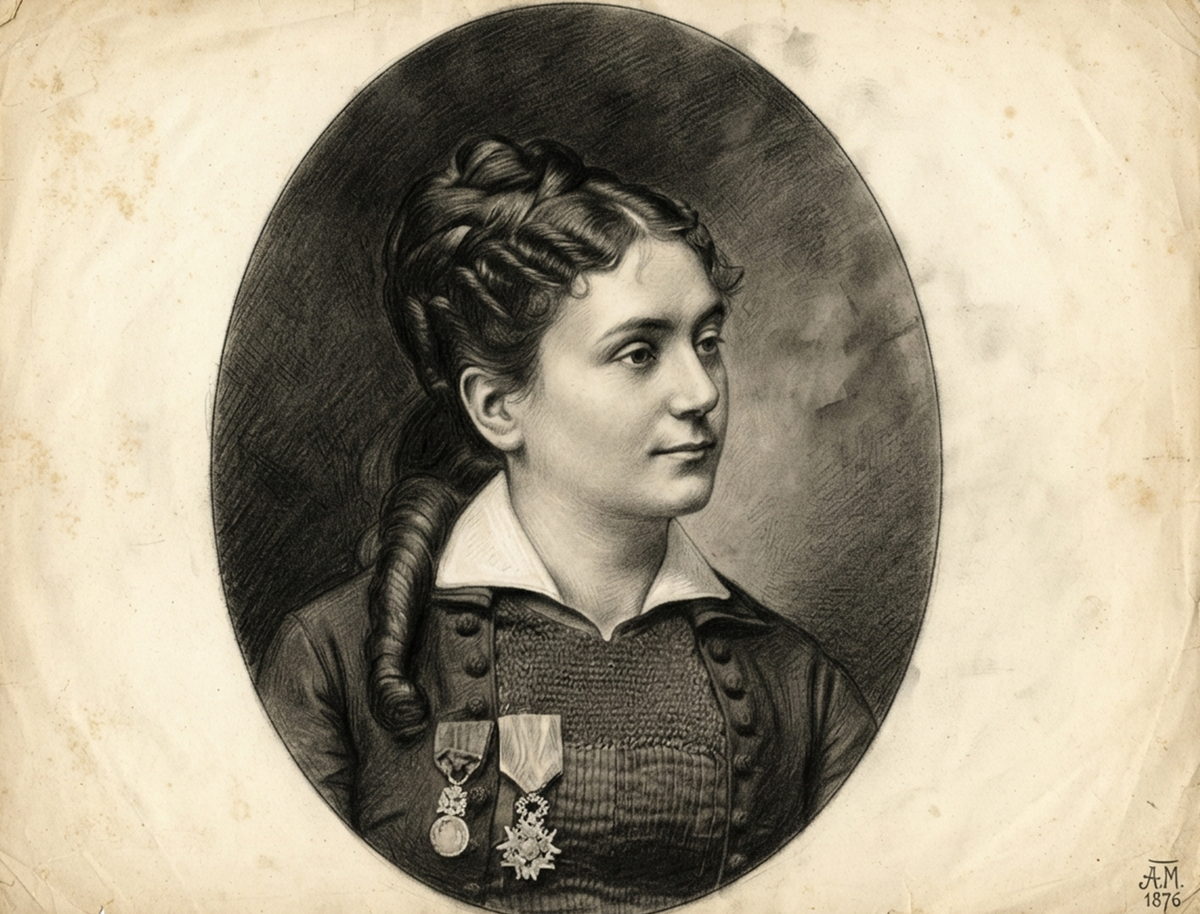
Juliette Dodu was born on 15 June 1848 at Saint-Denis on Réunion, the daughter of Alphonse Dodu, a naval surgeon. At sixteen, in 1864, she left the island for mainland France. In April 1870, at twenty-two, Juliette Dodu was appointed head of the telegraph office at Pithiviers, in the Loiret — a modest posting in a small provincial town. Five months later, war broke out. The Prussians occupied Pithiviers from September 1870. The telegraph office, requisitioned by the enemy army, kept operating under German control. The young office head stayed at her post. It was there, according to the official account, that Juliette Dodu performed the act that would make her a national heroine: for seventeen days, the telegraphist intercepted Prussian despatches by tapping a wire into the line, copied them out and passed them on to the French forces.
The story, as it settled into national memory, is a dramatic one. Juliette Dodu is said to have intercepted the Prussian army's movement orders, allowing French troops to avoid ambushes and saving the lives of some forty thousand soldiers. Discovered by the enemy, the telegraphist was reportedly sentenced to death by a Prussian court martial. The sentence was never carried out, thanks to the armistice of 28 January 1871 — or, according to other versions, thanks to the intervention of Prince Frederick Charles of Prussia, said to have been struck by the young woman's courage. Juliette Dodu became the first woman to receive the Médaille militaire, then the Légion d'honneur in a military capacity — two exceptional distinctions for a civilian, and more so for a woman in nineteenth-century France.
The story of Juliette Dodu, as it has been told since the 1870s, raises factual problems that historians have long pointed out. Military archive records confirm neither the interception of forty thousand despatches nor the figure of forty thousand soldiers saved. The court martial and the death sentence appear in no known record. The exact role of Prince Frederick Charles in any pardon remains undocumented. Some historians believe Juliette Dodu did intercept despatches — the technical operation was feasible with the equipment of the day — but that the scale and the military consequences were considerably inflated by the patriotic propaganda of the Third Republic, hungry for heroes and heroines in the wake of the 1870 defeat.
Sentenced to death by the Prussians, pardoned at the last minute by Prince Frederick Charles of Prussia, awarded the Médaille militaire and the Légion d'honneur for military service: Juliette Dodu's story is too good not to be questioned.
Juliette Dodu died on 28 October 1909 at Clarens, in Switzerland, at sixty-one. Her grave lies in Division 28 of Père-Lachaise. A street in the tenth arrondissement of Paris bears her name, as does another at Saint-Denis on Réunion. True or embellished, the story of the telegraphist of Pithiviers is that of a twenty-two-year-old Réunionnaise woman, thrust into an extraordinary situation by the Prussian occupation, whose account was shaped by the needs of a nation seeking consolation after defeat. The grave in Division 28 settles nothing: it carries the medals and the dates, but not the proof. Père-Lachaise preserves the memory of Juliette Dodu just as the Republic built it — heroic, female and Réunionnaise.
Juliette Dodu (1848-1909), born in Réunion, ran the telegraph office at Pithiviers (Loiret) during the 1870 war. Juliette Dodu is said to have intercepted Prussian despatches for 17 days. She was the first woman awarded the Médaille militaire, a French military honour.
Juliette Dodu's grave lies in Division 28 at Père-Lachaise. She died on 28 October 1909 at Clarens, in Switzerland; the heroic telegraph operator of 1870 rests not far from the graves of generals and military officers in the same Division.
Historians dispute the scale of the feat attributed to Juliette Dodu. Intercepting Prussian despatches at the Pithiviers office in 1870 was technically feasible, but the figure of 40,000 soldiers saved and her death sentence are not confirmed by the archives.
Juliette Dodu (Division 28), heroine of 1870, is the most famous. Père-Lachaise also holds Resistance fighters and wartime nurses. Juliette Dodu's grave is one of the few in the cemetery to honour a woman for a feat of arms.
 Figures