In 1810, the mining engineer Héricart de Thury proposed digging a network of fifteen-metre-high galleries beneath the cemetery to house monumental tombs. The scheme collapsed. The only underground space actually built, in 1953, is a functional ossuary hidden behind Bartholémé's Monument to the Dead.
Beneath Père-Lachaise, there was meant to be another Père-Lachaise. In 1810, Louis-Étienne-François Héricart de Thury, the inspector general of the Paris quarries, proposed digging a network of underground galleries beneath the Eastern Cemetery, fifteen metres high and eight metres wide, meant not to stack up bones but to house monumental tombs. A gently sloping cypress-lined avenue, two hundred metres long, would have led funeral processions from the surface down to an underground chapel. On either side, wealthy families would have had marble graves built in the half-light of the galleries. The project was never carried out. A century and a half later, an underground space was indeed dug beneath the cemetery — but it is neither a temple nor a cathedral of the dead. It is a functional ossuary, brought into service on 1 January 1953, where boxes of bones sit lined up on concrete shelves behind Bartholomé's Monument to the Dead.
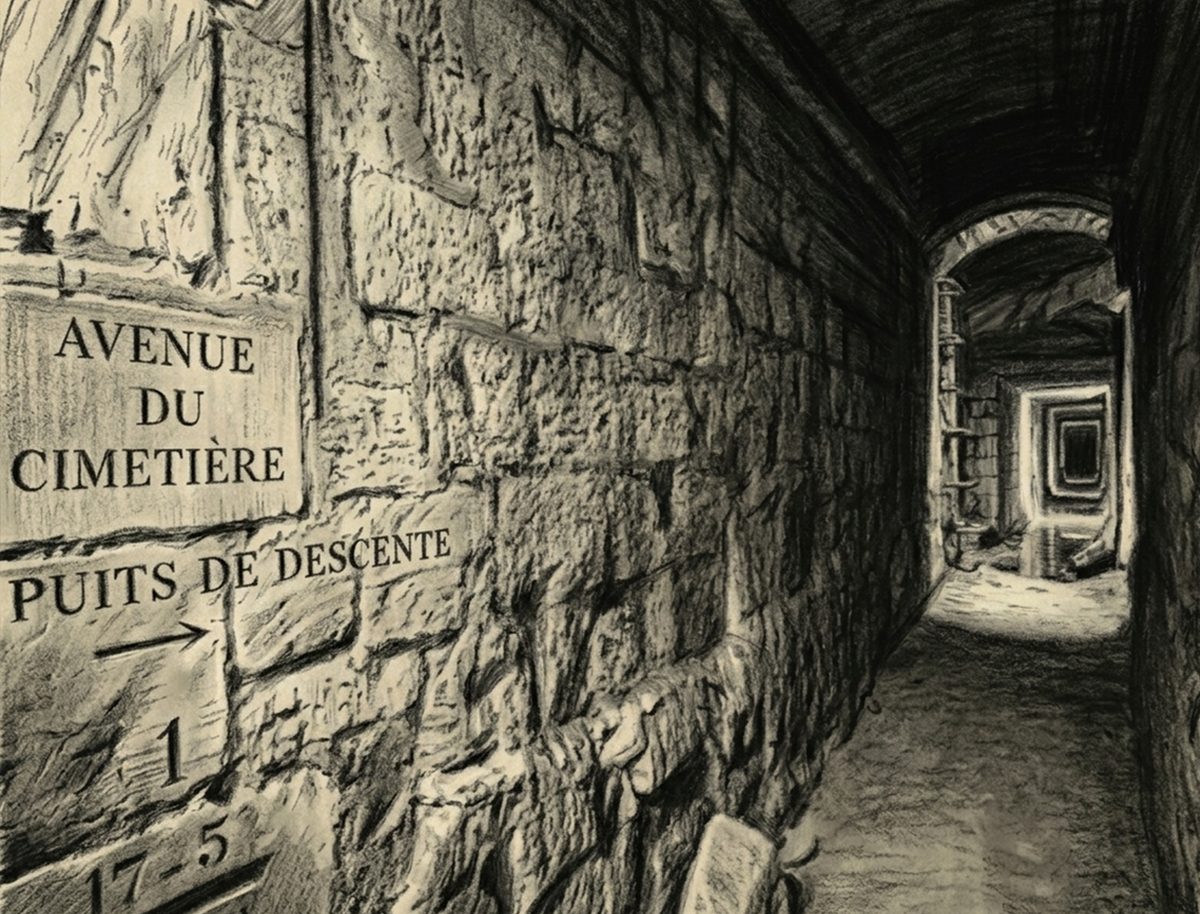
Héricart de Thury was no dreamer. A viscount from old nobility and a mining engineer, he was appointed to the Paris quarry inspectorate in 1809 and took over as director general in December 1810. He had already turned the old quarries of the Left Bank into a funerary monument: the Catacombs of Paris, which he shored up, decorated and opened to the public. But the Catacombs were merely an ossuary — a place for piling up anonymous bones, shifted in bulk from the capital's overflowing parish cemeteries. Héricart de Thury wanted something else. His plan for Père-Lachaise called for an above-ground sepulchral monument with a crypt for funeral ceremonies and a meeting room for families. Two pavilions would have flanked the entrance to the underground ramp: one for the caretaker, the other to receive visitors. The underground galleries, on a scale never seen before, would have rivalled the crypts of the great basilicas. The idea belonged to a current of thought that had emerged under the Directory: in 1799, the official Jacques Cambry had proposed turning the Montmartre quarries into an underground cemetery that wealthy families would adorn with marble and paintings. Héricart de Thury took up this vision and moved it beneath Père-Lachaise, on a far more ambitious scale.
Fifteen metres high, eight metres wide, a two-hundred-metre avenue of cypresses: the underground cemetery dreamed up in 1810 was never built. What exists instead is a neon-lit store of bone boxes.
The plan did not survive the realities of ground and politics. The cemetery above ground was only just beginning to fill up: on 1 January 1813, Brongniart counted only seventy-one perpetual plots scattered over the Mont-Louis hill. The pressure on space that would eventually make Père-Lachaise too small would only appear decades later, once five successive extensions between 1824 and 1850 took its area from seventeen to forty-three hectares without solving the problem of overcrowding. On top of this, the ground beneath the cemetery did not share the same qualities as the Left Bank quarries. The political climate shifted too: the fall of the Empire in 1814 changed budget priorities. Héricart de Thury kept his post under the Restoration, but the July Revolution of 1830 pushed him out of office over his royalist sympathies. His monumental underground cemetery stayed on the drawing board. Above ground, Brongniart had died on 6 June 1813 without seeing his own plan completed — the pyramid, the campo santo, the follies. The two rival visions of Père-Lachaise, one reaching upward and the other downward, died together. All that remains of these ambitions are the winding paths and the changing levels of the romantic garden.
The ground beneath Père-Lachaise did eventually take in the dead, though in a form Héricart de Thury would never have recognised. The law of 3 January 1924 allowed municipalities to reclaim abandoned perpetual plots — a necessity forced by the overcrowding of Parisian cemeteries after the First World War. The exhumed bones had to be kept in perpetuity. The decree of 21 November 1946 authorised the City of Paris to create a single, centralised ossuary at Père-Lachaise for all seventeen of the capital's cemeteries. The Conseil municipal approved the loan for it on 29 December 1947 and entrusted the design to the architect Jules Formigé. The site chosen was behind Albert Bartholomé's Monument to the Dead, unveiled on 1 November 1899 at the far end of the main avenue. Two side entrances, invisible from the path, lead into galleries where each crypt corresponds to one cemetery of origin. The remains are placed in boxes set on shelves. Once a crypt is full, a slab bearing the engraved names of the dead seals it for good. The ossuary was brought into service on 1 January 1953. The first remains came from reclaimed plots at Montmartre and Montparnasse. It was not until 10 January 1963 that remains from Père-Lachaise itself were transferred there.
The visitor who stops in front of the Monument to the Dead, in Division 4, looks at the bronze figures — a couple on the threshold of the afterlife, suffering humanity, an angel lifting the sepulchral stone — without suspecting what lies on the other side. The monument conceals the cemetery's only underground space, and that space bears no resemblance to the funerary temple dreamed up under the First Empire. No fifteen-metre vaulted galleries. No underground cypresses. No sculpted marble in the half-light. Instead, narrow corridors, functional lighting, metal shelving, boxes of zinc and wood. Of the grand 1810 scheme, no physical trace remains — just a few pages in the Description des catacombes de Paris, published by Héricart de Thury in 1815, and a few lines in his reports to the Direction des Mines. The phantom cemetery only ever existed on paper. The underground Père-Lachaise that eventually came into being is the exact opposite of the one once imagined: not a grand place of memory, but a discreet mechanism that keeps the cemetery running.
What was the plan for an underground cemetery beneath Père-Lachaise in 1810?
Quarry inspector Héricart de Thury proposed digging galleries 15 metres high and 8 metres wide beneath Père-Lachaise to house monumental tombs. A 200-metre avenue of cypress trees was to lead to an underground chapel. The project was never carried out.
Yes. A central ossuary, designed by architect Jules Formigé, has been in use since 1 January 1953 behind the Monument to the Dead by Bartholomé. It receives bones exhumed from reclaimed plots across the 17 cemeteries of Paris. The ossuary is not open to the public.
Who was Héricart de Thury, the man who wanted an underground Père-Lachaise?
Louis-Étienne-François Héricart de Thury (1776-1854), a viscount and mining engineer, was inspector general of the Paris quarries from 1810 to 1830. He turned the Catacombs of Paris into a visitable ossuary and published his Description des catacombes de Paris in 1815.
Why is there an ossuary behind the Monument to the Dead by Bartholomé?
The monument by Albert Bartholomé, unveiled on 1 November 1899 at the end of the main avenue, was chosen in 1947 as the site of Paris's central ossuary. The underground galleries open on either side through 2 side entrances, invisible to visitors.
 History