 Heritage
The First Chapel
Eternity, made to measure — the invention of the Greffulhe chapel.
HeritageEternity, made to measure — the invention of the Greffulhe chapel.
Fifty thousand francs. In 1810, such a sum was enough to buy the splendour of a private mansion at the heart of the Marais; yet it was towards a very different dwelling that Count Jean-Henri-Louis Greffulhe chose to direct his fortune. This banker of Genevan origin, whose influence stretched from the City of London to the salons of Paris, was preparing to build an edifice of a mere thirty-six square metres — not to house the living, but to shelter the rest of the dead. In raising this monument, Greffulhe did more than build a tomb: he invented the family funerary chapel, a model of ostentatious devotion that thousands of bourgeois families would copy throughout the century, shaping the very face of France's cemeteries.
At a time when Père-Lachaise was barely six years old, offering little to the eye but a scattering of isolated headstones and a still-sparse population of the dead, this future Peer of France understood, ahead of everyone else, that death could become a prestige property investment. To give shape to his ambition, he called on the talents of Alexandre-Théodore Brongniart, the very architect who had designed the cemetery. It would in fact be the only chapel Brongniart completed in his lifetime, before he died in 1813 without seeing his grand landscape project through to completion.
Building a private chapel in a place the clergy still eyed with suspicion amounted almost to provocation.
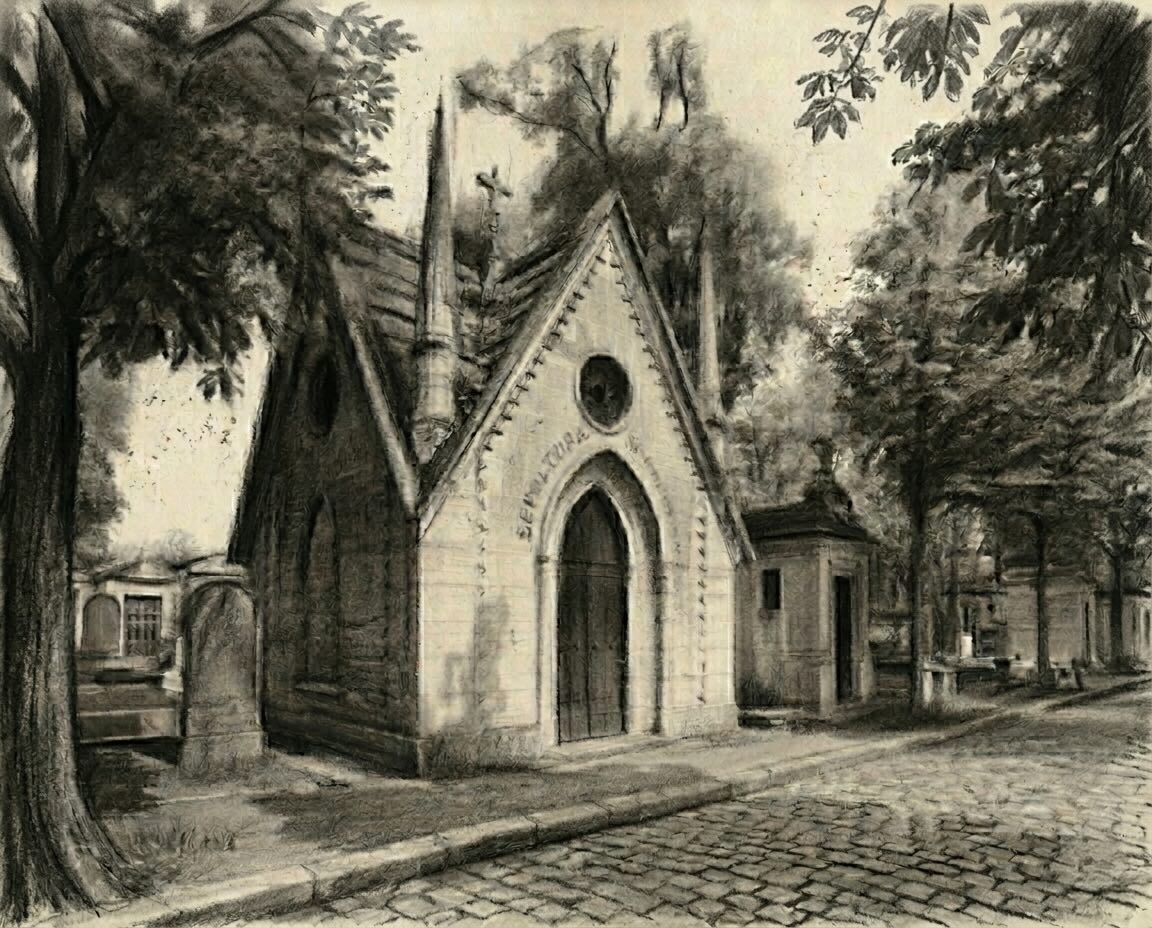
Rising beside the Allée des Peupliers, in Division 43, this miniature neo-Gothic church stands almost as a challenge. At a time when burials inside churches had already been banned for a quarter of a century, building a private chapel in a place the clergy still eyed with suspicion amounted almost to provocation. It was a way of declaring that fortune could extend beyond death, and that faith, too, needed a prestigious address.
The impact was immediate, stirring up “considerable noise” among fashionable Paris society and prompting the great families to demand houses of eternity of their own. In this way, these pocket-sized churches, ranged like the dwellings of a miniature town, became the visual signature of Père-Lachaise. Now a listed heritage building, the Greffulhe chapel remains its creator's last refuge — he still rests at the heart of the one property he never sold.
In Division 43, on the edge of the Allée des Peupliers. Built in 1810, it measures 36 square metres: from the outside, it looks like a miniature neo-Gothic church, wedged between much later chapels that it inspired.
Plan your visitAlexandre-Théodore Brongniart drew up the cemetery's plans in 1804, modelled on an English landscape garden. He died in 1813 having completed only one chapel himself: that of Count Greffulhe, in Division 43.
The history of Père-LachaiseBecause the 1810 Greffulhe chapel set a trend. Its impact on fashionable Parisian society drove the great families to demand their own, and these pocket-sized churches, lined up like the houses of a miniature town, became the cemetery's visual signature.
Who was Father La Chaise?In the older, lower-numbered Divisions, between 7 and 49: this is where the neo-Gothic chapels and artists' tombs are concentrated — Chopin in Division 11, Géricault in Division 12, Delacroix in Division 49.
Painters and sculptors