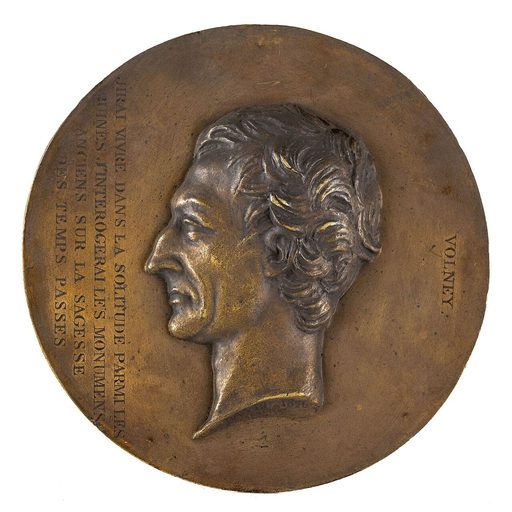
Volney's name was Chassebœuf, and he had made himself a name by welding Voltaire to Ferney, the estate where the philosopher had retired: less a pseudonym than an allegiance. Setting out for the East in 1782, he spent two years in the Levant learning Arabic, and his travel account was the authority for half a century. His Ruins, a meditation written before Palmyra, became the handbook of freethinkers and were translated throughout Europe.
The story
Constantin-François de Chassebœuf made himself a name by contracting Voltaire and Ferney, the estate where the philosopher lived: Volney. This traveller and orientalist did not take a pen name, he made a declaration of allegiance.
Born at Craon, in the Mayenne, on 3 February 1757, he sailed at the end of 1782 for the East — Egypt, Syria, then two years in the Levant learning Arabic. His Voyage en Égypte et en Syrie would remain the authority for half a century.
In 1791 came The Ruins, or Meditation on the Revolutions of Empires, written in front of the rubble of Palmyra: the book became a handbook of free thought, translated across Europe. Deputy for the Third Estate at the Estates-General, imprisoned under the Terror, senator under the Empire and then peer of France, he crossed four regimes without ever governing, and entered the Académie française.
He died in Paris on 25 April 1820. His epitaph keeps only the last of his titles, the one the Restoration had given him: “A F. VOLNEY, pair de France” — to F. Volney, peer of France. Not the Academy, not the East, not the Ruins — a Restoration dignity.
The grave
A grave whose inscription is five words long and chooses the latest title: “A F. VOLNEY, pair de France.” — to F. Volney, peer of France. Neither the Académie française, nor the two years spent in the Levant learning Arabic, nor The Ruins of 1791 that made his European fame. The traveller of Egypt and Syria rests beneath a dignity of the Restoration.
On site, do not miss
An epitaph of five words that keeps the latest title: “A F. VOLNEY, pair de France” — to F. Volney, peer of France. Neither the Académie française, nor the East, nor The Ruins.
Visitors' questions
Where is Volney's grave?
In Division 41, chemin des Anglais, fourth row. The epitaph is startlingly brief for a member of the Académie française: “A F. VOLNEY, pair de France.” — to F. Volney, peer of France. Nothing of the East, nothing of The Ruins.
Edmond du Sommerard, Division 41What is Volney's The Ruins?
His great book, published in 1791: a meditation on the revolutions of empires, written before the rubble of Palmyra. It became a handbook of free thought, translated across Europe and read well beyond its own century.
Auguste ComteWhy was he called Volney?
Because he decided to be: born Constantin-François de Chassebœuf, he forged the name by contracting Voltaire and Ferney, the estate where the philosopher lived. It is a declaration of intellectual allegiance rather than a pen name.
Jules DanbéDid Volney serve the Empire?
Yes, without enthusiasm: a senator under Napoleon, he was then a peer of France under the Restoration. A deputy of the Third Estate in 1789 and a prisoner under the Terror, he crossed four regimes without ever governing.
SieyèsAudio guide to Père Lachaise: the best unusual guided tour!
Discover the secrets of the most astonishing tombs
the audio guidefrom€6.99