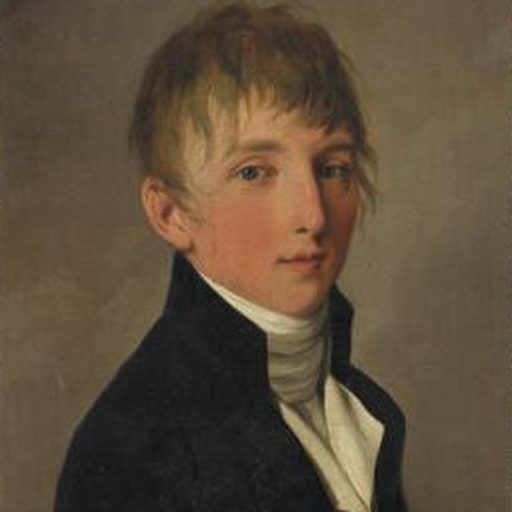
In March 1830, he was one of the 221 deputies who voted the address of no confidence in Charles X, the gesture that led to the Three Glorious Days. Son of Christophe-Philippe Oberkampf, he ran the toiles de Jouy factory. His epitaph opens with the Gospel of John: a rare Protestant mark.
The story
In March 1830, two hundred and twenty-one deputies voted the address of no confidence in Charles X. Their move brought the dissolution of the chamber, then the crisis that led to the Trois Glorieuses, the three days of revolution that swept the king away. Émile Oberkampf, a liberal deputy, was one of them.
Born at Jouy-en-Josas on 1 November 1787, he was the son of Christophe-Philippe Oberkampf, founder of the factory that gave its name to the toiles de Jouy, the printed cottons of that village. He succeeded his father at the head of one of the largest textile firms in France, and became a councillor for the department of Seine-et-Oise.
He died on 9 April 1837. His epitaph, in Division 39, begins with Scripture, before even his name and dates: “Je suis la résurrection et la vie. Celui qui croit en moi vivra quand même il serait mort. Jean XI, 25” — I am the resurrection and the life; he that believeth in me, though he were dead, yet shall he live. The Oberkampfs were Lutherans who had come from Germany: that verse at the head is a rare Protestant mark at Père-Lachaise. Neither the factory nor the two hundred and twenty-one appear.
The grave
An epitaph that begins with Scripture: “Je suis la résurrection et la vie. Celui qui croit en moi vivra quand même il serait mort. Jean XI, 25.” — I am the resurrection and the life; he that believeth in me, though he were dead, yet shall he live. Then the civil record: “Emile baron OBERKAMPF, né le 1 no. 1787, décédé le 9 avril 1837.” — Émile, Baron Oberkampf, born 1 November 1787, died 9 April 1837. The biblical quotation at the head is a Protestant mark rare at Père-Lachaise — the Oberkampf family was Lutheran, and had come from Germany. Nothing of the Jouy factory, nothing of the 221.
On site, do not miss
The epitaph quotes the Gospel of John before giving the name: “Je suis la résurrection et la vie… Jean XI, 25.” — I am the resurrection and the life… John 11:25. A rare Protestant mark in the cemetery.
Visitors' questions
Where is Émile Oberkampf's grave?
In Division 39, Avenue Transversale No. 1, first row. His epitaph opens on a verse from the Gospel of John — “Je suis la résurrection et la vie”, I am the resurrection and the life — a Protestant note rarely struck at Père-Lachaise.
Camille JordanWhat was the Jouy manufactory?
The printed-cotton works founded by his father Christophe-Philippe Oberkampf at Jouy-en-Josas — the one that gave “toile de Jouy” its name. Émile took it over after him.
Émile-Justin MenierWho were the 221?
The deputies who voted the address of no confidence to Charles X in March 1830: their move brought the dissolution, then the crisis that led to the Three Glorious Days. Oberkampf, a liberal deputy, was one of them.
Jacques-Antoine ManuelWhat does his epitaph say?
It quotes Scripture before the civil record: “Je suis la résurrection et la vie. Celui qui croit en moi vivra quand même il serait mort. Jean XI, 25.” — I am the resurrection and the life: he that believeth in me, though he were dead, yet shall he live. Then his name, his barony and his two dates.
Jean-Baptiste SayAudio guide to Père Lachaise: the best unusual guided tour!
Discover the secrets of the most astonishing tombs
the audio guidefrom€6.99