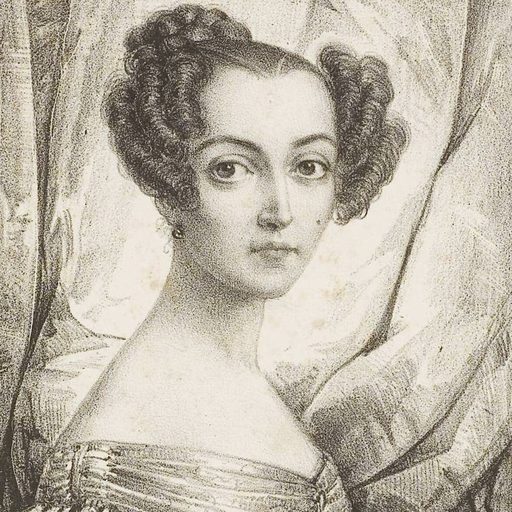
Abandoned at birth and named by the Nantes foundling hospital, she published her first collection at eighteen and was nicknamed “the Armorican muse”. Lamartine said of her: “That little girl will surpass us all.” Consumption carried her off at twenty-five; her tomb bears stanzas of her poems engraved on it.
The story
Élisa Mercœur was born at Nantes in 1809 and abandoned at birth: the name Mercœur was given her by the foundling hospital. Her mother took her back and raised her alone.
Her early gift showed itself in the drawing rooms of Nantes. At eighteen, a subscription of three thousand francs paid for her first collection; she was nicknamed the muse of Brittany.
She went up to Paris, where Casimir Delavigne — who lies in Division 49 — obtained her a pension of nine hundred francs. She was received by Dumas, Hugo and Lamartine, who said of her: “This little girl will outstrip us all.”
In 1831 the Comédie-Française turned down her tragedy “Boabdil”. The blow was a hard one for a young woman whose whole standing rested on the recognition of her peers.
Consumption carried her off on 7 January 1835, at twenty-five. Her tomb in Division 17, restored not long ago, carries lines of her own verse cut into the stone, among them: “Qu'importe qu'en un jour on dépense une vie, si on doit en aimant épuiser tout son cœur” — what matter that a life be spent in a day, if loving is to use up the whole of a heart.
The grave
The tomb, recently restored, has the peculiarity of bearing on its sides stanzas from her own poems — a rare case at Père-Lachaise, where one usually engraves titles or dedications. One reads there, among others, from “Rêverie”: “What matter if a life is spent in a single day, if in loving one must exhaust one's whole heart.” The epitaph, by the Comtesse d'Hautpoul, speaks not of literature but of filial devotion: “She adored, served and fed her mother.” For a child abandoned at birth and raised alone by that mother, the line says it all.
On site, do not miss
Walk round the tomb to read the stanzas engraved on its sides, then the epitaph: “She adored, served and fed her mother.”
Visitors' questions
Where is Élisa Mercœur's grave?
In Division 17, chemin de La Bédoyère, first row — the Division of the statue of Auguste Comte. The tomb, recently restored, has stanzas from her poems carved on its sides.
Auguste ComteWho supported her in Paris?
Casimir Delavigne, who secured her a pension of nine hundred francs and rests in Division 49. She moved in the circles of Dumas, Hugo and Lamartine, who said of her: “This little girl will outstrip us all.”
Casimir DelavigneWhy was she called “the Armorican muse”?
Because she came from Nantes, and her gift had first shone in the city's salons. Abandoned at birth, she had been given her name by the foundling hospital, and published her first collection at eighteen.
Marie d'AgoultWhat are the verses carved on her grave?
Extracts from her own poems, carved on the sides of the tomb, among them these lines from “Rêverie”: “Qu'importe qu'en un jour on dépense une vie, si on doit en aimant épuiser tout son cœur” — what does it matter if a life is spent in a single day, so long as in loving one has poured out one's whole heart.
Alfred de MussetAudio guide to Père Lachaise: the best unusual guided tour!
Discover the secrets of the most astonishing tombs
the audio guidefrom€6.99