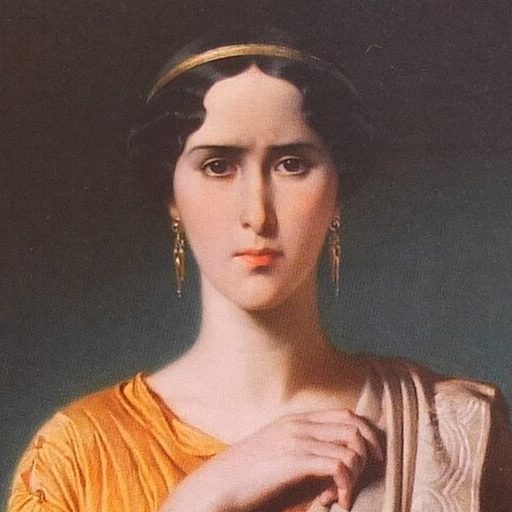
Rachel Félix was born in a Swiss inn, to an Alsatian Jewish family that lived by peddling, and sang as a child in the streets of Paris for a few coins. Entering the Comédie-Française at seventeen, she brought back to life there the Racine that Romanticism had abandoned, with a stripped-down, almost brutal diction. More than a hundred thousand people followed her funeral procession. A road in the cemetery bears her name.
The story
Élisabeth Rachel Félix, known as Élisa, was born on 28 February 1821 in an inn at Mumpf, in Switzerland, into a family of Alsatian Jewish pedlars. Her childhood was one of grinding poverty; she sang in the streets of Paris for coppers, and the story goes that Victor Hugo, hearing her, gave her a coin and some verses.
She entered the Comédie-Française at seventeen and there brought Racine back to life, whom Romanticism had let go. Her Phèdre of 1843, her Hermione, her Émilie imposed a stripped, almost brutal delivery, against everything the declamation of the day held dear.
She was the most famous actress in Europe. Mistress of Alfred de Musset and of Émile de Girardin, received by Queen Victoria, she played in London, in Saint Petersburg, in America.
The American tour finished her. She died of consumption at Le Cannet on 3 January 1858, at thirty-six.
More than a hundred thousand people followed the hearse to the Jewish section of Père-Lachaise, where she was buried according to the rite. Her sister, the actress Lia Félix, who died in 1908, lies with her in Division 7 — and the avenue carries her name.
The grave
A simple stele, in the Jewish section of Division 7, whose inscription comes down to one word: “RACHEL”. No first name, no surname, no dates — the stage name was enough, as for Talma in Division 12. The avenue Rachel that runs along the grave bears the same name: the tragedienne became a landmark of the cemetery before becoming one of its visits. Her sister, the actress Lia Félix (1831-1908), rests with her.
On site, do not miss
A single engraved word, “RACHEL” — and the name of the avenue, which is the same.
Visitors' questions
Where is Rachel's grave?
In Division 7, avenue Rachel, second row — the avenue bears her name, in the lower part of the cemetery, not far from the Rothschild chapel and the grave of Camille Pissarro. She rests in the Jewish section.
James de RothschildWho was Rachel?
The greatest tragedienne in nineteenth-century Europe, who joined the Comédie-Française at seventeen. There she brought Racine back to life, at a time when Romanticism had abandoned him, with a stripped-down delivery that flew in the face of the declamatory style then in fashion.
François-Joseph TalmaIs it true that she sang in the street?
As a child, yes: her family of Jewish pedlars from Alsace lived in dire poverty. Victor Hugo is said to have heard her singing in a Paris street and given her a coin and some verses.
Jane AvrilHow many people attended her funeral?
More than a hundred thousand, by contemporary counts, all the way to the Jewish section of the cemetery, where she was buried according to the rite. She had died of tuberculosis at Le Cannet on 3 January 1858, aged thirty-six.
Marietta AlboniAudio guide to Père Lachaise: the best unusual guided tour!
Discover the secrets of the most astonishing tombs
the audio guidefrom€6.99