Pauline FOURÈS
See onthe map
Writer and painter, known as “Bellilote”, Napoleon's mistress in Egypt.
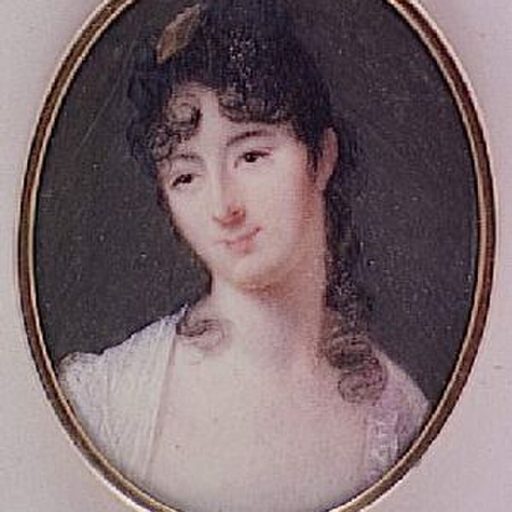
Pauline Fourès followed her officer husband to Egypt in 1798, dressed as a soldier, since women were not taken aboard. Bonaparte noticed her and displayed her as his mistress; the Army of the Orient at once christened her Our Lady of the Orient. To get the husband out of the way, he was sent to carry dispatches on a ship the English intercepted. She later made herself a new life as an artist, painter and novelist.
The story
Born Marguerite Pauline Bellisle at Pamiers on 15 March 1778, she married a young officer, Jean-Noël Fourès, and followed him to Egypt in 1798 — dressed as a soldier, women being forbidden to embark.
Bonaparte noticed her and, in December 1798, made her his official mistress. The Army of the East christened her at once “Notre-Dame de l'Orient”, Our Lady of the East, and “la Cléopâtre”; she was also “la Bellilote”, from her maiden name.
To get the husband out of the way, Bonaparte sent him to carry dispatches to France on a ship the British intercepted — the episode has stayed in Napoleonic anecdote. The affair ended with the return from Egypt, in 1799.
She married again, to Henri de Ranchoup, a consul in Sweden, became a countess, and made herself a second life as an artist: she painted, played music, published two novels in 1813 and 1814. None of it took her out of her one celebrity.
She died in 1869, at ninety-one, one of the last people alive to have made the Egyptian campaign. She lies in Division 26, chemin Monvoisin, second row, under a stone that cuts them all: “Marguerite Pauline FOURES, née BELLISLE, dite La Bellilote, comtesse de Ranchoup”.
The grave
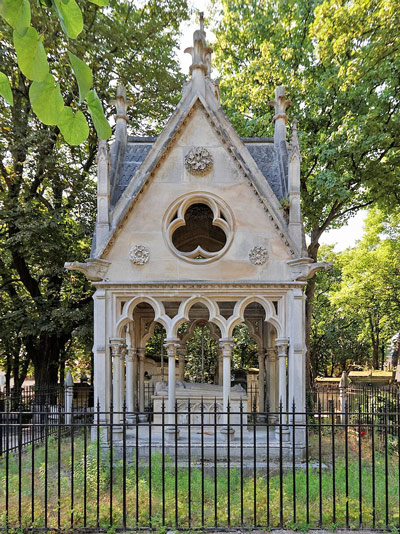
A simple tomb, whose inscription stands for the whole life: “Marguerite Pauline, FOURES, née BELLISLE, known as La Bellilote, Countess of Ranchoup, 1778-1869.” Four civil identities stacked up — the maiden name, that of the first husband, the nickname from the Army of the Orient, the title from the second marriage. The last is that of Pierre-Henri de Ranchoup, whom she married after Egypt.
On site, do not miss
The inscription is a biography in one line: née BELLISLE, wife FOURES, known as La Bellilote, Countess of Ranchoup — the title of her second marriage.
Visitors' questions
Where is Pauline Fourès's grave?
In Division 26, chemin Monvoisin, second row. The Division is also that of Alphonse Daudet, the chemist Gay-Lussac and the opera singer Giulia Grisi. Her stone stacks up her four successive names, from her maiden name to her title of countess.
Giulia GrisiWhy was she called Notre-Dame de l'Orient?
Because in December 1798 she became Bonaparte's official mistress during the Egyptian campaign. The Army of the Orient gave her that nickname — Our Lady of the Orient — and another, “la Cléopâtre”; she was also “la Bellilote”, from her maiden name.
Louis Blanc, Division 67What is written on her grave?
“Marguerite Pauline, FOURES, née BELLISLE, dite La Bellilote, Comtesse de Ranchoup, 1778-1869.” Four civil identities stacked up: the maiden name, that of the first husband, the nickname given her by the Army of the Orient, and the title of her second marriage to Pierre-Henri de Ranchoup.
Enrique Gómez CarrilloWhat became of her after Egypt?
She remarried, to Pierre-Henri de Ranchoup, became a countess, painted, made music and published novels. She lived until 1869, to the age of ninety-one — forty-eight years longer than Napoleon — and was one of the last survivors of the Egyptian campaign.
Thérèse de BassanvilleAudio guide to Père Lachaise: the best unusual guided tour!
Discover the secrets of the most astonishing tombs
the audio guidefrom€6.99