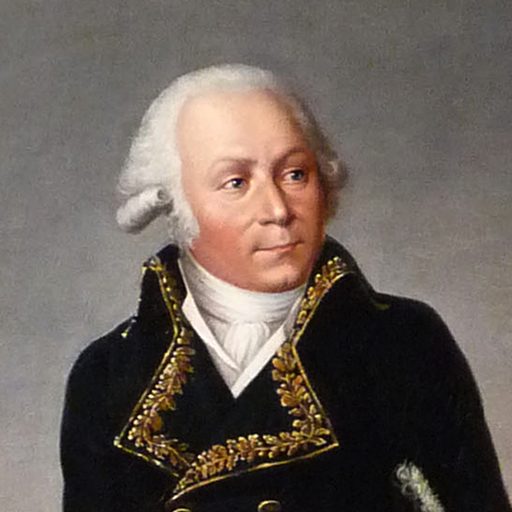
Kellermann was fifty-seven, with a whole career behind him, when the Revolution entrusted him with an army. On 20 September 1792, at Valmy, the cannonade was enough: the Prussians gave up and withdrew, and that improbable victory saved a Republic proclaimed the next day. Goethe, in the opposite camp, saw in it the beginning of an era. The Convention nevertheless had him imprisoned for thirteen months.
The story
Born in Strasbourg on 28 May 1735, a cavalry officer under Louis XV, Kellermann was fifty-seven and had a whole career behind him when the Revolution handed him the Army of the Centre.
On 20 September 1792, at Valmy, he faced the Prussians of the Duke of Brunswick. The cannonade was enough: the enemy gave up and withdrew. That improbable victory saved the infant Republic, proclaimed the next day; Goethe, present in the opposing camp, saw in it the beginning of a new age.
Suspected of lukewarmness by the Convention, he was imprisoned for thirteen months and came within an inch of the scaffold. Acquitted unanimously in November 1794, he was given his commands back.
Napoleon made him a marshal in 1804 — one of the four honorary marshals, with Lefebvre, Pérignon and Sérurier — then Duke of Valmy in 1808. Too old for campaigning, he organised the reserve armies. In 1815, sitting among the peers who tried Ney, he voted for the death of his old comrade in arms.
He died on 13 September 1820, aged eighty-five, the day before Marshal Lefebvre. His body lies in Division 18, avenue des Acacias, with his son François Étienne, second Duke of Valmy, and his grandson Edmond, the third. His heart was laid in the middle of the battlefield of Valmy on 3 September 1821.
The grave
A family monument raised by the architect van Cleemputte (1796-1871), adorned with sculptures by Jean-Baptiste Plantar (1790-1879): coat of arms, mask, angel's head. It bears the names of three Dukes of Valmy and two names of battles, Valmy and Marengo — the father's victory and the son's. The main inscription can still be read: “François Christophe de KELLERMANN, Duke of VALMY, peer and Marshal of France, born in Strasbourg on 28 May 1735, died in Paris on 13 Sept. 1820.” The body is there, the heart is at Valmy.
On site, do not miss
Two names of victories answer each other on the monument: Valmy, the father's, and Marengo, the son's. Look for the mask and the angel's head carved by Plantar, then the inscription that gives the marshal eighty-five years.
Visitors' questions
Where is Marshal Kellermann's grave?
In Division 18, avenue des Acacias, in a vault that brings together the three Dukes of Valmy. The Division is also that of Champollion, Monge and Fourier: the oldest of the Empire's marshals lies among its scientists.
Jean-François ChampollionWhere is Marshal Kellermann's heart?
At Valmy, in the middle of the battlefield, where it was laid on 3 September 1821 in accordance with his last wishes. Kellermann is the only person in the cemetery whose heart was carried to a place of history rather than to a home town or a family church.
Anna de NoaillesWhy does the battle of Valmy matter?
Because the cannonade of 20 September 1792 halted the Prussian invasion and saved the Republic, proclaimed the very next day. Goethe, who watched the scene from the enemy camp, saw in it the dawn of a new era.
Marshal NeyWhat can be seen on Marshal Kellermann's grave?
A monument by the architect van Cleemputte, adorned with sculptures by Jean-Baptiste Plantar: a coat of arms, a mask and an angel's head. Two victories answer each other across the stone — Valmy for the father, Marengo for the son, a cavalry general.
Marshal LefebvreAudio guide to Père Lachaise: the best unusual guided tour!
Discover the secrets of the most astonishing tombs
the audio guidefrom€6.99